
Will a Jack Shaft Garage Door Opener Fit Your Garage?
A jack shaft opener frees ceiling space, but needs compatible door hardware. Check torsion-shaft clearance, track layout, power and installation scope.
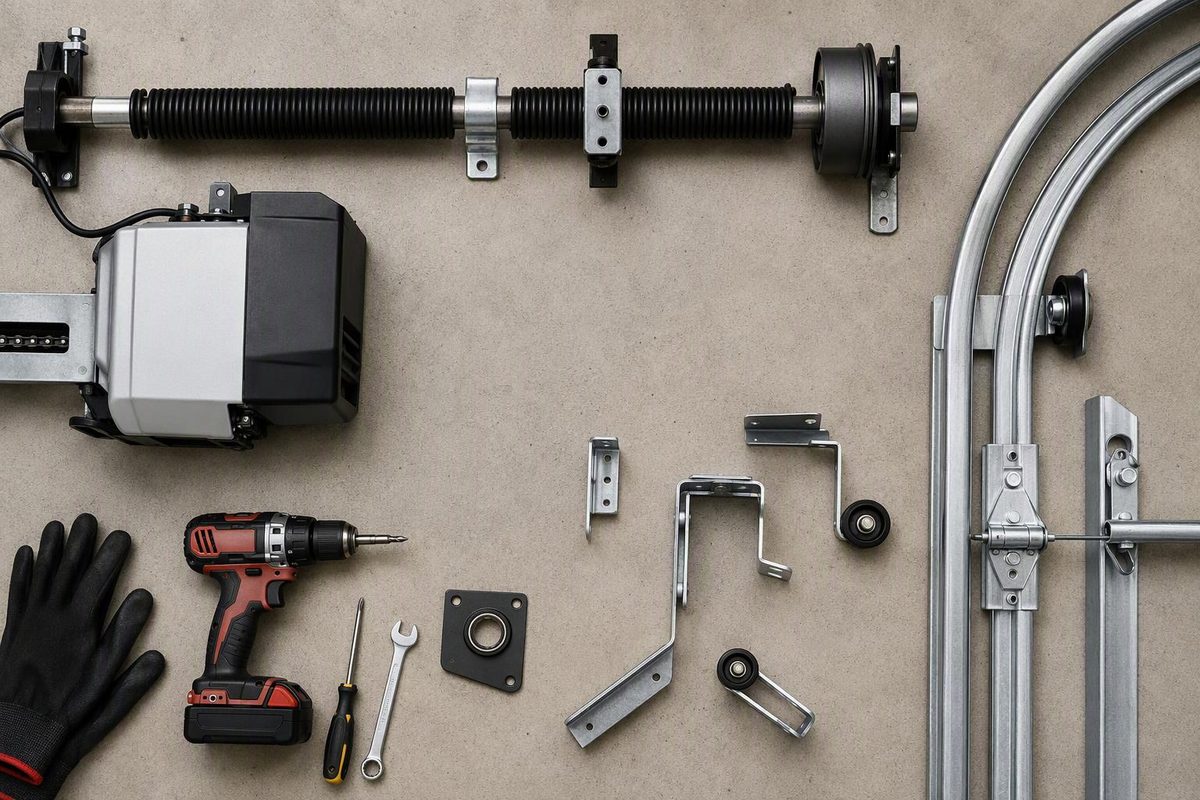
A jack shaft garage door opener, usually written jackshaft, mounts beside the door and drives its torsion shaft rather than using a ceiling-mounted rail and door arm. It can free up the center of the garage ceiling—but it is not a universal replacement for an overhead opener. The door’s spring system, cable drums, track arrangement and shaft clearance determine whether it fits.
For example, LiftMaster’s 98022 manual specifies sectional doors with torsion assemblies and excludes extension-spring doors and low-headroom tracks with outside pickup drums.
What changes—and what stays
A residential jackshaft opener couples to the torsion shaft. Turning that shaft turns the cable drums to operate the door; the springs still provide the counterbalance. The opener does not replace the springs or correct a poorly balanced door. Manufacturer preparation instructions require a door that moves without sticking or binding and is properly balanced. Source: LiftMaster manual
Removing the central opener rail can solve an overhead beam obstruction or make a storage layout easier. Genie identifies both ceiling-space savings and beam-obstruction applications. However, the door and its tracks still occupy their existing travel space. A wall-mounted opener alone does not turn a standard-lift door into a high-lift door.
Check compatibility before measuring for a purchase
Stop if you see a broken spring, frayed or loose cable, crooked door or displaced hardware. Do not operate the door to complete a fit check. Spring, cable and counterbalance repairs belong to a trained door-systems technician; Genie specifically warns against operating doors with broken springs or damaged lift cables. Source: Genie wall-mount manual
Take photographs of the door, springs, both cable drums, shaft ends and tracks without moving the door just to obtain a better view. Keep hands and measuring tools away from moving hardware, and do not stand beneath a partially open door.
If no damage is apparent, establish these four points with the installer:
- Door type: Is it sectional, rather than a one-piece tilt-up door?
- Spring system: Does it have the torsion assembly required by the proposed opener?
- Drums and tracks: Are their size, cable pickup arrangement and lift type approved in that model’s manual? “Low headroom” is not enough information to decide.
- Door limits: Does the door meet all applicable height, width, weight and drum limits—not just the advertised maximum lifting weight?
Do not assume that every enclosed spring tube accepts a standard shaft coupler. Some systems require a manufacturer-approved adapter; the Genie 6170H-B/6070 manual, for example, identifies alternate mounting kits for TorqueMaster systems.
Measure from the shaft—not the opening
Door-opening width and height do not establish opener clearance. Record the free space around each shaft end, then compare it with the installation drawing for the exact model. If a measurement requires reaching into hardware or working beneath an open door, leave it to the installer.
As a concrete example, the LiftMaster 98022 planning instructions specify:
| Check | 98022 requirement |
|---|---|
| Torsion-shaft diameter | 1 inch |
| Door/header wall to shaft centerline | At least 2.5 inches |
| Ceiling to shaft centerline | At least 3 inches |
| Shaft end to side wall or obstruction | At least 8.5 inches |
| Shaft projection beyond bearing | At least 1.5 inches; installation needs may vary |
| Electrical outlet | Within 6 feet of installation area |
These are 98022 measurements, not generic jackshaft dimensions. Do not substitute the motor housing’s width for installation clearance. Shelving, pipes and cabinets count as obstructions too. If you are also ordering a door, collect the separate opening, headroom, sideroom and backroom measurements in our garage-door sizing guide.
Decide whether the conversion is worth it
A jackshaft opener is worth considering when usable ceiling space or an overhead obstruction is the main problem and the existing door hardware is compatible. If the goal is simply quieter operation, also compare a conventional belt-drive versus chain-drive opener; relocating the motor is not the only option.
Ask for an installation scope that separates the opener from any spring or track conversion, shaft work, electrical work, automatic lock and lighting. Confirm which accessories are included. As of October 2026, for instance, Genie lists battery backup and an automatic door lock with the 6072H-B, but its Aladdin Connect accessory is sold separately.
Treat fit measurements as planning—not permission to loosen drums, bearings or spring hardware. LiftMaster specifies technician-only installation for the 98022. Before handover, have the installer demonstrate the lock and emergency release and complete the manual’s contact-reversal and photo-eye tests. The same manual requires a monthly safety-reversal test: a successful opening cycle alone does not prove the installation is safe. Source: LiftMaster manual