
Choose the Quieter Belt or the Lower-Cost Chain for Your Garage
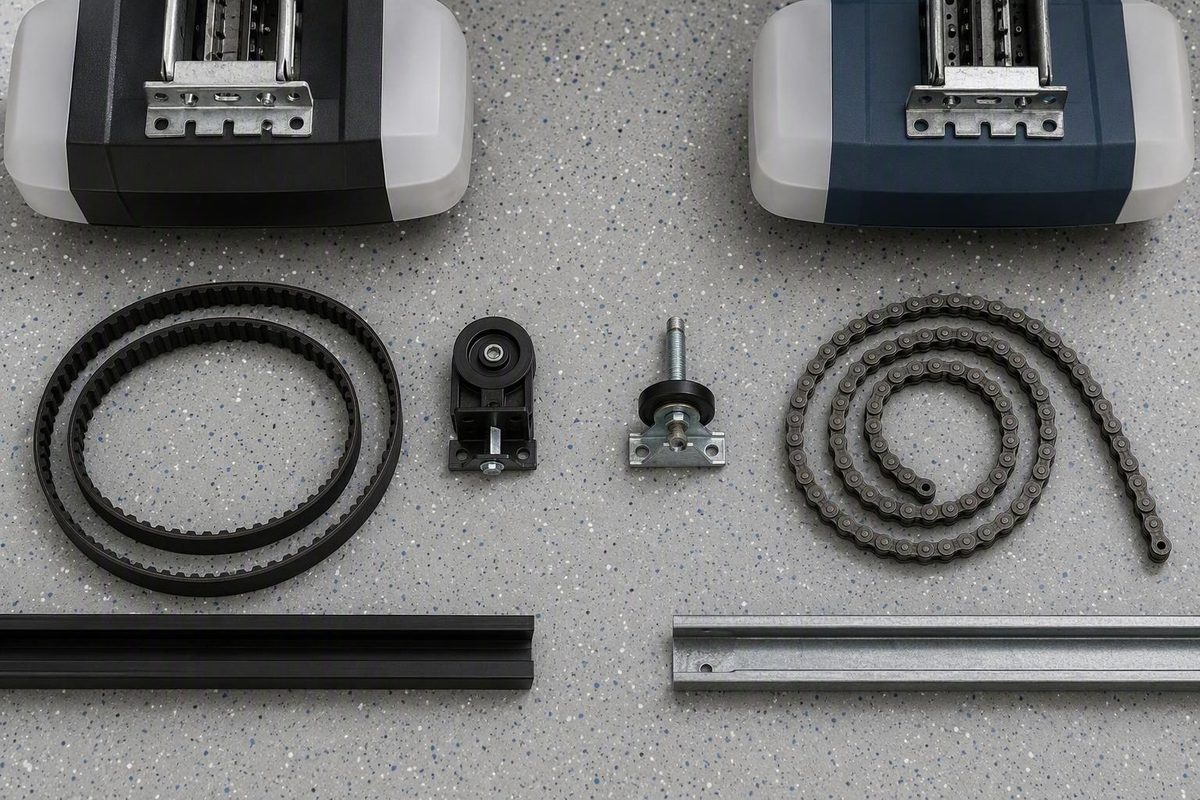
The short answer: choose by garage, door, and priorities
For most homeowners, the belt vs chain garage door opener decision comes down to garage location, tolerance for noise, budget, and the specifications of the door and opener.
Choose a properly rated belt-drive opener if the garage is attached, sits below or beside a bedroom or living area, or belongs to a household that values quiet operation and less routine drive maintenance. Belt drives generally create less mechanical noise and vibration because they use a reinforced belt instead of a metal chain.
Choose a properly rated chain-drive opener if upfront cost is the leading concern, the garage is detached, or opener noise is unlikely to disturb anyone. Chain models generally cost less, although the chain may require lubrication and inspection under the manufacturer’s instructions.
For a heavy, oversized, wood, wind-rated, or frequently cycled door, do not choose from the drive label alone. Although chain models are commonly marketed for demanding applications, “chain drive” is not a capacity rating. Obtain the door specifications and confirm that the exact opener model is approved for the door’s dimensions, construction, track arrangement, and expected use.
Many standard residential doors can use either system when the opener is correctly rated and the door is in good condition and properly balanced. Compare individual models rather than assuming every belt opener or every chain opener performs alike.
| Your situation | Best starting point | Why |
|---|---|---|
| Attached garage | Belt drive | Reduces drive noise and vibration near occupied space |
| Detached garage or workshop | Chain drive | Often offers better upfront value when sound is unimportant |
| Noise-sensitive household | Belt drive | Generally quieter and smoother |
| Budget-focused buyer | Chain drive | Usually costs less at a comparable product tier |
| Standard residential door | Either | Compare ratings, price, warranty, features, and service |
| Unusually demanding door | Verify exact-model compatibility | Door specifications and opener ratings matter more than the drive label |
This is a starting matrix, not a substitute for checking specifications. Neither drive is automatically stronger, faster, longer-lived, or better in every installation.
How belt-drive and chain-drive openers work
Both types are conventional trolley openers. A motor-driven mechanism moves a trolley back and forth along a rail. A door arm connects that trolley to the garage door, causing the door to open or close.
The moving drive component is the primary mechanical difference:
- A chain-drive opener uses a metal chain running around a motor-driven sprocket.
- A belt-drive opener uses a reinforced belt running around a pulley.
The basic arrangement looks like this:
CHAIN-DRIVE OPENER

[Motor + sprocket] ===== metal chain along rail ===== [Trolley]
                                                       |
                                                    [Door arm]
                                                       |
                                                 [Garage door]


BELT-DRIVE OPENER

[Motor + pulley]  ===== reinforced belt along rail === [Trolley]
                                                       |
                                                    [Door arm]
                                                       |
                                                 [Garage door]
The drive is only one part of the complete system. Motor design, gears, rail construction, mounting, controls, rollers, hinges, track alignment, and the condition of the door all influence perceived noise and performance. A well-installed chain model may therefore behave better than a poorly installed entry-level belt model, even though belt systems are generally quieter as a category.
The opener should move a properly operating, correctly counterbalanced door. It is not a remedy for binding tracks, damaged hardware, or poor balance. Buying a more powerful unit—or choosing a chain because it is assumed to be stronger—does not correct an underlying door problem.
Belt vs chain comparison: noise, cost, upkeep, and suitability
The most dependable distinctions are directional: belt drives are generally quieter and require less routine drive maintenance, while chain drives generally cost less upfront. Broader claims about speed, lifespan, or universal lifting strength are less dependable because models differ in motor design, rail construction, electronics, installation, and intended application.
| Factor | Belt drive | Chain drive |
|---|---|---|
| Mechanism | Reinforced belt and pulley | Metal chain and sprocket |
| Relative noise | Generally quieter, with less drive vibration | More audible and vibration-prone |
| Upfront price | Usually carries a premium | Usually less expensive |
| Routine drive maintenance | Normally no lubrication; inspect as directed | Lubricate where specified; inspect for wear or improper tension |
| Typical residential fit | Attached garages and noise-sensitive homes | Detached garages, workshops, and tighter budgets |
| Door suitability | Depends on the exact model rating | Depends on the exact model rating |
| Durability | Model- and condition-dependent | Model- and condition-dependent |
| Features | Determined by model | Determined by model |
Noise and vibration
A belt avoids the sound of a metal chain moving through the drive assembly, so it is usually the better starting point when a garage shares walls or a ceiling with occupied rooms. Belt operation is also commonly perceived as smoother.
That does not make a belt opener silent. The motor, gears, rail, trolley, mounting, rollers, hinges, and door panels can all generate or transmit sound. Vibration may also travel through the building’s framing. Secure mounting and a properly operating door matter alongside the drive choice.
A chain drive is normally more noticeable during operation. That disadvantage may have little practical importance in a detached garage, outbuilding, or workshop where sound cannot readily transfer into occupied rooms.
Avoid relying on exact noise-reduction percentages or decibel comparisons. Commercial comparison articles publish different figures without consistent model matching or disclosed testing methods. The defensible conclusion is that a belt drive is generally quieter, not that every belt opener will achieve a fixed reduction.
Purchase price
Comparable chain-drive openers generally have a lower purchase price. Belt models generally carry a premium, but they also often appear in higher-feature product tiers.
Comparing an entry-level chain opener with a feature-rich belt opener can therefore exaggerate the drive-related difference. Match products by manufacturer, motor and control design, rail configuration, included controls, lighting, battery backup, connectivity, warranty, and rated application before comparing prices.
Routine upkeep
A chain commonly needs more attention. Follow the manual for the exact model, including its lubrication instructions, and perform only the visual checks or routine tasks that the manufacturer designates for the owner. Look for visible wear, corrosion, damage, or abnormal slack, but do not assume that one maintenance interval or adjustment procedure applies to every product.
A belt normally does not require lubrication. “Low maintenance” does not mean “no inspection,” however. Follow the manufacturer’s instructions and check for visible cracking, fraying, slipping, damage, or abnormal tension.
Never apply lubricant to a belt unless the manufacturer specifically instructs you to do so. If chain or belt tension appears abnormal, consult the manual rather than improvising an adjustment. Use a qualified technician when the procedure is not expressly designated as homeowner maintenance.
Durability and lifespan
The available comparison material does not establish a universal longevity winner. Some commercial articles describe chains as longer-lasting, while others give belts an equal or better expected life. One Precision Door comparison even presents conflicting conclusions about belt and chain longevity within the same article, illustrating why broad service-life claims should not decide the purchase (Precision Door).
Durability depends on factors beyond the drive material:
- Product tier and component quality
- Gears, bearings, electronics, and motor design
- Correct opener sizing
- Door balance and condition
- Installation and rail alignment
- Usage frequency
- Climate and exposure
- Manufacturer-directed maintenance
- Availability of replacement parts
Compare model-specific warranties, parts support, and service arrangements rather than relying on generalized lifespan estimates.
Speed and smoothness
A belt model may feel smoother, but that can reflect a DC motor or soft-start and soft-stop controls rather than the belt alone. Do not assume every belt opener is faster or smoother than every chain opener. Compare published specifications for the exact models under consideration.
Which drive fits an attached, detached, or demanding garage?
Attached garage near a bedroom or living area
Start with properly rated belt-drive models. Reducing drive noise and vibration is most valuable where the garage shares framing with a bedroom, office, nursery, or primary living area.
Look beyond the belt itself. Mounting quality, rail alignment, roller condition, door hardware, and soft-start or soft-stop operation can affect what occupants hear. If the existing door rattles, binds, or runs roughly, address that condition rather than expecting a new belt opener to conceal it.
Detached garage or workshop
A chain opener is often the practical value choice. When sound cannot readily transfer into occupied rooms, the premium for a quieter belt may have little day-to-day benefit.
You may still prefer a belt if you work in the garage for long periods or routinely operate the door early or late. A detached location weakens the case for paying extra for quiet operation, but it does not eliminate personal noise preferences.
Standard, balanced residential door
Either drive may work when the selected model is approved for the application. This is where a matched-model comparison is most useful.
Compare:
- Complete installed price
- Manufacturer-rated door compatibility
- Included rail and required rail length
- Motor and control design
- Remote and wall controls
- Lighting
- Battery backup
- Connected features
- Warranty scope
- Replacement-part availability
- Local service support
- Maintenance instructions
For a standard door, these model-level differences may matter more than whether the trolley is moved by a chain or belt.
Heavy, oversized, wood, wind-rated, or frequently cycled door
First identify the door. Record its dimensions, construction, manufacturer label, track configuration, and any available weight or wind-rating information. Then check the documentation for the exact opener model.
A chain-drive product line may contain suitable options for demanding doors, but the chain itself is not proof of compatibility. Likewise, a belt should not be rejected merely because the door is double-wide, insulated, or made of wood. The relevant question is whether the specific opener is approved for that specific, properly balanced door and expected usage.
Frequently cycled doors require particular care. Do not rely on a broad “heavy duty” description or motor-size marketing alone. Ask the manufacturer or installer to document that the opener is intended for the application.
Noise-sensitive buyer
Choose a belt as the starting point, then investigate the whole moving system. Consider roller and hardware condition, opener mounting, rail alignment, and whether the model provides soft-start or soft-stop operation.
If possible, listen to the proposed model in a comparable installation. Showroom sound may not predict what you will hear at home because framing, mounting, door construction, and room location affect sound transmission.
Budget-focused buyer
A chain opener usually minimizes the initial product cost. Balance that saving against the value of lower noise and the chain’s manufacturer-specified maintenance.
The least expensive quote is not necessarily the best value if it excludes the rail, required accessories, removal of the old opener, or meaningful service support. Conversely, paying for a belt may be unnecessary when the garage is detached and noise does not matter.
Selection flowchart
Does the garage share a wall or ceiling with occupied space?
├─ Yes → Start with a properly rated belt drive.
└─ No  → Keep both belt and chain in consideration.
          |
          v
Is the door heavy, oversized, wood, wind-rated, or frequently cycled?
├─ Yes → Obtain door specifications and verify exact-model compatibility.
└─ No  → Compare appropriately rated models of either type.
          |
          v
Is quiet operation a high priority?
├─ Yes → Favor belt; also assess mounting, rollers, and soft start/stop.
└─ No  → Continue.
          |
          v
Is the lowest upfront price the priority?
├─ Yes → Favor a comparable chain model.
└─ No  → Compare the complete package, warranty, and service.
          |
          v
Choose model-level features separately from the drive type.
Price and long-term value without misleading averages
At comparable product levels, chain-drive openers generally cost less upfront, while belt-drive openers generally carry a premium. The exact difference changes with manufacturer, rail length, motor and control design, accessories, warranty, local inventory, and installation conditions.
As a cautious planning reference, one seller-published comparison lists pre-installation prices of approximately $150–$350 for chain-drive units and $200–$450 for belt-drive units. These are seller estimates, not current national averages, guaranteed prices, or installed totals (Raynor Door Authority).
The cleanest comparison uses matched products from the same manufacturer. Ideally, compare models with equivalent:
- Rated door compatibility
- Motor technology
- Rail type and length
- Lighting
- Remote and wall controls
- Battery backup
- Connectivity
- Security and safety functions
- Warranty terms
Otherwise, the apparent belt premium may also reflect a different motor, additional controls, battery backup, stronger warranty coverage, or other upgrades.
Ask for an itemized quote using this worksheet:
| Quote item | Model A | Model B |
|---|---|---|
| Manufacturer and exact model | ||
| Belt or chain | ||
| Opener unit | ||
| Rail and rail extension | ||
| Installation labor | ||
| Wall control and remotes | ||
| Keypad or other access control | ||
| Battery backup | ||
| Camera or connectivity accessories | ||
| Additional brackets or mounting work | ||
| Electrical work, if applicable | ||
| Removal and disposal | ||
| Tax and fees | ||
| Total installed price | ||
| Product warranty | ||
| Labor warranty | ||
| Maintenance included |
Do not assume either drive has a lower five- or ten-year ownership cost. The available evidence does not support a dependable calculation covering maintenance, repairs, usage, installation quality, and component replacement. A belt avoids routine chain lubrication, but that alone does not prove lower lifetime cost.
Service access can outweigh a modest purchase-price difference. A somewhat more expensive opener with available parts, clear warranty procedures, and competent local support may offer better practical value than a cheaper unit that is difficult to service.
Maintenance, noise diagnosis, and safety boundaries
Maintenance starts with the manual for the exact opener. Instructions vary by manufacturer and model, so avoid applying a universal schedule, lubricant, or adjustment procedure.
For a chain drive:
- Follow the manufacturer’s lubrication directions.
- Use only a lubricant approved for that model.
- Perform manufacturer-authorized visual checks for visible wear, damage, corrosion, or abnormal slack.
- Pay attention to irregular movement or new mechanical noise.
- Do not adjust tension or other mechanisms unless the manual expressly designates the procedure for the owner.
For a belt drive:
- Do not lubricate the belt unless the manual explicitly requires it.
- Perform manufacturer-authorized visual checks for cracking, fraying, slipping, damage, or abnormal tension.
- Follow model-specific inspection instructions.
- Refer adjustments or repairs to the appropriate service provider when the owner documentation does not authorize the work.
Noise does not necessarily originate in the drive. Possible contributors include:
- Loose opener mounting or door hardware
- Poor rail alignment
- Worn rollers
- Damaged hinges or brackets
- Loose door sections
- Door condition or poor balance
- Vibration transmitted into ceiling or wall framing
Replacing a chain opener with a belt model can reduce drive noise while leaving rattling rollers, loose hardware, or door-panel vibration unchanged. Diagnose the complete system before replacing an opener solely to solve noise.
If the door binds, does not travel normally, or the belt or chain appears visibly damaged or slips abnormally, stop trying to operate it and consult the applicable manual or a qualified garage-door technician. Commercial maintenance guidance consistently treats door balance, correct sizing, and safe handling of the system as important boundaries rather than problems to overcome with a more powerful opener (Dayton Door Sales).
Garage-door springs and related counterbalance components store substantial energy and can cause serious injury. Do not adjust springs, lift cables, cable drums, or other high-tension counterbalance hardware as part of routine opener maintenance. A door that appears unusually heavy, drops, rises unexpectedly, or does not move normally needs assessment—not an improvised spring adjustment.
Features and specifications that matter more than the drive label
Drive type does not determine the complete feature set. Both belt- and chain-drive product lines may include Wi-Fi, smartphone control, battery backup, cameras, lighting, rolling-code controls, alerts, guest access, and smart-home integration. Availability and included accessories depend on the exact model.
The same is true of smoothness-related features. DC motors and soft-start or soft-stop controls may reduce abrupt movement and perceived noise, but they should not be attributed automatically to every belt opener. Check the model’s specification sheet.
Before purchase, verify:
- Door dimensions and construction
- Manufacturer-rated door compatibility
- Intended usage or cycle classification
- Rail length
- Headroom and installation clearance
- Backroom and ceiling obstructions
- Power requirements and outlet location
- Included rail, brackets, controls, and accessories
- Battery-backup availability
- Connected-platform compatibility
- Manufacturer maintenance instructions
- Local parts and service availability
When documenting the opening and available clearance, use actual measurements rather than relying on a “single” or “double” label. The garage-door measurement guide explains opening, sideroom, headroom, backroom, and floor-level measurements that can affect door and opener planning.
Use this warranty checklist:
- Motor: Coverage period and exclusions
- Belt or chain: Separate coverage, if any
- Gears and mechanical parts: Covered failures and exclusions
- Electronics: Logic board, controls, sensors, lighting, and connectivity
- Accessories: Remotes, keypad, battery, and camera
- Labor: Included or product-only
- Travel or service-call fees: Included or excluded
- Wear items: Defined exclusions
- Registration: Whether it is required
- Transferability: Whether coverage follows a new homeowner
- Claims process: Who provides diagnosis and service
- Parts access: Availability after the warranty expires
Also ask who will service the opener locally. A long parts warranty offers limited convenience if diagnosis, shipping, or labor is difficult to arrange.
Belt and chain trolley openers are not the only configurations. If ceiling storage, beams, low clearance, or room layout makes an overhead rail undesirable, a wall-mounted or other compatible opener may deserve consideration. Evaluate that configuration separately according to the door, track, clearance, electrical, and manufacturer requirements.
A pre-purchase checklist for the final decision
Complete this worksheet before shopping or requesting quotes.
Garage location and noise
- [ ] Garage is: attached / detached
- [ ] Occupied room above garage: ________
- [ ] Occupied room beside garage: ________
- [ ] Typical opening times: ________
- [ ] Noise would be: unimportant / noticeable / highly disruptive
- [ ] Structural vibration is currently noticeable inside the home: yes / no
Door identification
- [ ] Opening width: ________
- [ ] Opening height: ________
- [ ] Door material or construction: ________
- [ ] Insulated: yes / no / unknown
- [ ] Manufacturer: ________
- [ ] Model or identification label: ________
- [ ] Listed weight or other available specifications: ________
- [ ] Wind-rated or otherwise specialized: yes / no / unknown
- [ ] Track configuration: ________
Current door behavior
- [ ] Door binds or hesitates: yes / no
- [ ] Travel appears uneven: yes / no
- [ ] Door or hardware makes abnormal noise: yes / no
- [ ] Rollers, hinges, brackets, panels, or tracks show visible damage: yes / no
- [ ] Balance or spring condition is a concern: yes / no
- [ ] A technician should inspect the door before opener selection: yes / no
Do not alter springs, cables, or other high-tension counterbalance hardware while completing this assessment.
Usage
- [ ] Estimated opening-and-closing cycles per day: ________
- [ ] Ordinary residential use: yes / no
- [ ] Unusually frequent use: yes / no
- [ ] Workshop or other special application: ________
Installation conditions
- [ ] Available headroom: ________
- [ ] Available backroom or rail clearance: ________
- [ ] Ceiling obstructions or storage: ________
- [ ] Suitable power available: yes / no / needs verification
- [ ] Existing rail expected to be reused: yes / no / unknown
- [ ] Existing brackets and wiring need assessment: yes / no
Do not assume a new opener can reuse an old rail or other hardware. Confirm compatibility for the exact product.
Desired features
- [ ] Battery backup
- [ ] Wi-Fi or smartphone control
- [ ] Smart-home platform compatibility: ________
- [ ] Camera
- [ ] Additional lighting
- [ ] Keypad
- [ ] Number of remotes: ________
- [ ] Vehicle-integrated controls
- [ ] Alerts or guest access
- [ ] Soft-start or soft-stop operation
- [ ] Other: ________
Model and quote comparison
Compare at least two appropriately rated models.
- [ ] Exact manufacturer and model recorded
- [ ] Door compatibility confirmed in documentation
- [ ] Itemized installed price received
- [ ] Rail and extensions included
- [ ] Accessories identified as included or optional
- [ ] Product and labor warranties reviewed
- [ ] Maintenance instructions reviewed
- [ ] Replacement parts locally available
- [ ] Local warranty service identified
- [ ] Existing door problems addressed separately
- [ ] Belt-versus-chain choice made only after compatibility is confirmed
The final rule is straightforward: choose a model that meets the door manufacturer’s and opener manufacturer’s specifications first. Then use noise, cost, and maintenance preference to choose between belt and chain.
A properly rated belt-drive model is usually the better choice when quiet operation near living space is worth the premium. A properly rated chain-drive model is usually the practical choice when lower upfront cost matters more than noise. With either drive, address existing door or balance problems, compare itemized quotes and warranties, and select safety and convenience features at the model level.
Is a belt-drive garage door opener worth the extra cost?
Usually, yes, if the garage is attached or close to a bedroom, office, or living area. A properly rated belt model generally reduces drive noise and does not require routine chain lubrication. That difference may be much less valuable in a detached garage where noise is unimportant.
Compare equivalent models before deciding. A higher belt price may also reflect a different motor, controls, lighting, battery backup, connectivity, or warranty rather than the drive alone.
Can a belt-drive opener handle a heavy or double garage door?
It can if the exact model is rated for that door and the door is properly balanced. Labels such as “double,” “wood,” or “insulated” do not by themselves establish whether a belt opener is suitable.
For a heavy, oversized, wind-rated, or frequently cycled door, obtain the door specifications and check the opener manufacturer’s compatibility documentation. A chain product line may offer suitable models, but a chain drive is not automatically capable merely because it uses metal.
How often does a chain-drive opener need maintenance?
Use the schedule and procedure in the manual for the exact model. Chain-drive openers commonly require lubrication where specified, plus inspection for visible wear, damage, corrosion, or improper tension, but no universal interval applies to every manufacturer, climate, and usage pattern.
If the chain appears damaged, slips abnormally, or accompanies binding door movement, stop operating the system and consult the manual or an appropriate technician rather than attempting an undocumented adjustment.
Do belt and chain openers both support Wi-Fi and battery backup?
They can. Wi-Fi, app control, battery backup, cameras, lighting, alerts, and other convenience features depend on the specific model rather than whether it uses a belt or chain.
Check whether each feature is built in, requires an accessory, needs a particular control panel, or depends on a compatible smart-home platform. Confirm what is included in the quoted price.
Will replacing a chain opener with a belt opener make the whole door quiet?
Not necessarily. It will generally reduce noise and vibration from the drive mechanism, but the door may still make noise because of its rollers, hinges, hardware, panel movement, mounting, alignment, or overall condition.
A belt model delivers the greatest benefit as part of a correctly aligned, securely mounted, properly operating door system.