
Low Headroom Garage Door Track: Measure Before You Choose
Compare low-headroom track layouts, measure the clearances that matter, and check spring, opener and vehicle fit before ordering hardware.
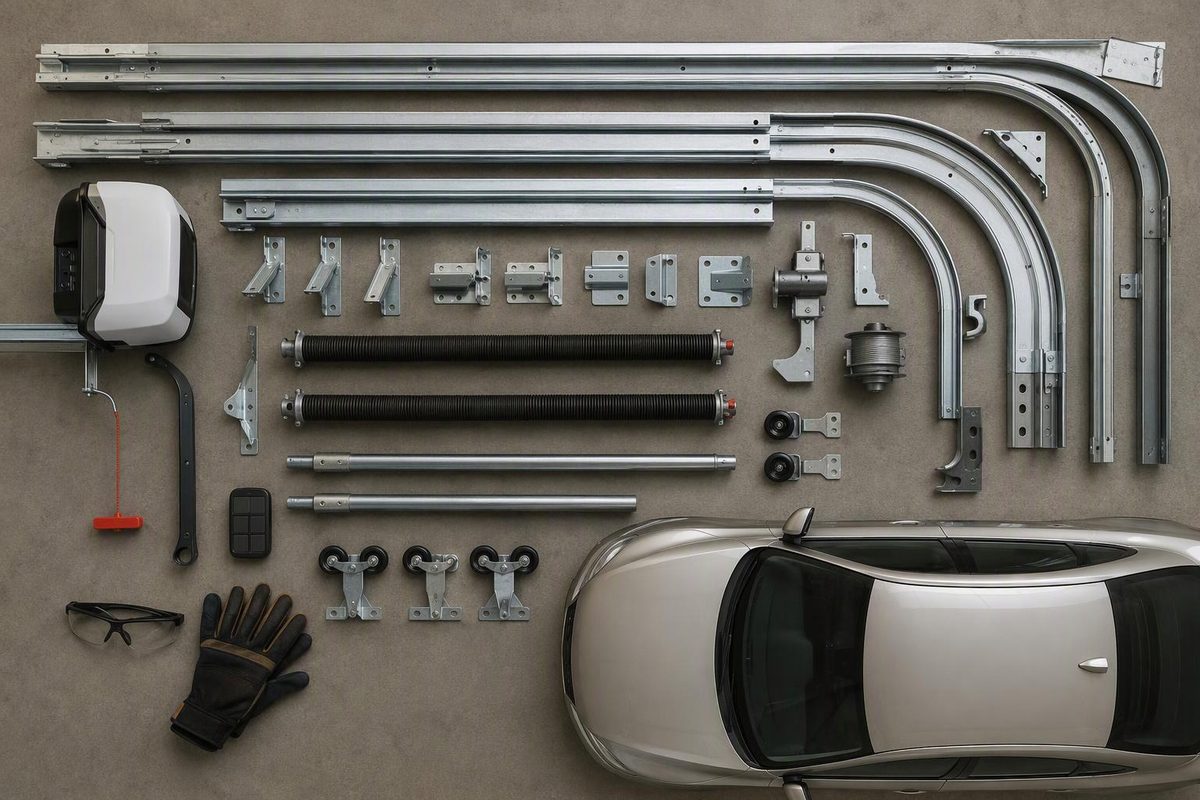
Low-headroom garage door track lets a sectional door turn overhead with less space above the opening. It commonly uses two horizontal tracks on each side: an upper track for the top rollers and a lower track for the remaining rollers. That changes how the top section moves—not the size of the framed opening. Clopay’s conversion-kit instructions show this arrangement.
The important buying distinction is the spring layout. A low-headroom extension-spring system, front-mounted torsion system and rear-mounted torsion system can have different clearance requirements. Choose the complete door-and-hardware combination, not a track kit based on ceiling height alone.
1. Measure the space the hardware will occupy
Stop if the door is crooked, off-track, binding or has damaged cables. Do not operate it just to collect measurements; have a trained door technician assess it first. The Chamberlain RJO101 manual likewise directs owners to a trained technician for a binding, sticking or unbalanced door.
For a door that is safely closed, record these measurements without loosening hardware:
- Opening width and height: Measure the framed opening, excluding stop molding. Keep these dimensions separate from clearance measurements.
- Headroom: Measure vertically from the top of the opening to the lowest obstruction. Check across the opening and farther into the garage where the tracks, springs and opener will sit. Record beams, ducts, pipes and light fixtures—not just the ceiling height.
- Sideroom: Measure from each side of the opening to the nearest wall or obstruction. Record left and right separately.
- Backroom: Measure from the opening toward the back wall, noting anything that would obstruct the horizontal tracks or open door.
These are the measurement categories in Clopay’s sizing guide. For the full opening-measurement sequence, see garage door sizes and how to measure.
Photograph the existing tracks, spring location, top roller brackets, door label and opener label. Those details help identify whether a proposed kit matches the existing system.
2. Compare layouts using one manufacturer’s specifications
There is no universal minimum headroom for every garage door. The following figures are IDEAL Door’s published residential requirements, useful for comparing layouts—not approving another brand’s installation.
| Track and spring arrangement | Required headroom | Required sideroom |
|---|---|---|
| Standard lift, 12-inch radius, extension springs | 10 inches | 3¾ inches |
| Standard lift, 12-inch radius, torsion springs | 12 inches | 3¾ inches |
| Low headroom with extension springs | 4½ inches | 6 inches |
| Low headroom, front-mounted torsion | 9½ inches | 6 inches |
| Low headroom, rear-mounted standard torsion | 5 inches | 6 inches |
IDEAL’s chart also says a trolley opener may require up to 3 additional inches of headroom, and directs readers to commercial specifications for doors over 8 feet high. Source: IDEAL residential track options.
The practical trade-off is clear: saving space above the opening can require more space beside it. Rear-mounted torsion puts the spring assembly farther back, so that area needs its own clearance and mounting check. Clopay’s track guide describes this layout and its separate backroom requirements.
For example, 6 inches above the opening would not meet IDEAL’s front-torsion requirement. It might accommodate the listed rear-torsion layout, but only after checking sideroom, backroom, mounting and opener compatibility.
3. Check opener fit and actual vehicle clearance
A door fitting its tracks does not prove that an opener will fit—or that the fully open door will leave the whole opening clear.
For a ceiling-mounted trolley opener, have the installer check the rail, header bracket, door arm and top-section movement against the selected door hardware. Do not simply add an assumed clearance allowance to a track advertisement.
For a wall-mounted opener, check the exact model manual. Moving the motor off the ceiling is not an automatic solution. The Chamberlain RJO101 manual excludes low-headroom tracks with outside-pickup drums and doors using extension springs. It also specifies clearance around the torsion shaft. Our jackshaft opener fit guide covers the separate checks.
For vehicle clearance, ask for the clear height beneath the fully open door. Clopay’s 2007 double-track conversion-kit instructions warn that its configuration leaves vehicle clearance 6 inches below the opening height: a 7-foot opening becomes 6 feet 6 inches. That is a kit-specific warning, not a universal deduction. Check the current instructions for the proposed hardware, especially if your vehicle carries roof equipment. Source: Clopay conversion-kit manual.
4. Specify the conversion before authorizing work
Ask the installer to put these details in the proposal:
- Door model and compatible track or conversion-kit part number.
- Spring type and front or rear mounting location.
- Required headroom, left/right sideroom and backroom.
- Compatible opener model and any mounting changes.
- Fully open vehicle clearance.
- Any changes to cables, bottom brackets, top brackets, track hangers or reinforcement.
A conversion kit can involve more than adding an upper rail. Clopay’s cited kit is for steel doors only, and its instructions include track alterations, special brackets and spring-system-specific arrangements. Do not treat it as a universal bolt-on accessory. Source: Clopay conversion-kit instructions.
Measuring and documenting are reasonable homeowner tasks. Spring, cable, drum and bottom-bracket changes are specialist work. DASMA’s safety labels warn that counterbalance components are under extreme tension and can cause serious injury or death. Do not cut installed tracks, relocate spring hardware or remove cable-connected brackets to make a kit fit.