
7 Epoxy Garage Floor Color Ideas—and How to Choose
Compare gray, tan, charcoal, blue and metallic garage floor palettes, then check samples for lighting, dirt visibility, sunlight and wet traction.
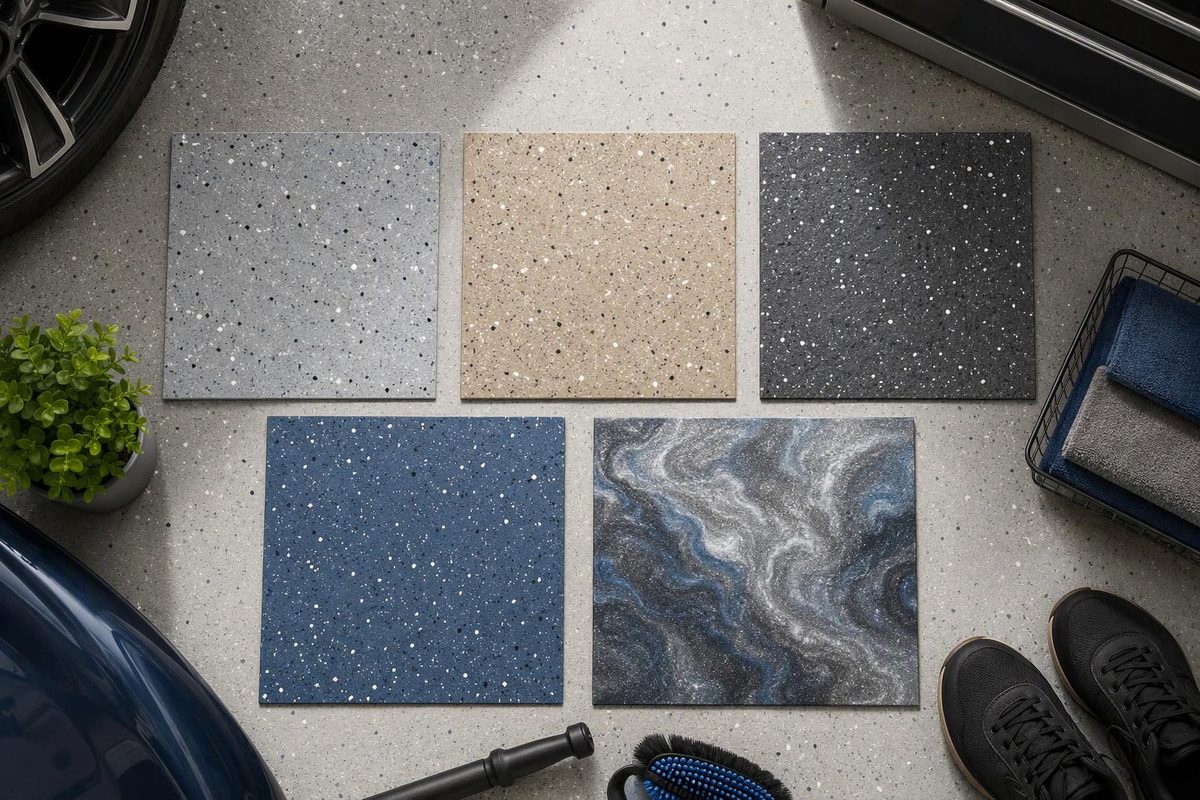
Start with medium-gray flake for a neutral garage, warm greige for beige walls or wood cabinets, and light-gray solid color for a working bay with a simple visual background. Sample charcoal if you want a darker floor, but check its contrast with pale dust. For metallic finishes, focus on the overall effect rather than an exact pattern match.
Choose the color and pattern together. A solid gray floor, gray with scattered chips, and a dense black-white-gray flake blend can look quite different—even when all three are sold as “gray.”
Seven color combinations to compare
These are palette suggestions, not standardized manufacturer color names. Use them to narrow the samples you request.
| Color idea | Suggested combination | Where to consider it | What to check on a sample |
|---|---|---|---|
| Medium-gray flake | Medium gray with white, charcoal and a little black | A mixed-use parking and storage garage; white walls, steel shelving or black cabinets | Keep the blend mostly midtone if you want less contrast with ordinary gray dust. Dense speckling may make small hardware harder to find. |
| Warm greige | Warm gray with beige, cream and dark-brown flakes | Beige walls, brick accents or wood cabinets | Compare it directly with the walls. A blend that looks neutral online may look distinctly brown beside a cool white. |
| Sand or tan | Tan with cream, brown and restrained black flakes | A warmer, less industrial-looking garage | Try a little of the dirt you actually track in beside the sample; tan is not a universal dirt-hiding color. |
| Light-gray solid | An even pale gray, without chips or with only a light scattering | A repair or hobby bay where visual simplicity matters | Check how clearly your screws and washers stand out. Tire marks and dark debris will also contrast with the pale background. |
| Charcoal flake | Dark gray with medium-gray and small white accents | Light walls and cabinetry, especially when you want a darker floor without solid black | Pale dust contrasts with a dark background. Read the separate black epoxy floor guide before going darker. |
| Blue-gray accent | A mostly gray-and-white blend with a restrained amount of blue | Blue tool cabinets or a cool-toned garage | View a larger sample: decide whether the blue should be an occasional accent or the dominant color. |
| Silver-and-charcoal metallic | Silver-gray pigment with darker accents | A display-oriented garage or hobby space | Request a cured system sample and completed-floor examples from the proposed applicator. Agree on the acceptable overall effect, rather than treating one photograph as an exact pattern specification. |
To browse beyond these combinations, Torginol’s flake catalog groups blends into cool, warm and neutral families. A decorative blend is not a complete coating specification: Torginol’s FAQ explains that flake and quartz add color and texture, while chemical and heat resistance depend on the resin system.
Decide how much pattern you want
- Solid color: The simplest background. Start here if finding dropped parts or noticing fresh drips matters more than disguising debris.
- Partial flake coverage: Scattered chips leave the base color visible. Approve both the base shade and the chip density.
- Full flake coverage: A dense broadcast makes the blend the main visual surface. Do not select it from a loose-flake sample alone.
- Metallic: Choose this for a decorative effect, not merely as another shade of gray. Confirm that the proposed system is suitable for your garage’s vehicle use.
Do not assume every kit offers every palette. For example, Rust-Oleum’s EpoxyShield pouch-kit data sheet lists gray, tan and dark-gray gloss versions with decorative chips. Check the exact product before planning a custom shade.
Approve the finish in your garage
Ask for a cured sample with the proposed base coat, flake size and coverage, clear coat, and traction additive. Torginol recommends physical samples and an installer-prepared system sample for the most accurate comparison.
Place the sample flat on the floor—not upright like a wall-paint chip—and check it:
- Near the vehicle door in daylight.
- At the back of the garage under your normal lights.
- Beside the cabinets, wall paint and stored equipment.
- With a few spare screws or washers on it, if you use the garage as a workshop.
Check sunlight exposure separately from color preference. For example, Sika’s Hong Kong product page warns that Sikafloor-264 epoxy may discolor in direct sunlight. Ask the coating supplier what protects color retention in the complete proposed system, especially near the open door. A clear coat should not be assumed to provide UV protection; use the clear-coat selection guide to check compatibility and exposure limits.
Likewise, chips and a matte appearance are not proof of wet traction. Rust-Oleum’s data sheet warns that coated concrete can become slippery when wet and specifies anti-skid options. Approve the final texture as well as the color.
Before ordering, record the base-color code, flake blend and size, coverage level, topcoat sheen and traction specification. If the slab has moisture problems, loose concrete or a failing coating, pause the color purchase and work through the garage epoxy installation plan first. A more forgiving pattern cannot fix a poor bond.