
Choose a Black Garage Floor That Fits Your Slab
Compare solid black, flake and metallic garage epoxy finishes, with checks for wet traction, sunlight, concrete preparation and vehicle-ready cure times.
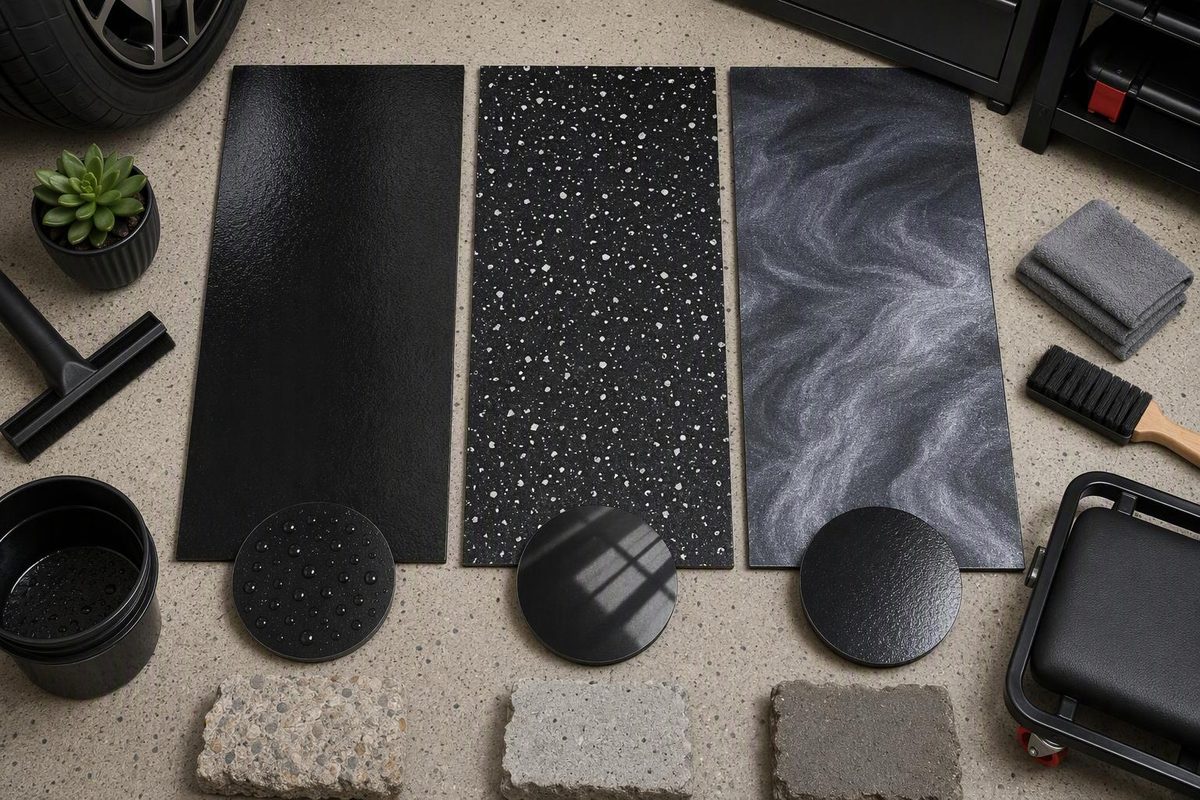
A black epoxy floor can work in a garage, but black is a color choice—not a durability specification. For daily vehicle use, compare textured solid black with black-and-gray flake, then verify the exact coating system’s wet traction, sunlight limits and slab requirements. Choose smooth, glossy black only if its appearance and cleaning demands suit your garage.
Select your slab condition, sunlight exposure and wet-use conditions to identify what must be resolved before coating.
Black Epoxy Suitability Check
Resolve the Unknowns First
Verify slab readiness, check direct sunlight and assess water exposure before selecting the complete coating system.
- Slab: use the chosen system’s moisture-testing and preparation requirements.
- Sunlight: check the doorway and any apron you intend to coat.
- Traction: assess rainwater and snowmelt; black color and flakes do not establish slip resistance.
Sources: Rust-Oleum water-based EpoxyShield technical sheet, CFS high-performance epoxy technical sheet and Epoxy.com high-build instructions cited in the article. This check is not product approval.
Choose the Finished Appearance, Not Just Black Pigment
Specify what the completed floor should look like. For a flake system, ask how much of the black base will remain visible. For a metallic finish, approve the contrasting tones as well as the black.
| Finish | Appearance | Sample Check |
|---|---|---|
| Solid black | Uniform color | Dust visibility, texture and glare |
| Black-and-gray flake | Patterned surface | Flake blend and base-coat visibility |
| Black metallic | Decorative variation | Representative pattern and contrasting tones |
Do not assume black will hide all dirt: pale dust and light-colored residue contrast with a dark surface. View the sample with the door open and closed, under your actual lighting. Include the proposed clear coat, if any, and traction additive. A glossy color chip does not show the finished floor’s texture or sheen.
If you regularly work with small fasteners, consider a plain finish around the workbench. In a December 2024 discussion among garage owners, several participants reported difficulty finding dropped screws and washers on flake floors. That is a usability trade-off, not evidence that one system is stronger.
Specify Wet Traction Separately From Color
Color and pattern do not establish slip resistance. Rust-Oleum’s EpoxyShield water-based garage-floor technical sheet warns that coated concrete can become slippery when wet and specifies an anti-skid additive in the coating or in its designated clear topcoat.
For a garage that receives rainwater or snowmelt, have the installer identify the traction additive, its application rate and whether it goes into the exposed coating or a clear topcoat. Approve a finished sample showing that texture, and obtain its cleaning instructions.
Do not treat decorative flakes as a substitute for a specified traction treatment. Texture also changes cleaning: Epoxy.com’s maintenance guidance notes that textured systems may need a brush or scrubber to reach the bottom of the texture. See our guide to textured non-skid garage epoxy for the specification details.
Direct Sunlight Can Rule Out a Particular Epoxy
Check where direct sunlight reaches the slab with the door open. Include the exposed apron if you intend to coat it; approval for the covered garage does not establish suitability outside it.
Some garage epoxies are restricted to covered areas. The Rust-Oleum technical sheet cited above explicitly excludes carports and areas exposed to direct sunlight. Separately, CFS’s high-performance epoxy technical sheet warns that its product is not UV color-stable and will discolor under UV exposure. These are restrictions for those products, not proof that every epoxy system has identical limits.
Black pigment does not override a product’s exposure restrictions. Obtain written approval for the complete system’s exposure conditions. If a contractor proposes a protective topcoat, confirm its compatibility and the manufacturer’s sunlight limitations. “Clear coat” alone is not a sufficient specification.
Moisture and Unsound Concrete Are Stop Points
Before buying coating, identify moisture, oil contamination, sealers, peeling coatings and loose or spalled concrete. Rust-Oleum excludes unsound coatings and moisture-problem floors. Epoxy.com’s high-build coating instructions require clean, dry, sound concrete and removal of contaminants through appropriate mechanical preparation.
Use the selected system’s moisture-testing and preparation requirements—not a generic procedure borrowed from a different kit. Investigate growing cracks or vertical displacement before treating them as cosmetic repairs. A black finish does not resolve an underlying slab problem.
Grinding is a separate safety decision. NIOSH identifies hazardous crystalline-silica exposure during concrete grinding and describes grinder shrouds connected to suitable dust-extraction equipment. If you cannot control dust safely, stop and arrange professional preparation. Our slab-first epoxy installation plan covers these stop points in more detail.
Compare Complete Coating Systems and Prices
A quote for “black epoxy” leaves too much unspecified. Compare quotes or DIY materials lists only after they identify the work below.
| Part of the Job | What Must Be Specified |
|---|---|
| Preparation | Repairs and removal of existing coatings |
| Moisture | Testing and any required mitigation |
| Coating layers | Primer and black epoxy product names |
| Material quantity | Coverage and required film thickness for each coat |
| Finished surface | Flake coverage, topcoat and traction treatment |
| Timing | Recoat windows and release times for foot traffic, stored items and vehicles |
The cited material does not provide a comparable installed price or DIY cost for these black finishes. A price comparison needs quotes for your slab and the same scope of work; a lower total may simply omit preparation, a topcoat or moisture mitigation.
Do not stretch a kit to cover the garage at less than its specified thickness. Epoxy.com’s high-build instructions state that actual coverage varies with concrete profile, porosity, waste and application method. Those instructions also require following the current safety data sheet for protective equipment, ventilation and handling precautions.
Vehicle Access Depends on the Exact Product
Do not read “dry overnight” as permission to park. The Rust-Oleum water-based EpoxyShield instructions allow light foot traffic in 12–16 hours but require three days before vehicle traffic, with more time needed in cooler conditions.
That schedule applies to the cited product, not every black epoxy floor. Confirm the vehicle-traffic release time for your exact system and installation conditions before scheduling the work. The finish choice comes after the slab, exposure limits and coating specification—not instead of them.