
Find the Cause of a Gap Under Your Garage Door Before Sealing It
Measure a gap under your garage door, distinguish worn seals from floor or closing problems, and choose a fix without forcing the door down.
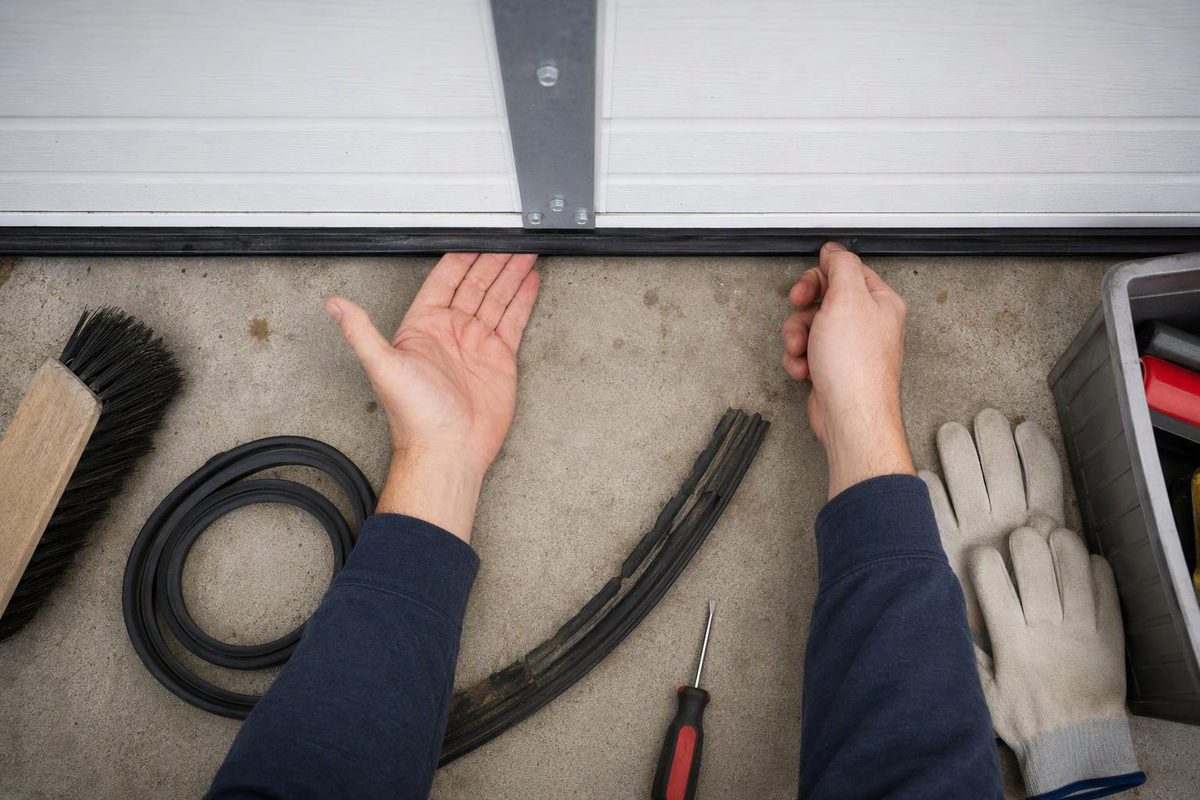
For an overhead garage door, the bottom weather seal should meet the floor—or a fitted threshold—across the opening. A visible gap is a reason to check the seal, floor and closing position, not automatically to install a taller threshold.
The rigid bottom of the door does not need to touch concrete; the flexible seal bridges that space. Genie’s closing-limit guidance calls for enough compression to seal across the door’s width, but explicitly warns against compressing it so much that the door bends or buckles. It also notes that damaged doors and uneven floors may prevent a proper seal. Use sealing contact as the target rather than choosing an arbitrary “acceptable gap” in inches. Source: Genie
Here, bottom seal means the flexible strip attached to the door. Threshold means the raised strip attached to the floor. If you have no added strip, check the gap against the concrete instead.
1. Check for a stop-work condition
Before measuring or cycling the door, look for a crooked door, a roller out of its track, loose or damaged cables, a visibly broken spring, or a bent bottom section.
If you see one of these, stop operating the door and arrange a door-system inspection. Do not pull the emergency release on an elevated, suspect door or try to force it shut. The CPSC warns that a severely unbalanced door can crash down and recommends professional service for doors that bind or stick. Source: CPSC
Do not loosen bottom corner brackets, cable attachments or spring hardware to level the door. These are different from the seal retainer and can be under extreme tension even with the door closed. Source: DASMA safety labels
2. Measure the gap—not just the door width
If the door is already fully closed and appears sound, disconnect power to the opener for the stationary inspection, including any backup battery, following its manual. Keep remotes out of use and fingers out from beneath the door.
Record:
- Location: left end, center, right end and any other daylight patches.
- Height: measure the open space from the underside of the flexible seal to the floor or threshold at each location. Read a ruler beside the gap; do not lift the door or push the seal up to make it fit.
- Seal condition: note tears, missing sections, folding or obvious flattening.
- Threshold condition: if fitted, check for lifting, splits or gaps beneath its base.
- Floor profile: place a straightedge on the accessible floor alongside the door line to look for humps or depressions. This is a comparison, not a structural assessment.
Photograph the full closed door and the individual gaps with the ruler visible. Those measurements are more useful than “light comes underneath.”
3. Use the pattern to choose the next check
These are diagnostic leads, not proof of a particular fault.
| Gap pattern | Next check |
|---|---|
| Similar gap across most of the width | Is the seal intact, and is the door actually reaching its proper closed position? |
| Gap follows torn, missing or folded seal sections | Check the seal’s fit and condition; replace damaged material with a compatible seal. |
| Center touches but ends do not, or the reverse | Compare the floor profile with the door’s bottom edge; do not assume the opener needs more travel. |
| One end is raised and the door looks crooked | Stop operating it; have the door hardware and counterbalance system inspected. |
| Door touches down, then reverses | Follow the opener’s troubleshooting instructions rather than treating this as a simple sealing gap. |
If the bottom seal is damaged
Identify the door model and existing retainer before ordering. When replacing only the flexible strip, match its attachment profile and dimensions—not merely its length or the word “universal.” A kit that replaces the retainer instead needs to fit the door itself. For example, Action Industries’ replacement kit includes a matching T-end seal and retainer, with retainer options selected by door thickness. Source: Action Industries
Use the bottom weather-seal selection and replacement guide for the fitting details. If access requires disturbing a bottom bracket or cable attachment, leave that work to a technician.
If the door stops short
Check the exact opener manual for down-travel programming. Do not increase closing force to overcome binding, crush a seal or compensate for uneven concrete. Travel sets the closing position; it is not the same as closing force. The closing position should produce sealing contact without bending the door, as described in Genie’s travel-limit guidance.
If the floor or existing threshold is the problem
A compatible threshold may help a sound, correctly operating door, but dry-fit it before applying adhesive. Check that the door closes normally and that any lock still works. GaraDry’s installation instructions specifically require these checks and call for repositioning the threshold if it interferes with closing. Source: GaraDry
Before adding a raised barrier, consider where water from inside the garage needs to escape. Do not block a needed drainage route. Use the garage-door threshold guide to compare profiles and plan the installation; do not stack another strip over a loose existing threshold.
4. Verify closing safety after the fix
Once the door is sound and the work is complete, restore power and follow the opener manual’s safety tests. A quieter close or disappearance of daylight does not prove the reversal system works.
Chamberlain requires testing after adjustments and monthly: with the door fully open, place a 2×4 flat on the floor, centered beneath the door, and operate it downward. The door must reverse on contact. Keep people clear and never substitute a hand or foot for the board. If it fails, stop automatic use until the problem is corrected. Source: Chamberlain
Finally, recheck the same gap locations. If sealing one low spot requires crushing the seal elsewhere, the remaining job is to correct the floor, door or profile mismatch—not keep driving the opener farther down.