
Choose a Garage Door Threshold That Seals Without Binding
Decide whether a garage door threshold will help, measure for the right profile, and install it without blocking drainage or compromising door safety.
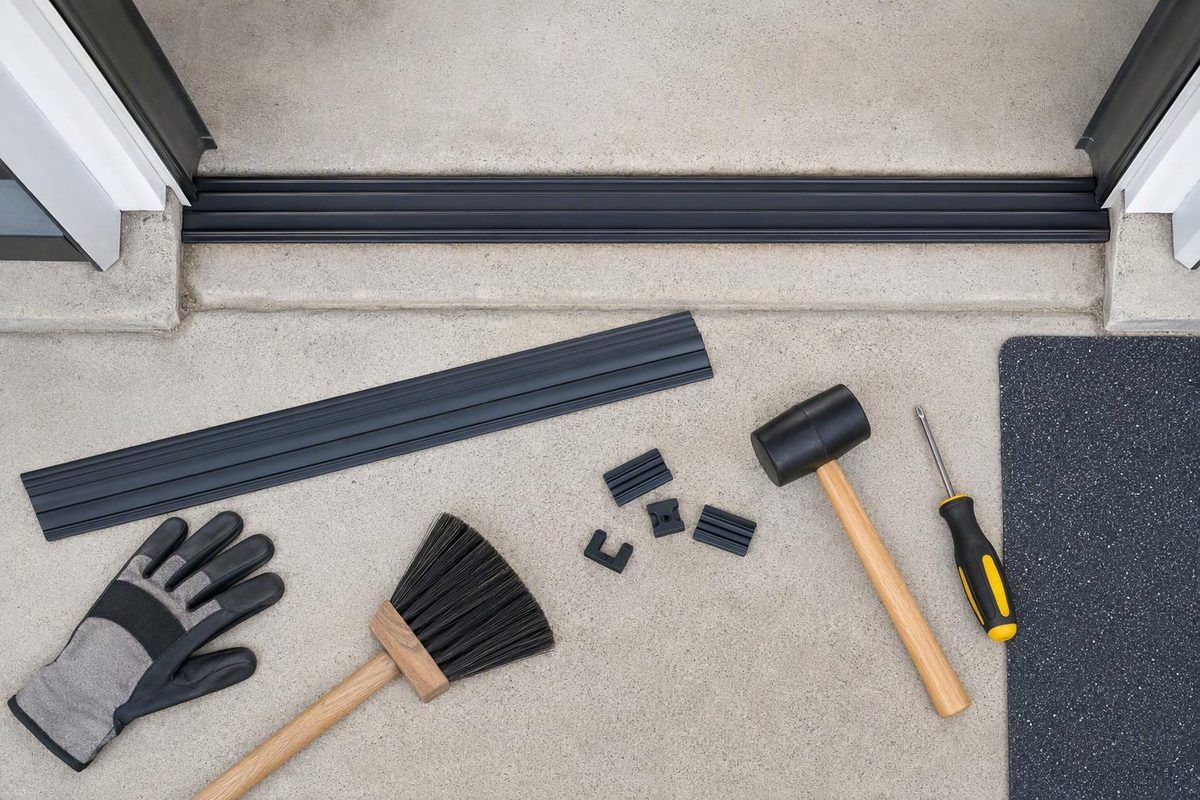
A garage door threshold is a raised strip fixed to the floor at the doorway. It works against the closed door to reduce gaps that admit rain, drafts and debris. It is not the same as the bottom weather seal, which attaches to the door and moves with it. The two can work together, but a threshold should not be used to disguise a door that closes incorrectly. PDQ Door explains the distinction.
The right choice depends on three things: where water enters, the gap beneath the closed door, and whether the new strip lets the door close normally.
Check whether a threshold is the right fix
Before buying, inspect the doorway with the door fully closed and stationary:
- Look at the bottom seal. If it is torn, missing or hardened, address that first. Our bottom weather-seal guide explains how to match the replacement to its retainer.
- Locate the entry point. A threshold targets the bottom of the doorway; water entering through a wall or elsewhere needs a different repair.
- Check the drainage route. Does snowmelt from vehicles or cleaning water normally flow out through the opening? A raised threshold can trap that water inside. PDQ Door identifies this drainage drawback.
- Check normal closing behavior. If the door already binds, closes crookedly or reverses unexpectedly, resolve that problem before adding a floor strip.
Treat substantial driveway runoff or recurring flooding as a drainage problem to evaluate, not simply a reason to buy the tallest threshold. A raised strip has a finite barrier height and does not repair the slope of the driveway or slab.
Stop if fitting would require loosening springs, cables or bottom brackets. Those components can be under extreme tension; they are specialist work, not part of a threshold installation. DASMA’s warning labels explicitly prohibit adjustment or removal of these parts.
Measure the opening and choose the profile
Record these measurements rather than ordering from the nominal door size:
| Check | What to record |
|---|---|
| Opening width | Actual width at the floor, including the end-fitting space required by the chosen kit |
| Bottom gap | Gap beneath the closed door at both ends and several points between; note the largest |
| Floor condition | Dips, cracks, loose concrete, paint or coating along the bonding area |
| Threshold footprint | Available floor depth and the profile’s position relative to the door and tracks |
Do not put fingers beneath the door to measure. Keep others away from the controls during measurement and fitting, and clear hands and tools from the opening before operating the door.
GaraDry’s buying guide bases seal-height selection on the largest gap, measured at several points. Its PVC threshold fitting instructions also require about 1½ inches of extra length at each end for notching around the frame or tracks. That allowance is specific to its system—not a universal cutting rule.
Choose height and shape together. Some profiles sit beneath the door; GaraDry’s PVC profile sits against the back of the door, with the door closing onto its front face. A taller strip is not automatically a better fit: it must still allow normal closure and locking. The manufacturer’s fitting guide calls for checking both before bonding.
Rubber, PVC and aluminum products are available. Compare the actual kit’s floor compatibility, vehicle-load guidance, adhesive requirements and profile dimensions rather than assuming one material is best for every garage. Consider the bump for low-clearance vehicles, wheeled equipment and people walking through the opening.
Fit first, glue second
For an adhesive-mounted strip, use this sequence alongside the exact kit instructions. The GaraDry details below apply to its PVC threshold system, not its separate aluminum range.
- Prepare a sound bonding surface. Remove oil, grease, debris and loose paint. GaraDry excludes loose concrete and gravel, requires sealing dusty or powdery concrete, and recommends dulling very smooth epoxy or tile before bonding. Check your floor-coating instructions before sanding.
- Cut and dry-fit the strip. Notch its ends as specified. Confirm that the door closes and locks correctly, without forcing it against the threshold. Keep hands and tools clear during any operation check.
- Mark the final position. Trace the edges only after confirming the fit, then remove the strip for adhesive application.
- Use the specified adhesive pattern and application conditions. Follow the adhesive’s temperature limits. For GaraDry’s PVC system, the pattern is continuous beads along both sides and a zigzag between them, followed by sealing the ends. Gaps beneath or around the strip can leave a route for water.
- Allow the specified cure time. Do not drive over it early. GaraDry specifies 24 hours before vehicle traffic; follow your own kit and adhesive instructions if they differ.
These preparation and bonding details come from GaraDry’s PVC threshold installation instructions.
Check operation and leakage
After curing, check normal door operation and perform the opener manual’s safety-reversal test. For Chamberlain/LiftMaster equipment covered by its guidance, the door must reverse on contact with a 2×4 laid flat, centered beneath the door. The manufacturer requires testing after adjustments and monthly thereafter. If reversal fails, stop automatic use and have the problem corrected. Do not increase closing force just to squeeze the door onto a poorly fitted threshold. Chamberlain’s testing instructions explain the procedure.
Finally, use a gentle hose flow outside to check for leaks after the prescribed cure period. Inspect the ends and bonding edges, and check that water inside still has an acceptable drainage route. GaraDry recommends this water check after 24 hours and warns against pressure-washing the strip because it can damage the seal and adhesive. Installation and care guidance.