
Why Repair Beats the Old 50% Replacement Rule
Compare 2026 garage door repair and replacement by cost per year, see how tariffs distort the old 50% rule, and know when a new door wins.
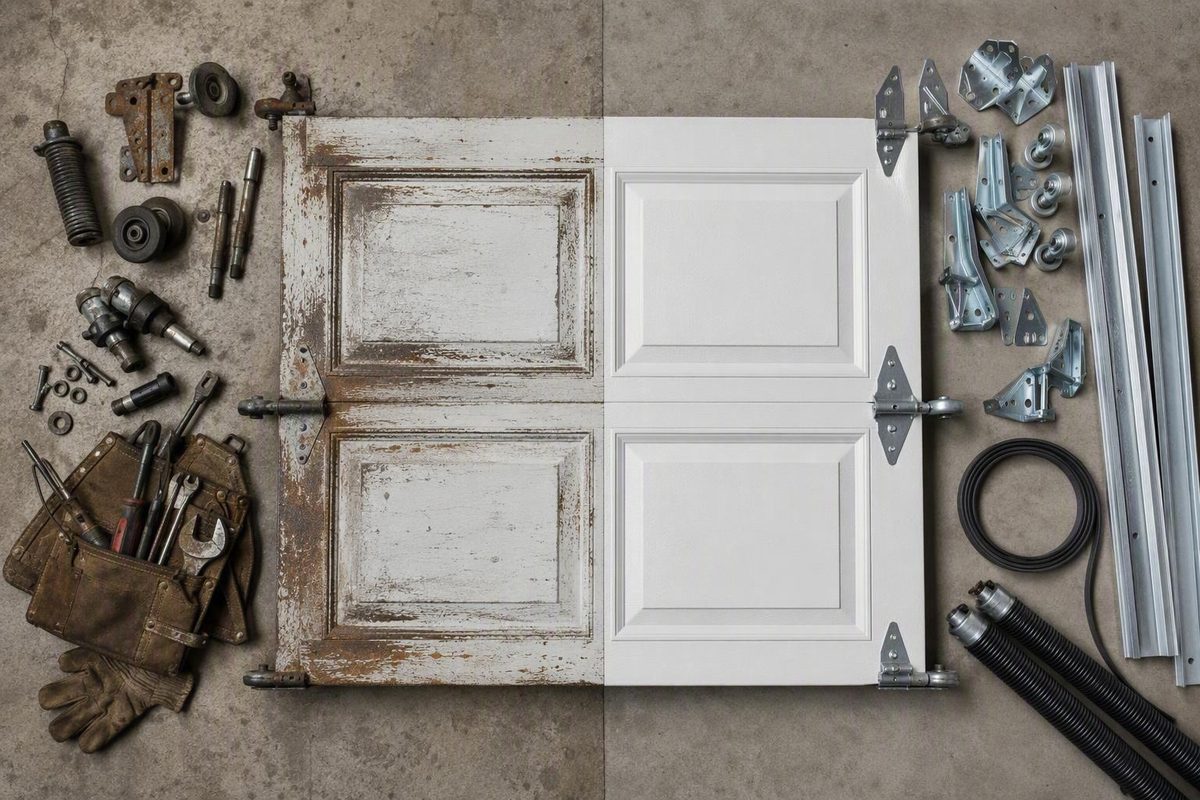
Installed steel garage doors are running 35% to 40% above 2024 prices, so the old rule that favors replacement when a repair approaches half the price of a new door now overweights replacement. On a structurally sound door, compare cost per expected year of service instead: a $450 spring-and-roller overhaul that provides five more years costs $90 per year, versus $240 per year for a $2,400 replacement expected to provide about 10 years.
That verdict is limited to doors with sound panels, tracks, framing and counterbalance components. Replacement still wins when sections are rotted or extensively corroded, several panels are damaged, required parts are unavailable, failures are recurring, or the door cannot operate and reverse safely after professional service.
The Old Rule Still Has a Sensible Case
The received wisdom is straightforward: if a garage door is at least 15 years old, or a repair exceeds roughly 50% of replacement cost, stop putting money into aging equipment. A new door resets the major hardware, avoids a succession of service calls and can improve sealing, appearance and warranty coverage.
That reasoning is sound when age comes with deterioration. Three damaged panels can cost $750 to $2,700 at the draft’s published range of $250 to $900 per panel, overlapping the price of a complete single door. Rot, extensive corrosion, a distorted frame, obsolete sections and repeated failures also make a narrow repair poor value.
The percentage cutoff is the weak part. It assumes repair and replacement prices have moved together. In 2026 they have not.
A replacement is panel-heavy and therefore exposed to steel pricing, freight and manufacturer increases. A spring, roller, sensor or opener repair is more heavily composed of local labor and a relatively small amount of hardware. As one 2026 market guide puts it, when the panels are sound and the failure is a spring, opener or set of rollers, repair may carry far less steel cost than full replacement because the duty scales with the steel in the product.
Cost Per Year Gives the Better Answer
Divide each complete quoted cost by the useful service it is reasonably expected to provide. The lower annual figure is the better financial path, provided it leaves the door structurally sound and safe.
For the default comparison:
- Repair: $450 divided by five expected years equals $90 per year.
- Replacement: $2,400 divided by about 10 expected years equals $240 per year.
- Break-even point: the $450 repair needs to provide about 1.9 years to match the replacement’s annual cost.
The service-life figures are estimates, not warranties. Ask the technician what the repair corrects, what remains old and what observed condition supports the estimate. If the contractor cannot estimate how much service the proposed work should provide, the cost-per-year result must remain uncertain rather than being presented as precise.
Enter both quotes and the service years you expect; the result identifies the lower-cost path and checks the door’s condition.
Change the quotes and expected service years. Dollar figures are complete project costs; service years are estimates, not guarantees.
Tariff share is — because a retail quote does not disclose the covered steel value. Do not multiply the full installed quote by 50%.
| Condition | Default | Effect on Decision | Change |
|---|---|---|---|
| Panels and sections are structurally sound | Yes | Supports repair | |
| Frame and tracks are stable | Yes | Supports repair | |
| Failure is isolated rather than recurring | Yes | Supports repair | |
| Correct replacement parts are available | Yes | Supports repair | |
| Door can be balanced after service | Yes | Required for viable repair | |
| Safety reversal can be restored and tested | Yes | Required for viable repair | |
| Door and opening can still seal effectively | Yes | Supports repair | |
| No several-panel or widespread damage | Yes | Supports repair |
Condition result: Repair remains a viable option; compare the annual costs above.
A “No” for balance or safety reversal blocks a repair-only recommendation. Rot, extensive corrosion, an unstable frame, unavailable parts or widespread panel damage should trigger a complete replacement quote.
Recent repair spending should be added when it reveals a pattern of related failures. Do not automatically count an old, isolated remote or sensor invoice against an otherwise sound door. Count current work, known additional defects and recent spending that reflects deterioration of the same assembly.
Replacement Prices Absorbed the Larger 2026 Increase
Current planning ranges remain broad because door size, construction and quote scope differ. HomeGuide lists ordinary repair at $150 to $350, installed single-door replacement at $700 to $2,700 and a double-wide door at $1,000 to $3,500 in its 2026 garage-door cost guide. Another national guide gives narrower capacity-based estimates of $1,093 to $1,674 for one-car capacity and $2,186 to $3,348 for two-car capacity in its 2026 cost guide.
For insulated steel doors, a 2026 commercial guide places installed single-car replacement at $1,000 to $1,800 and double-wide replacement at $1,800 to $3,200, approximately 35% to 40% above its 2024 levels. It connects much of that pressure to the steel tariff and manufacturer pricing, although it is a lead-generation source rather than a government classification authority and its figures remain planning ranges.
The trade-policy sequence helps explain why waiting for a quick return to 2024 pricing is not a dependable plan. The Section 232 steel tariff doubled from 25% to 50% on June 4, 2025. An August 18–19, 2025 expansion covering 407 derivative categories brought finished garage doors into the wider tariff net, according to the same commercial guide. The duty relates to covered steel value, not necessarily the entire retail installation invoice.
Spring 2026 then brought three reported manufacturer increases in roughly 60 days. Clopay moved in mid-March. C.H.I. raised sectional-door pricing 6% on April 6 and full-view aluminum pricing 10%; the reporting contractor calculated that 6% as about $144 on a $2,400 16-by-7 door. Amarr followed with 5% on April 27, while LiftMaster added a 6.5% tariff surcharge to openers according to the contractor’s account of dealer notices.
These are brand-specific, contractor-reported changes, not an independent national transaction dataset. They do not prove that every installed quote rose by the same percentage. Labor, distribution, freight, product mix and local competition still affect the final number.
Nor can a homeowner calculate the tariff dollars hidden in a $2,400 retail quote without the dutiable steel value or equivalent supplier detail. The explorer therefore reports that amount as unknown unless the user enters a disclosed value. Multiplying a retail total by 50% would overstate the tariff because installation includes labor and other non-steel costs.
There is no clear policy signal that the pressure is about to unwind. On August 4, 2026, the Bureau of Industry and Security proposed adding 14 more derivative product categories to Section 232 measures according to KPMG’s regulatory summary. Those 14 proposed categories did not themselves list garage doors, components or repair services, and the proposal was not proof of another garage-door increase. It did show a widening tariff regime rather than announced relief.
Use Complete Quotes, Not Advertised Door Prices
A repair invoice cannot be compared fairly with a bare-door price. Obtain itemized totals for the actual opening.
A replacement quote should identify the manufacturer and product line, dimensions, material, insulation, wind rating, finish, tracks, spring system, rollers, cables and seals. It should also state whether delivery, installation, removal, disposal, tax, permits, opener work and required framing or electrical changes are included.
Two separate single doors are not equivalent to one double-wide door. Two openings have two track systems, two spring arrangements and potentially two openers. Have contractors price each opening explicitly.
Repair scope needs the same precision. A spring quote should say whether it covers one spring or the complete required arrangement, along with winding, balancing, operational testing, removal and related bearings or hardware. A low one-spring quote is not equivalent to a two-spring overhaul.
Broad published repair ranges are useful only after that scope is defined:
| Work | Published Range | Main Scope Variable |
|---|---|---|
| Spring work | $100–$350 | System, quantity and door weight |
| Cable work | $85–$350 | Root cause and related hardware |
| Track work | $125–$500 | Alignment versus replacement |
| Opener repair | $100–$400 | Electronics, gears or motor |
| Sensor work | $75–$300 | Alignment, wiring or replacement |
| Panel replacement | $250–$900 each | Match, freight and finish |
| Inspection or tune-up | $75–$250 | Included adjustments and parts |
One commercial provider gives an overall repair range of $150 to $600, including springs at $100 to $300, cables at $85 to $200, opener work at $125 to $400, panels at $250 to $800 each and tune-ups at $75 to $150 in its 2026 repair guide. These are service-company estimates, not guaranteed national rates.
For opener-only decisions, a repair of $100 to $400 can be compared with a new opener commonly listed around $300 to $900 installed. An opener fault does not by itself justify replacing sound door sections and tracks. The technician should first confirm that a broken spring, binding track or unbalanced door is not making the opener appear defective.
Repair Wins for Isolated Failures on Sound Doors
A repair normally has the stronger cost-per-year case when the failure is confined to a spring arrangement, cable, rollers, sensor, remote, wall control or repairable opener component.
The condition requirement matters. Panels should be straight and structurally sound. Tracks and framing should be stable. The door should be capable of balanced movement after the work, and seals should remain renewable without rebuilding the opening.
Age alone does not defeat that case. A 15-year-old door with sound sections and one failed spring may be a better repair candidate than a younger door with collision damage across several sections. Age becomes decisive when it coincides with corrosion, rot, repeated failures, obsolete components or poor sealing.
Panel repair requires closer comparison. At $250 to $900 per panel, replacing three sections produces a $750 to $2,700 subtotal before possible freight, hinges, struts, glass, refinishing or correction of the original damage. Exact profiles may be unavailable on an older proprietary door, and a new section may not match a faded finish.
When panel costs overlap a complete replacement, compare matching availability, remaining-panel condition, warranty, freight and any frame or track damage. There is no universal panel-count cutoff.
Replacement Wins When the Assembly Is Failing
Price a complete replacement when the defect is not truly isolated. Strong replacement signals include:
- Rot, extensive corrosion or severe section distortion
- A deteriorated or unstable frame
- Several damaged panels
- Multiple simultaneous mechanical defects
- Frequent recent breakdowns
- Proprietary or obsolete parts that cannot be sourced reliably
- An opening or door that can no longer be sealed effectively
- Damage that prevents stable, balanced operation
- Safety-reversal performance that cannot be restored through proper service
The cost-per-year calculation does not override these conditions. A cheap repair that leaves an unstable door, dead section or unresolved reversal failure is not a viable option and should not be entered as though it were equivalent to replacement.
Preferences should remain separate from necessary work. Windows, premium finishes, upgraded insulation, decorative hardware, smart controls and a new opener can justify spending more, but they belong in an upgrade column. Including them only in the replacement quote makes a basic mechanical repair appear artificially competitive or makes replacement look more expensive for reasons unrelated to the failed component.
Safety Sets a Nonnegotiable Boundary
Loaded springs, lifting cables, cable drums and major track components store or control substantial force. Spring and major track work should be left to qualified professionals; mistakes can cause injury and property damage as the commercial repair guidance also cautions.
Keep people, pets and vehicles away from a door that is crooked, off-track, structurally damaged, unexpectedly heavy, binding or supported by damaged cables or panels. Do not work beneath it or attempt to brace and move it. Ask a service company how to secure the opening temporarily if normal operation is unsafe.
After any repair, the door should be balanced and tested with the opener’s safety-reversal system according to the manufacturer’s instructions. If safe operation cannot be restored, replacement or broader corrective work is necessary regardless of the sticker-price comparison.
Emergency work can cost more, but no universal surcharge appears in the available figures. When circumstances allow, ask for the emergency fee, minimum charge and immediate scope before authorizing service.
The practical 2026 rule is narrower than “always repair”: repair the isolated failure when the door itself remains sound and the expected cost per year is lower. Replace the assembly when structure, parts availability, repeated failures or safe operation make the repair path incomplete.