
Before You Move a Door With a Broken Spring, Check These Risks
Leave a fully closed door shut. An elevated, crooked, binding, off-track or cable-damaged door should be isolated and treated as urgent.
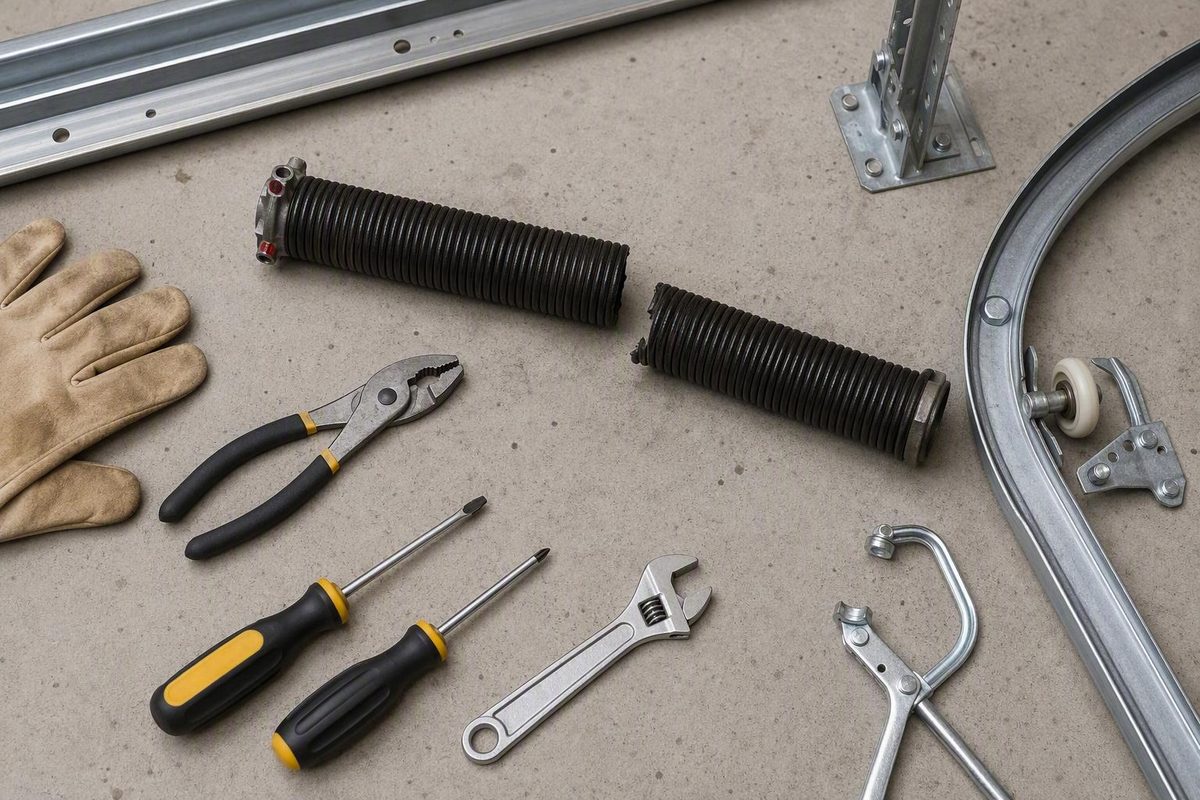
The immediate answer: do not open it unless access is truly urgent
If you suspect a broken garage-door spring, stop operating the door immediately. Do not press the wall control again, try another remote or keypad, or use the automatic opener for one last cycle.
If the door is fully closed, the safest default is to leave it closed, use another entrance, and arrange an inspection by a qualified garage-door technician. Keep children, pets, vehicles, and bystanders away from the door, tracks, and travel path. Commercial garage-door guidance recommends stopping operation and leaving a closed door in place rather than forcing it open (Fast Fix’s broken-spring guidance).
Immediate decision rule
- Fully closed and nonurgent: Leave it closed, prevent activation, use another entrance, and schedule repair.
- Partially or fully elevated: Keep everyone out of the opening. Do not pull the emergency release. Request urgent professional guidance.
- Crooked, binding, off track, visibly damaged, or accompanied by loose cables: Do not move it manually or with the opener. Isolate the area and request urgent service.
- A person is trapped or in immediate danger: Contact emergency services. Do not improvise with the springs, cables, tracks, opener, or temporary supports.
The available topic-specific sources for this guide are predominantly commercial garage-door service providers rather than manufacturer, government, or standards-body publications. Because that evidence is commercially interested and some sources disagree about emergency manual movement, this article takes a deliberately conservative approach: stop work, isolate unstable doors, and obtain door-specific help rather than follow a universal lifting procedure.
You may electrically disable the opener to prevent accidental powered operation, but only if you can reach an already identified opener plug or labeled disconnect without walking beneath an elevated door or entering the door’s travel path. Do not experiment with electrical panels or unfamiliar switches.
Electrically disabling the opener is different from pulling the red emergency-release cord. Unplugging or switching off the opener prevents powered activation. Pulling the release cord mechanically disconnects the door from the opener trolley and may allow an unbalanced door to move independently.
A vehicle trapped in the garage is frustrating, but it is not automatically an emergency. Missing work, delaying an appointment, or losing access to the preferred vehicle generally does not justify moving a door whose balance, cables, rollers, tracks, and panels have not been assessed. Consider another vehicle, a ride, taxi, delivery, or roadside-assistance option while waiting for repair.
If a person is pinned, trapped in dangerous conditions, or unable to leave during a fire, medical event, or other immediate threat, contact emergency services. Garage-door springs store substantial energy, and a door that has lost its counterbalance can create falling and crushing hazards. Improvised rescue attempts involving springs, cables, tools, or makeshift supports may create additional danger (First Choice Garage Doors’ spring-safety overview).
How a broken spring changes the door
Garage-door springs do not merely give the opener a small boost. They counterbalance the door, reducing the effort required to raise it and helping control it as it descends. The opener is designed to move a properly balanced system; it is not intended to replace missing spring assistance.
When a spring fails:
- The door may become unusually difficult to lift.
- One side may rise while the other lags.
- The door may bind or wedge in the tracks.
- Cables may lose tension or move out of position.
- An elevated door may descend unexpectedly.
- The opener may strain, stop, or move the door only a few inches.
The exact behavior depends on the door’s construction, dimensions, spring arrangement, cable condition, track alignment, existing damage, and current position. A method that appeared to work on another door cannot be assumed safe for yours.
The two common spring arrangements are:
- Torsion springs, generally mounted horizontally above the opening, often on a shaft.
- Extension springs, generally positioned beside the door along the upper horizontal tracks.
You may observe the spring location from outside the door’s travel path, but do not touch the spring, shaft, cable drums, pulleys, brackets, or nearby fasteners. Identifying the spring type does not make manual movement, adjustment, or replacement safe. Both systems perform the same essential counterbalancing function (Garage Door Specialists’ spring-system explanation).
Why the opener should not be used to force the door
An opener may still hum, move its trolley, or lift the door several inches after a spring fails. That does not establish that the door is safe or that the opener can complete the cycle.
Without normal counterbalance, continued powered operation may overload or damage the opener. Uneven movement may also damage panels, cables, rollers, rails, or tracks, and a door that rises crookedly may become harder to stabilize. Stop at the first sign of strain, limited travel, binding, or uneven movement (Don’s Garage Doors’ broken-spring guidance).
Do not rely on an average garage-door weight. Doors vary by size, construction, insulation, glazing, reinforcement, and hardware. The important question is whether this particular door, in its current damaged condition, can remain balanced and controlled. That cannot be established through a general article.
Signs that suggest a spring failure
No single symptom proves that a spring has failed in every case. Opener faults, broken cables, damaged rollers, bent tracks, obstructions, and panel damage can produce overlapping symptoms. Use these signs to recognize when operation should stop—not to justify hands-on testing.
| What you notice | What it may suggest | What to do |
|---|---|---|
| A loud bang or sharp pop | A spring may have fractured | Stop operating the door |
| A visible separation in a torsion-spring coil | The torsion spring may have broken | Do not touch the spring, shaft, drums, or cables |
| The door rises only a few inches | The opener may be encountering an unbalanced door | Stop using the opener |
| The door suddenly feels much harder to move | Counterbalance assistance may be missing | Do not perform a manual balance test |
| The opener strains, grinds, hums, or stops | It may be overloaded, or another fault may exist | Prevent further activation |
| One side rises faster than the other | A spring, cable, roller, or track problem may be creating uneven loading | Stop immediately |
| The door descends rapidly | Counterbalance or control may have been lost | Keep everyone out of the opening |
| Cables appear loose, hanging, or displaced | Cable or spring-system tension may be affected | Do not touch or reposition them |
| Rollers are outside the tracks | The door is mechanically unstable | Do not move it |
| Tracks or panels are visibly damaged | The door may bind, buckle, or travel unpredictably | Isolate the area |
These symptoms are suggestive rather than conclusive, but unusual weight, limited opening, uneven movement, rapid descent, a visible spring gap, a loud bang, and loose cables are all identified as possible signs of spring failure (Central Oregon Garage Door’s diagnostic overview).
Observe without conducting a test
Inspect only from a safe distance and outside the door’s travel path. Do not stand beneath an elevated door or climb a ladder beside an unstable one.
A manual balance test may be used as a maintenance check on an otherwise functioning door, but do not perform one after a spring failure is suspected. Disconnecting the opener or moving the door to see how heavy it feels can expose the missing counterbalance and permit unexpected movement.
Treat the following as automatic stop conditions:
- Loose, hanging, crossed, or displaced cables
- Rollers outside the tracks
- Bent, separated, or visibly damaged tracks
- Cracked, bent, folding, or buckled panels
- Pronounced crooked movement
- Scraping, jamming, or binding
- An elevated door that appears unstable
- Any door that begins descending faster than expected
These are not troubleshooting invitations. Leave the door alone and tell the technician what you observed. Final diagnosis should include the related hardware rather than only the visibly separated spring.
Emergency release versus electrical disconnection
The opener’s electrical supply and the red emergency-release cord perform different functions:
- Electrical disconnection prevents the opener motor from receiving a normal activation command. Use only an already identified, safely accessible plug or labeled disconnect.
- The emergency release mechanically separates the door from the opener trolley, allowing the door to move independently of the opener.
The emergency release does not restore the spring, rebalance the door, reduce its effective weight, repair a cable, or correct a damaged track.
Do not pull the cord beneath an elevated door
Do not pull the emergency-release cord when the door is partially or fully elevated and unsupported. Disconnecting an unbalanced door may permit it to move or fall. Do not stand in the opening, reach beneath the door, climb near it, or tug the cord from an awkward position.
Instructions that discuss emergency manual operation generally say the door should be fully down before the release is used. That is a necessary precaution, not proof that every closed door is safe to release or lift. A closed door may still have displaced cables, off-track rollers, damaged panels, or an uncontrolled load. HomeServe’s explanation confirms that the release disconnects the opener, specifies starting with the door fully down, and notes that a broken spring requires more lifting force (HomeServe’s emergency-release discussion).
“Manual mode” does not mean normal operation. It only removes the powered connection. After a suspected spring failure, do not reconnect the trolley and try another cycle merely because the door has returned to the closed position. Keep the opener out of service until the spring system and associated damage have been assessed and repaired.
What to do based on the door’s current position
The appropriate response depends on whether the door is closed, suspended, fully raised, crooked, binding, or off track. Use the following position-based decision guide rather than a universal opening procedure.
If the door is fully closed
- Stop using every wall control, remote, keypad, vehicle button, and app.
- Leave the door closed.
- Keep people away from the springs, cables, tracks, and bottom edge.
- Electrically disable the opener only if its identified plug or labeled disconnect is safely accessible.
- Use another entrance.
- Arrange qualified inspection and repair.
Do not pull the emergency release to test the door. Do not lift a corner, perform a balance test, or use the opener to confirm whether the spring is broken.
If a vehicle is inside, first consider alternatives that do not require moving the door. Waiting for service usually avoids turning a stable closed-door problem into an elevated-door support problem.
If the door is partially open
Treat a partially open door as urgent and unstable:
- Keep everyone out of the opening and travel path.
- Do not walk, crawl, or drive beneath it.
- Do not pull the emergency-release cord.
- Do not attempt to raise or lower the door.
- Do not push on a crooked panel or return a roller to its track.
- Prevent anyone from activating the opener.
- Tell the garage-door company that the door is suspended partway open.
Lowering is not automatically safer than lifting. Without normal counterbalance, the load may become increasingly difficult to control during descent. Commercial guidance addressing spring failure similarly warns that closing the door can remain hazardous as the unsupported load changes (Dayton Door Sales’ spring-failure guidance).
If the door is fully open
A fully open door is not necessarily safely supported merely because it has remained in place.
- Restrict access to the garage and the area outside the opening.
- Prevent activation from wall controls, remotes, keypads, vehicle buttons, and apps.
- Do not pull the emergency release.
- Do not rely on the opener alone as assurance that the door cannot descend.
- Obtain real-time, door-specific guidance before anyone attempts to lower, restrain, or work near it.
No one should stand, walk, or drive beneath an unstable raised door. This guide does not prescribe locking pliers, clamps, lumber, ladders, brackets, or household props because their capacity, placement, compatibility, and effects on the tracks cannot be established without evaluating the particular door. Any restraint or support method must be selected or confirmed for that specific installation by its manufacturer or a qualified technician.
If the door is crooked, binding, or off track
Do not move it manually or with the opener.
Crooked travel may reflect uneven counterbalance, a cable problem, a displaced roller, track damage, or several faults at once. Continuing to operate the door can wedge it more tightly or allow one side to move independently. Slack cables, rapid descent, crooked movement, panel damage, and track jamming are all warning conditions requiring door-specific assessment (Forest Door’s broken-spring overview).
The same stop rule applies if:
- A cable is loose or hanging.
- A roller is outside its track.
- A track is bent or pulling away from its mounting surface.
- A panel is buckled or folding.
- The door scrapes, catches, or stops unevenly.
- The opener rail or trolley appears distorted.
- The door has been struck by a vehicle or another object.
Do not pull, push, pry, hammer, straighten, loosen, or reposition anything. Isolate the area and describe the visible condition to the technician.
If emergency access appears unavoidable
There is no universal safe lifting sequence for a garage door with a broken spring. Door construction, dimensions, spring layout, current position, cable condition, track integrity, panel damage, and available restraints all affect whether movement can be controlled.
Some commercial sources describe emergency manual movement by multiple capable adults lifting a fully closed door slowly and evenly. Others advise against manual movement altogether. That disagreement does not make the more convenient option safe. It shows that movement is hazardous, exceptional, and dependent on the specific door. One provider, for example, describes emergency lifting as risky while recommending that a closed door ordinarily be left for a trained technician (Overhead Door Company of Brunswick’s broken-spring guidance).
No fixed number of helpers guarantees control. Additional people cannot compensate for a cable leaving a drum, a roller coming out of its track, a buckling panel, or the absence of a confirmed way to stabilize the door after it rises.
Separate emergency from inconvenience
Use a narrow definition of urgent access:
- A person faces immediate danger: Contact emergency services and explain that the garage door may be unstable.
- A vehicle is trapped but nobody is in danger: Wait for a garage-door technician in most cases.
- The garage blocks the only practical exit: Tell the technician or emergency dispatcher immediately.
- Critical equipment is inaccessible: Seek real-time professional guidance and consider whether another service can address the underlying emergency without moving the door.
Before anyone considers movement, contact a qualified garage-door professional, describe the exact condition, and ask whether emergency stabilization is available. “Qualified” here means a technician who works on the relevant spring and door system and can evaluate the door’s position, hardware, and damage—not a general online adviser giving instructions without seeing the installation.
Automatic stop conditions
Do not attempt movement if:
- The door is partially or fully elevated.
- The door is crooked, binding, scraping, or jammed.
- A roller is off track.
- A cable is loose, hanging, crossed, or displaced.
- A track, panel, hinge, opener rail, or bracket appears damaged.
- The door has been struck.
- The door begins moving unevenly.
- The load cannot be continuously controlled.
- No door-specific support method has been confirmed by the manufacturer or a qualified technician.
Do not use the opener to assist, touch the springs or cables, stand beneath the door, or improvise with pry bars, ladders, lumber, household objects, or unverified clamps.
Even if access is gained, the hazard remains. A raised door must be kept stable and may eventually need to be lowered. Temporary access does not restore counterbalance, repair cables, realign tracks, or return the system to service.
What not to repair and what to tell the technician
Visual observation from a safe position can help a technician prepare. Physical diagnosis, spring adjustment, and repair should be left to someone trained and equipped for the specific system.
Do not touch, loosen, adjust, remove, or reposition:
- Torsion or extension springs
- Spring anchors
- Winding cones or winding hardware
- Lift cables
- Cable drums
- Pulleys
- Bottom brackets
- Track fasteners
- Hinges or roller brackets on a loaded door
- Opener components associated with an elevated door
Spring systems can contain substantial stored energy. Correct replacement requires compatible parts, appropriate tools, proper adjustment, and confirmation that the repaired door is balanced. Professional spring service may also include inspection of cables, drums, rollers, bearings, hinges, and opener operation rather than merely replacing the visibly broken component (Mark’s Garage Doors’ spring-repair explanation).
Information to provide when you call
Give the technician a concise description without conducting additional tests:
- Is the door fully closed, partially open, or fully open?
- Is it level or crooked?
- Is it binding, scraping, or otherwise restricted?
- Did you hear a bang, pop, grinding noise, or another unusual sound?
- Is the apparent spring above the opening or beside the upper tracks?
- Can you see a gap in a spring coil from a safe position?
- Are cables loose, hanging, crossed, or displaced?
- Are any rollers outside the tracks?
- Are tracks bent, separated, or visibly damaged?
- Are panels cracked, bent, buckled, or folded?
- Did the opener hum, strain, move a few inches, reverse, or remain silent?
- Has anyone pulled the emergency release?
- Has anyone attempted to move, clamp, support, or repair the door?
- Does the door appear unsupported or unstable?
- Is anyone trapped or in immediate danger?
- Does the door block the only practical exit?
Photos may help the technician understand the condition, but do not enter the door’s travel path, stand beneath an elevated door, climb beside it, or move a component to obtain a better image.
What the inspection may need to cover
The visibly broken spring may not be the only concern. The technician may need to inspect:
- The remaining spring or springs
- Lift cables and cable drums
- Rollers and bearings
- Hinges and brackets
- Tracks and mounting points
- Door panels and reinforcement
- Opener rail, trolley, drive, and attachment point
- Final door balance
- Powered opener operation after mechanical repairs
On a paired-spring system, replacing both springs may sometimes be recommended because they have experienced similar service conditions. It is not a universal rule. The decision depends on the system, compatible replacement parts, the condition of the remaining spring, and the technician’s inspection.
Avoid generic promises about repair price, timing, availability, or spring lifespan. These vary by door, spring type, damage, parts, location, and provider.
Keep the door out of service until the failed spring and related damage have been repaired and the complete system has been tested. A fully closed door should normally remain closed. An elevated, crooked, binding, off-track, or cable-damaged door should be isolated and treated as urgent.
Frequently asked questions
Can you manually open a garage door with a broken spring?
A door may sometimes be physically movable after a spring breaks, but that does not mean it can be moved safely. Missing counterbalance can leave it unusually heavy, uneven, or capable of descending unexpectedly. Cable, track, roller, or panel damage can make movement even less predictable.
The safest default is to leave a fully closed door closed and call a qualified technician. If access involves an immediate threat to a person, contact emergency services. Do not attempt movement when the door is elevated, crooked, binding, off track, visibly damaged, or associated with loose cables.
Can I use the automatic opener just once to get my vehicle out?
No. The opener is intended to move a door with functioning counterbalance assistance. After a suspected spring failure, using it may overload the opener or cause the door to move unevenly, bind, or become harder to stabilize.
A trapped vehicle is normally an inconvenience rather than a reason to force an unstable door. Prevent further activation, arrange repair, and use alternative transportation if possible.
Is it safe to pull the red emergency-release cord when the spring is broken?
Not as a general rule. The release disconnects the door from the opener trolley; it does not restore spring assistance, reduce the door’s effective weight, or repair damaged hardware.
Never pull it when the door is partially or fully elevated and unsupported. Although instructions discussing manual access commonly specify that the door must first be fully closed, a closed position alone does not establish that the cables, tracks, rollers, and panels are safe for movement.
What should I do if the door is already partially open or crooked?
Keep everyone away, prevent opener activation, and request urgent professional assistance. Do not pass beneath the door, pull the emergency release, push it straight, return a roller to its track, or attempt to raise or lower it.
Crooked movement may indicate uneven spring loading, cable displacement, roller trouble, track damage, or multiple faults. Loose cables, binding, off-track rollers, bent tracks, and damaged panels are all stop conditions.
Should both garage-door springs be replaced when one breaks?
Not automatically. In a paired system, a technician may recommend replacing both after considering their compatibility, condition, service history, and the requirements of the particular door. Another system may call for a different repair decision.
Ask the technician to explain the recommendation and confirm that the completed work will include inspection of associated hardware, a door-balance check, and testing of opener operation. The goal is not to apply a universal replacement rule, but to restore the correct spring system and verify that the entire door operates properly.