
What to Do When Your Garage Door Spring May Have Snapped
Pulling the emergency release disconnects the opener, but it does not restore the spring's counterbalancing force or make the door light enough to handle.
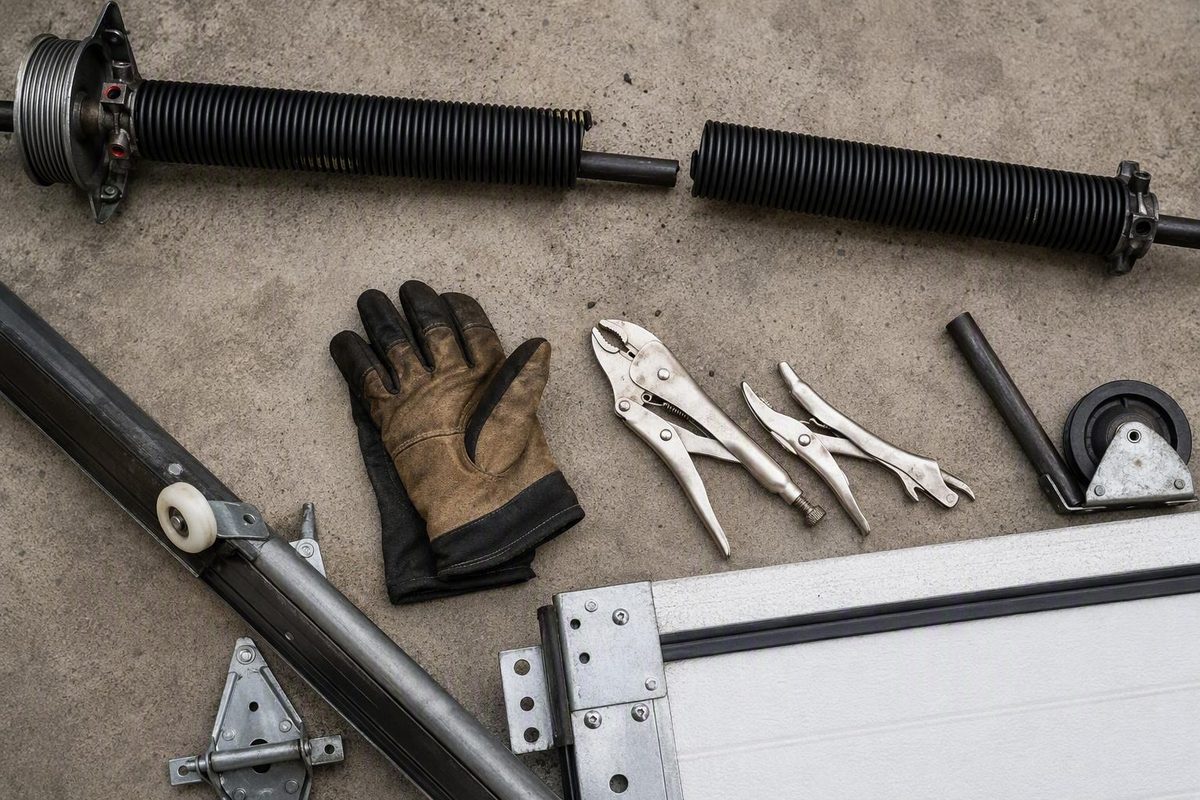
A garage door that stops moving, opens only a few inches, hangs crooked, falls rapidly, or follows a sudden bang may have a broken spring. Treat the door as potentially unstable until a qualified garage-door technician identifies the cause.
Do not test it. Stop operating the door, prevent access to the area, make only touch-free observations from a safe distance, and arrange an on-site assessment.
This article therefore takes a deliberately conservative approach: it does not offer manual-opening, stabilization, balance-testing, or repair instructions.
Start Here: The Immediate Safety Checklist
If you suspect that a garage-door spring has broken:
- Stop using every control. Do not press the wall button, remote, exterior keypad, vehicle control, or smart-home command again.
- Keep people and pets away. Prevent anyone from entering the door’s path or standing beneath it.
- Do not approach the door to retrieve property. Leave vehicles, bicycles, tools, and stored items where they are if moving them would require entering the opening, passing beneath the door, or approaching unstable hardware.
- Stay away from springs, cables, brackets, drums, tracks, and loose components.
- Do not pull the emergency release.
-
Do not lift, lower, straighten, catch, brace, or support the door manually.
-
Do not handle a loose or hanging cable.
- Call a qualified garage-door technician and report the door’s current position.
Garage-door springs counterbalance the door’s weight. If that support is lost, the door can become unusually heavy, unbalanced, crooked, or capable of rapid movement. Commercial safety guidance advises staying clear, stopping operation, and leaving spring work to a professional because the springs and connected door system can create sudden-movement, projectile, crushing, and pinch-point hazards (Precision Door’s spring-safety guide).
The appropriate immediate response depends partly on the door’s position. None of these positions should be assumed safe without an on-site assessment:
| Door position | Conservative immediate response |
|---|---|
| Closed | Leave the door untouched, stop using its controls, and use another entrance. Arrange professional assessment. |
| Partly open | Prevent access to the garage and opening. Do not pass beneath the door or attempt to raise or lower it. Request prompt on-site assessment. |
| Fully open | Keep everyone away from the opening and the space beneath the door. Do not enter the area to move a vehicle or other property. Request prompt on-site assessment. |
| Crooked or jammed | Stay clear. Do not straighten panels, tracks, rollers, or cables. Tell the technician that the door is uneven or jammed. |
| Falling or slamming | Move away immediately. Do not try to catch, brace, or support the door. Prevent anyone else from approaching. |
Commercial service guidance likewise advises against operating a heavy or crooked door and recommends keeping people, pets, and vehicles out of the opening when spring failure is suspected (Lee Company’s broken-spring guidance).
Repeatedly pressing the opener is not a useful diagnostic test. If the spring is no longer supporting the door, another attempt may strain the opener or connected hardware without establishing which component failed.
The emergency release is not a solution to lost spring support. It disconnects the door from the opener; it does not restore the spring’s counterbalancing force or make the door light enough to handle. Because the condition of the springs, cables, drums, tracks, and panels has not been established, the conservative rule is to leave the release untouched until a technician assesses the system.
If a vehicle is trapped: Arrange alternate transportation if possible. Tell the repair company that a vehicle is blocked inside and report whether the door is closed, partly open, fully open, or crooked. Do not attempt a manual opening or enter the door’s path to retrieve the vehicle.
Touch-Free Signs That a Spring May Be Broken
You do not need to touch or operate the door to collect useful information. From a safe distance, look and listen for:
- A loud bang, crash, pop, or snapping sound from the garage
- A door that will not open
- A door that rises only a few inches and stops
- An opener that hums, strains, stops, or reverses
- Crooked, uneven, or jerky movement
- One side of the door sitting higher than the other
- Rapid closing or a door that has slammed down
- Slack, detached, or hanging cables
- A visible separation in the coils of an exposed spring above the door
- A side-mounted spring that looks loose, stretched, displaced, or disconnected
- A door that appeared unusually heavy before operation was stopped
These are warning signs, not conclusive tests. Cable, drum, opener, roller, track, alignment, sensor, and other faults can produce overlapping symptoms. A visible separation in an exposed torsion spring is a strong indication of a break, but it should be observed without approaching or touching the assembly. Commercial service guidance identifies coil separation, partial opening, uneven movement, rapid closing, loose cables, and opener strain as possible spring-failure indicators (Central Oregon Garage Door’s symptom overview).
What a torsion-spring failure may look like
An exposed torsion spring generally appears as a tightly coiled spring mounted on a shaft above the door opening. If it snaps, the coils may separate and leave a visible gap along the shaft.
Some systems place the spring inside a tube or otherwise obscure it. In those systems, the break may not be visible. The absence of an obvious gap therefore does not rule out spring failure.
Do not move closer, use a ladder, or reach above the door to look for a break. If the spring cannot be seen clearly from an ordinary standing position outside the door’s path, leave the inspection to the technician.
What an extension-spring failure may look like
Extension springs generally run beside the horizontal tracks. A failed spring may look loose, elongated, displaced, hanging, or disconnected rather than showing the distinct coil separation associated with an exposed torsion spring. A nearby cable may also appear slack.
Do not inspect an attachment point, pulley, hook, bracket, or cable at close range. The useful observation is simply that something appears loose or out of position.
What to document for the technician
If it can be done without approaching the mechanism or entering the door’s path, record:
- Whether the door is closed, partly open, fully open, or crooked
- Whether the springs appear to be above the opening or beside the tracks
- The number of springs visible from a distance
- Any visible separation in an exposed coil
- Any loose or hanging cable
- Uneven panel or track alignment
- The sound heard immediately before the problem
- What the opener did on the last attempt
- Clear photographs taken from a safe location
Do not reposition the door, cable, panel, or any other component for a better photograph. Documentation is useful only if it can be obtained without entering the potentially hazardous area.
Why a Broken Spring Changes How the Door Behaves
The springs form part of the garage door’s counterbalance system. They reduce how much of the door’s actual weight must be handled by the opener or by a person during ordinary manual operation.
The opener is not a substitute for that system. It is intended to move a properly counterbalanced door, not compensate for a failed spring by carrying the unsupported load.
Loss of counterbalance helps explain several common symptoms:
- Opening only a few inches: The opener may begin moving the door but be unable to continue under the increased load.
- Humming or straining: The motor may be working against a door the spring is no longer helping to lift.
- Uneven movement: The two sides may no longer receive the intended support or cable tension.
- Rapid descent: The system may no longer control the door’s downward load as designed.
- Unusual heaviness: Disconnecting the opener would not replace the missing spring force.
- Jerking or crooked travel: Unequal forces may cause the door to shift or bind in the tracks.
A system with two springs is not necessarily functional merely because one remains intact. If one breaks, the remaining spring may provide only partial or uneven counterbalance. Commercial guidance also notes that one remaining spring in a paired system can contribute to crooked movement and abnormal loading (Ingstrup Garage Doors’ warning-sign discussion).
Continued operation may create secondary problems. The opener can be overworked, lift cables can lose tension or leave their drums, and the door can bind in its tracks. Panels, rollers, brackets, drums, and other connected hardware may also be strained. A commercial immediate-response guide specifically warns that continued operation after spring failure can damage the opener, tracks, panels, or related components (Fast Fix Garage Door’s response guide).
This is also why symptom-based diagnosis has limits. A loose cable may be a consequence of lost spring tension, or the cable may have failed independently. An opener may appear defective because it cannot move an unbalanced door, or it may have a separate fault. An on-site inspection must determine which component failed and whether other damage followed.
Torsion or Extension: Identify the System From a Distance
You may be able to identify the general spring system by its location. Do not approach the assembly or touch any component to do so.
| Feature | Torsion-spring system | Extension-spring system |
|---|---|---|
| Typical location | On a shaft or tube above the door opening | Beside the horizontal tracks, often with a spring on each side |
| Operating principle | Applies rotational force through a shaft, drums, and lift cables | Stretches and retracts through a cable-and-pulley arrangement |
| Possible visible failure clue | Separation between coils on an exposed spring | A spring that appears loose, displaced, hanging, disconnected, or overstretched |
| Possible cable clue | Lift cables may lose tension or appear out of alignment | Side cables may appear slack or displaced |
| Visibility limit | The spring may be enclosed, preventing visual confirmation | Attachment points may be difficult or unsafe to inspect from a distance |
| Components to avoid | Spring, shaft, winding hardware, drums, cables, and brackets | Spring, pulleys, hooks, cables, brackets, and mounting points |
Torsion springs generally wind and unwind on a shaft above the opening. Their rotational force is transferred through drums and lift cables near the lower corners of the door. Extension springs stretch and retract as part of a side-mounted cable-and-pulley arrangement. Both systems perform the same broad counterbalancing function (Overhead Door Company of Central Jersey’s mechanism comparison).
Some extension-spring systems include containment cables that run through the springs. Commercial spring guidance describes these cables as a way to restrain a spring if it separates, but their presence does not make close inspection or handling appropriate. Do not touch, tighten, reposition, or follow a containment cable to its attachment point (Precision Door’s spring-type guide).
Neither spring type should be treated as universally better or safer for every garage. Suitability depends on the door design, required force, available space, hardware, system specifications, and installation. A replacement must match the actual door and counterbalance configuration rather than being selected solely by appearance.
Broken Spring or Another Garage-Door Problem?
Several faults can produce similar behavior. The comparisons below are clues only, not homeowner tests or conclusive diagnoses.
| Possible problem | Touch-free clues | Important overlap |
|---|---|---|
| Spring failure | A bang followed by malfunction; visible separation in an exposed torsion spring; partial opening; unusual heaviness; crooked travel; rapid closing; opener strain | Not every failed spring makes a loud noise or leaves a visible gap. |
| Cable or drum problem | A slack, hanging, or detached cable; a tilted door; one side sitting differently; a cable visibly out of alignment | Spring failure can also cause cables to lose tension, so a loose cable does not establish which component failed first. |
| Opener problem | Motor noise without movement; stopping; reversing; intermittent operation | A functioning opener may behave similarly when a failed spring leaves the door improperly counterbalanced. |
| Track, roller, or alignment problem | Binding, jerky movement, crooked travel, a displaced roller, or a visible local obstruction | Uneven spring or cable forces may also make the door bind. Do not remove an obstruction or straighten anything while the door’s condition is unknown. |
| Sensor or control problem | Reversal or refusal to close, sometimes accompanied by an opener indicator | Reversal is not proof of spring failure and may have an electrical, control, sensor, or mechanical cause. |
| Other door damage | A visibly bent panel, damaged hinge area, or distorted section | Damage may be a cause, a result of uneven movement, or a separate fault. Do not touch or reposition the damaged area. |
A loud bang followed by immediate malfunction makes spring failure plausible, but the noise alone is not proof. Likewise, an opener that hums does not establish that its motor has failed.
The practical decision is simpler than the diagnosis:
If spring failure is plausible—or the door is heavy, crooked, unstable, partly suspended, or moving rapidly—stop using it and obtain an on-site diagnosis.
Do not lift the door or conduct a balance test to settle the question. Those actions would place the user in contact with the load and instability that the spring normally helps control.
Why Spring Replacement Is Not a Homeowner DIY Repair
Garage-door springs store mechanical energy. Releasing, retaining, or restoring that energy requires control of the spring and the connected door system. Mishandling can result in:
- Sudden spring or hardware movement
- Components becoming projectiles
- Rapid movement or falling of the door
- Crushing hazards beneath or beside the door
- Pinch points between panels, rollers, tracks, hinges, and brackets
- Unexpected cable or drum movement
- Loss of control as remaining tension changes
A snapped spring is generally replaced rather than patched. Replacement involves more than removing a visible coil and installing something that looks similar. The correct spring must be identified for the particular door, remaining tension must be controlled, the counterbalance must be restored, and connected hardware must be checked.
Homeowner involvement should be limited to touch-free observations made from a safe location. Do not:
- Release or adjust spring tension
- Wind or unwind a spring
- Remove spring, cable, or bottom brackets
- Handle a loose cable
- Move cable drums or pulleys
- Size a replacement by appearance
- Install a spring
- Convert the system from one spring type to another
- Lift or support the door
- Pull the emergency release
- Clamp the tracks
- Perform a manual balance test
Some commercial articles publish limited manual-opening, balance-testing, or track-clamping suggestions for particular situations. Those instructions are not reproduced here because the homeowner cannot establish from a distance whether the remaining spring, cables, drums, brackets, tracks, or panels can safely carry the door.
Disconnecting the opener also does not neutralize the problem. It separates the opener mechanism from the door but does not restore spring counterbalance. The door may remain too heavy, crooked, or unstable to control.
The temptation to operate the door “just once more” is understandable, especially when a vehicle is blocked or the door is partly open. Another attempt, however, does not safely identify the failed component and may add opener or hardware damage.
Spring diagnosis and replacement should therefore be handled by a qualified garage-door technician.
What Professional Diagnosis and Replacement Usually Involve
The exact service process depends on the door and spring system. At a high level, a technician will generally:
- Assess the door’s position and condition without relying on homeowner testing.
- Determine whether the spring, cable, drum, opener, track, roller, or another component failed.
- Identify the spring system and required specifications.
- Control the door and any remaining spring tension using methods appropriate to the system.
- Replace the failed spring rather than trying to patch it.
- Inspect connected hardware for damage, wear, or displacement.
- Restore the intended counterbalance.
- Check that the door travels evenly.
- Test opener operation and applicable safety features.
This is a description of the expected scope of professional service, not a replacement procedure.
Correct spring selection is door-specific
A replacement spring cannot be selected safely because it has the same general color, length, or location as the old one. Relevant variables may include:
- Door weight and geometry
- Door height and configuration
- Torsion or extension system
- Number and arrangement of springs
- Wire and coil dimensions
- Spring length and design
- Shaft, drum, cable, or pulley configuration
- Matching requirements in a multi-spring system
- Intended cycle rating
Commercial spring-selection guidance identifies door weight, height, system configuration, coil diameter, wire size, and spring length among the relevant sizing considerations.
Do not approach a broken or tensioned assembly to take measurements. Give the technician the door model or existing service records if they are readily available somewhere outside the hazard area; otherwise, allow the technician to determine what information is needed on site.
Related components to inspect
Ask whether the service inspection includes:
- Lift cables
- Cable drums or pulleys
- Spring and cable brackets
- Tracks and track supports
- Rollers and hinges
- Door panels
- Shaft and bearing components
- Opener connection and operation
- Applicable safety and reversal features
The technician should distinguish secondary symptoms from separate faults. A slack cable may simply have lost tension when the spring failed, or it may be damaged and need replacement.
Should a matched pair be replaced together?
Paired replacement may make sense when two springs operate as a matched set, have similar age and use, and show comparable wear. Replacing both may also be appropriate if retaining the old spring would create an incompatible specification or improper balance.
That does not mean both springs must always be replaced. Some systems have one spring; others use multiple springs with configuration-specific requirements. The decision should follow inspection and matching rather than a universal rule.
If both springs are proposed, ask:
- Do these springs form a matched operating pair?
- What is the condition of the remaining spring?
- Are their age and use histories likely to be similar?
- Would replacing only one create a specification or balance mismatch?
- Will the replacements have compatible specifications and cycle ratings?
- Is paired replacement technically required for this system or being recommended because of condition and wear?
What to request in the estimate
Ask for an itemized written estimate identifying:
- The proposed spring or springs
- Relevant specifications and rated cycles
- Related cables, drums, brackets, or other hardware
- Labor
- Service-call charges
- Emergency or after-hours fees
- Disposal or other listed charges
- Applicable taxes
- Available parts and labor warranty terms
Do not assume that every provider includes the same services or offers the same warranty.
After the work, ask the technician to explain or demonstrate:
- Whether the door is properly counterbalanced
- Whether it travels evenly
- Whether cables remain aligned on their drums or pulleys
- Whether the opener operates without abnormal effort
- Which safety features were tested
- The specifications and rated cycles of the installed spring or springs
- Whether other worn components were found but not replaced
Keep the invoice and installed spring specifications with the door or opener records. That information can make later service and quote comparisons more precise.
Cost, Service Life, and Reducing Future Risk
There is no dependable national price that applies to every broken garage-door spring. Estimates can vary according to:
- Geographic location
- Spring type and exact specification
- Door size, weight, and geometry
- Number of springs
- Matching requirements
- Specialty or proprietary hardware
- Cable, drum, track, panel, or opener damage
- Labor rates
- Service-call charges
- Emergency or after-hours timing
- Accessibility and door position
- Taxes, disposal, and other listed charges
The more useful approach is to obtain local, itemized quotes and confirm that each provider is proposing a technically comparable repair.
Understand spring life in cycles, not promises
Garage-door spring life is commonly expressed in cycles. One cycle means one complete opening and closing of the door (Garage Door Medics’ spring-life explanation).
A manufacturer’s rated cycle life is more informative than a promise that a spring will last a fixed number of years. A frequently used door consumes cycles more quickly than one opened only occasionally.
Actual service life can vary with:
- The product’s cycle rating
- Frequency of use
- Correct sizing and matching
- Door weight and configuration
- Installation quality
- System balance
- Corrosion and moisture exposure
- Environmental conditions
- Maintenance
- Damage or abnormal operation
Commercial sources publish differing cycle and calendar-life estimates, so no single figure should be treated as universal. Ask for the proposed spring’s rated cycles in writing and consider how often the door is actually used.
Why springs may fail
Repeated opening and closing subjects springs to ongoing fatigue. Commercial service guidance also commonly identifies corrosion or moisture, incorrect sizing, installation problems, and an imbalanced door system as possible contributors.
Temperature changes are frequently mentioned in commercial garage-door articles, but the available evidence does not establish that cold weather directly causes most spring failures. A break during cold weather may reflect accumulated fatigue, corrosion, system condition, or several interacting factors rather than temperature alone.
Maintenance can reduce uncertainty, not eliminate failure
Follow the door or spring manufacturer’s instructions for inspection and lubrication. Products and systems may require different materials or schedules, so a universal interval is not appropriate.
Routine observation may reveal corrosion, unusual noise, uneven movement, or other changes. A professional inspection may also identify balance, cable, roller, or hardware problems that are not obvious from a distance.
Maintenance has clear limits:
- Lubrication cannot reconnect a snapped spring.
- It cannot reverse metal fatigue.
- It cannot correct an improperly specified spring.
- It cannot guarantee that a spring will not fail unexpectedly.
- Inspection does not make spring adjustment suitable for homeowner DIY work.
If a spring has already snapped, the next step is diagnosis and replacement—not lubrication or a trial run.
Quote-comparison checklist
Before selecting a proposal, compare:
- Spring type and full specifications
- Rated opening-and-closing cycles
- Whether one or multiple springs are proposed
- The technical reason for paired replacement, if recommended
- Inspection of cables, drums, tracks, rollers, panels, and opener
- Parts and labor charges
- Service-call and emergency fees
- Taxes and additional charges
- Available parts warranty
- Available labor warranty
- Documentation of the installed spring specifications
Frequently Asked Questions
What should I do if my car is trapped behind a garage door with a suspected broken spring?
Arrange alternate transportation if possible and tell the repair company that a vehicle is blocked. Report whether the door is closed, partly open, fully open, or crooked, along with any visible coil separation, loose cable, recent bang, or unusual opener behavior.
Do not enter the door’s path, pull the emergency release, lift the door, or try to create enough clearance to drive underneath. A trapped vehicle is inconvenient, but it does not establish that the unassessed door is safe to handle. Request prompt on-site assessment.
Should I pull the emergency release if the garage-door spring is broken?
The conservative rule is no: when spring failure is suspected, leave the emergency release untouched until a qualified technician assesses the door.
The release disconnects the opener but does not restore the missing counterbalance. Because the door may remain unusually heavy, crooked, or unstable, pulling the release is not a safe diagnostic test or substitute for professional assessment.
Does a loud bang always mean the garage-door spring snapped?
No. A loud bang followed by failure to open, partial movement, visible coil separation, rapid descent, or slack cables makes spring failure plausible, but the sound alone is not definitive.
Other door or hardware faults can also produce sudden noise. Stop using the door, make only touch-free observations, and let a technician determine whether the spring, cable, drum, track, opener, or another component failed.
Do both garage-door springs need to be replaced when only one breaks?
Not always. Replacing both may be reasonable when they form a matched pair with similar specifications, age, use, and wear. It may also be appropriate when one old and one new spring would not provide compatible balance.
The decision depends on the system configuration and the remaining spring’s condition. Ask whether the springs form a matched system, why paired replacement is recommended, and how the proposed specifications will preserve correct counterbalance.
How much does professional garage-door spring replacement cost?
Cost depends on local labor rates, spring type and specification, door size and weight, the number of springs, specialty hardware, service-call or emergency fees, and any related damage. Commercially published ranges should not be treated as guaranteed market prices.
Request itemized local quotes showing the spring specifications, rated cycles, number of springs, related hardware, labor, additional fees, taxes, and available warranty terms. Confirm that each provider is quoting a comparable repair before choosing by price.
The Bottom Line
A suspected broken garage-door spring is a reason to stop, isolate the area, and arrange professional assessment—not an invitation to test the door.
Tell the technician the door’s position, where the springs appear to be located, whether a coil gap or loose component is visible from a safe distance, what sound occurred, and how the opener behaved on its last use. Do not approach the mechanism or operate the door to gather more information.
An on-site diagnosis should determine whether the spring or another component failed, identify any related damage, and establish the correctly matched repair.