
Lubricate Garage Door Springs Without Mistaking Damage for Noise
Find the manufacturer-approved lubricant, follow a controlled spring maintenance sequence, and recognize damage or persistent noise that needs a technician.
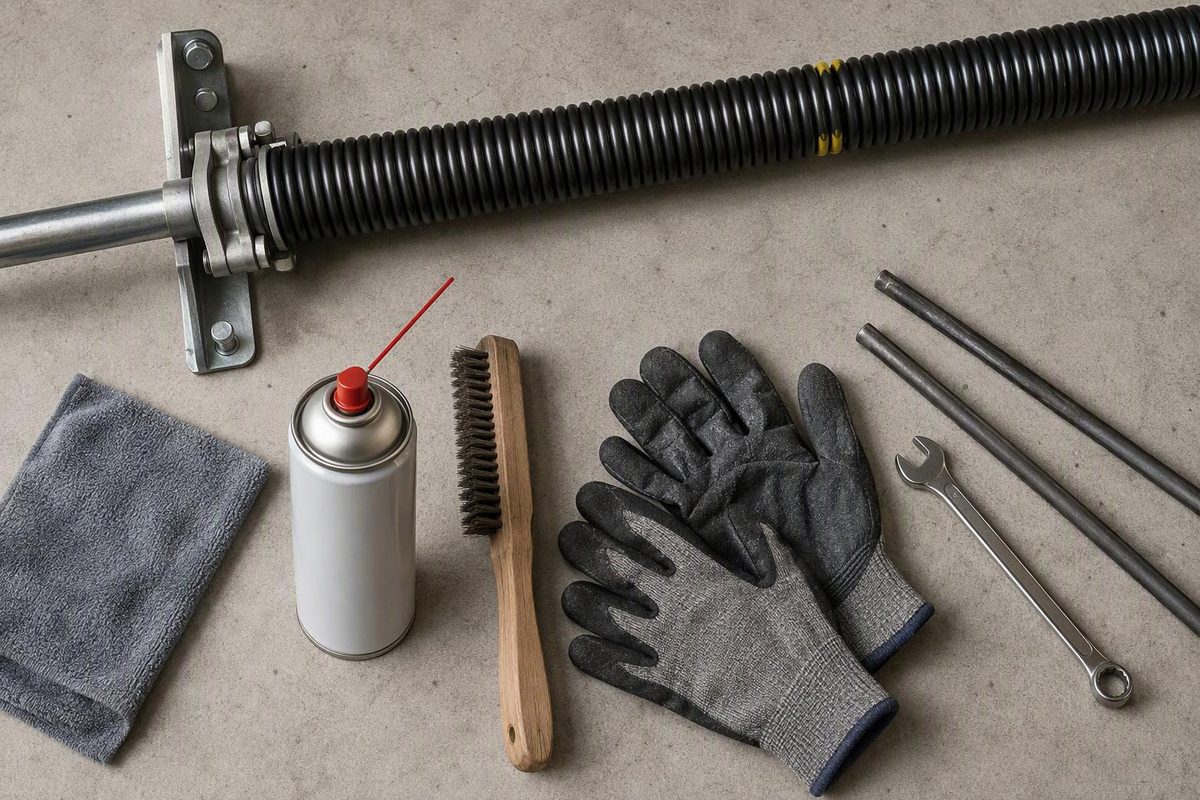
Garage door spring lubrication can reduce ordinary squeaking and friction between coils, but it cannot repair a broken spring or correct an unbalanced door. For an intact door that operates normally, use the lubricant specified by the door manufacturer and apply a thin coating—not a soaking. Stop if the spring looks damaged, the cables are frayed or the door moves abnormally.
DASMA’s safety guidance says spring squeaking does not necessarily indicate a fault and recommends a garage-door spray lubricant as an initial maintenance step. Persistent noise needs professional inspection. The distinction is between routine squeaking on a normally operating door and noise accompanied by damage or a change in movement.
Choose the door’s condition, spring system and manual guidance to see whether lubrication is the next step.
Check the Manual Before Spraying
For exposed torsion springs on a normally operating door, confirm the approved lubricant and application instructions first. Another manufacturer's recommendation is not approval for your door.
This check does not certify the door is safe. Switching off the opener does not release spring tension.
Sources: DASMA safety tips; Clopay steel-door maintenance manual; Raynor lubrication guidance; Chamberlain emergency-release warning. Model-specific instructions take precedence.
Damage or Abnormal Movement Means Stop
Inspect from a safe position without touching or manipulating the spring hardware. A visual check helps you decide whether to stop; it does not establish that every part of the spring system is sound. Do not operate a suspect door just to complete the check.
Stop rather than lubricate if you see or have noticed:
- A broken spring, cracks, deformation or significant corrosion.
- Frayed or damaged lift cables.
- A crooked, jerky or binding door, or rollers leaving the track.
- A door that suddenly feels unusually heavy, slams or opens only a few inches.
Clopay’s spring guide identifies visible damage, uneven movement and difficulty lifting as warning signs. Its steel-door maintenance manual specifically warns against operating a door with a broken spring or one that is too difficult to move, and lists worn or frayed cables for professional attention.
These symptoms take priority over a lubrication schedule. A door due for its regular maintenance is not a candidate for routine spraying if it has also become crooked or difficult to move. Likewise, lubricant is not a test for whether a visibly damaged spring can keep working.
If a spring appears broken, leave a fully closed door shut. Do not pull the emergency release to investigate an elevated or suspect door: Chamberlain warns that a door with weak or broken springs may fall rapidly and without warning. See what to do when a garage door spring breaks.
A squeak by itself does not tell you to adjust spring tension. It also does not prove that the spring is the source of every sound. If you cannot distinguish ordinary squeaking from a problem accompanied by abnormal movement, have the system inspected rather than trying successive sprays.
The Spring System Determines What You Can Lubricate
Identify the spring system before applying a product. Instructions for exposed torsion coils do not automatically apply to springs beside the tracks or to a mechanism hidden inside a housing.
| Spring System | What to Check | Lubrication Boundary |
|---|---|---|
| Exposed torsion | Coils around a shaft, usually above the opening | Follow the door’s instructions for exposed coils |
| Extension | Springs beside the horizontal tracks | Follow model instructions; visually check containment cables |
| Enclosed | Springs within an assembly or housing | Do not remove covers for generic lubrication |
For an exposed torsion spring covered by Clopay’s steel-door maintenance instructions, lubrication goes along the full spring length to reduce friction between coils. That direction describes the surface to coat; it is not permission to rotate the spring, separate the coils or loosen the hardware supporting it.
Extension springs typically run beside the horizontal tracks. Follow the model’s maintenance instructions and check visually for containment cables running through the springs. DASMA says missing containment cables require a safety inspection. Do not treat that finding as another item to address with lubricant.
For an enclosed spring system, use that system’s instructions or have a technician service it. Do not remove covers or dismantle the assembly to make it resemble an exposed spring shown in a general maintenance guide. If you cannot identify the system without taking something apart, stop at identification and get the correct instructions.
Use the Door Manufacturer’s Lubricant Specification
Start with the door manual, not simply a can marked “multipurpose.” Clopay specifies its Garage Door Pro Lube or a synthetic lubricant in its steel-door manual. Raynor recommends a light silicone-based oil. Those recommendations belong to their respective guidance; neither establishes approval for every door or spring assembly.
For a door whose instructions allow it, a silicone-based garage-door spray is a straightforward choice. Do not substitute a penetrating spray or pack the coils with thick grease without checking the manufacturer’s approval. The practical question is whether the exact product meets your door’s instructions, not whether its label mentions metal, hinges or general lubrication.
Be precise about WD-40. Clopay’s spring guide advises against WD-40 without identifying a formula, while the brand also sells a separate WD-40 Specialist Silicone lubricant. The silicone product’s existence is not proof that your door manufacturer approves it. A brand name alone is not enough to resolve the choice.
If the manual names a lubricant, match that product or the permitted lubricant type. If the instructions are missing or unclear, confirm the recommendation before spraying. Do not convert a recommendation from another manufacturer into approval for your own system.
The cited guidance does not provide one universal dose in milliliters or seconds of spraying. A light coating is the instruction here, not a measured quantity that applies to every spring length and spray nozzle. More lubricant is not a substitute for identifying damage or investigating noise that persists after a proper application.
Apply a Light Coating With the Door Stationary
Proceed only if the door is intact, operates normally and its manual permits this maintenance. Switching off the opener does not release the energy stored in the springs. Spring adjustment and disassembly remain specialist work even when electrical power is disconnected.
Close the Door and Disconnect Opener Power
Close the door fully and disable the opener’s power. Follow the opener manual to disconnect electrical power and any backup battery; Chamberlain’s maintenance warning specifies both. Check your opener’s instructions rather than assuming that unplugging its main supply addresses every power source.
Leave the door stationary while spraying and keep children, pets and other users away. Do not disconnect the trolley merely to lubricate springs. This procedure is for a door that can already close normally; it is not a reason to force a binding door closed or operate one with a suspected broken spring.
Reach the Spring Without Manipulating It
Wear safety glasses and gloves. Use stable access equipment without overreaching. If you cannot reach the spring safely, leave the task to a technician. Being able to direct spray toward the spring is not enough if doing so requires an unstable position or contact with the hardware.
Follow the spray label’s ventilation and ignition precautions. Prepare access before opening the can so that you are not repositioning equipment while trying to control the spray. Keep the maintenance limited to the surfaces your door instructions identify.
Coat the Specified Surfaces, Not the Hardware Around Them
Apply a light coating to the specified spring surfaces. For an exposed torsion spring covered by Clopay’s instructions, that means the full coil length. Keep hands clear; do not rotate the spring, pry coils apart or loosen any fastener.
The goal is to lubricate the permitted surface, not to work lubricant into the assembly by hand. If access to part of the spring would require moving a component or removing a cover, do not extend this routine procedure into disassembly.
Control overspray and keep lubricant off the floor and unrelated components. Do not spray the track running surfaces or roller tires. The CRC lubrication guide recommends a light application and eye protection; Clopay also specifies lubricating roller bearings, not tires. A door maintenance guide may include several lubrication points, but that does not make every nearby surface a lubrication point.
Clear the Work Area Before Cycling the Door
Clear tools and access equipment before restoring power. If the door remains safe to operate, run it through a few normal opening-and-closing cycles to distribute the lubricant, as Raynor recommends. Keep this separate from spraying: the application takes place with the door stationary, and the operating check follows after access equipment is removed.
Stop if movement becomes abnormal. Do not keep cycling a door that begins to bind, travel unevenly or behave differently from its normal operation. A quieter sound does not cancel a movement problem, and a movement problem is not a reason to add another coat.
Six Months Is a Reference, Not a Universal Schedule
Use your model’s maintenance schedule. Every six months is a useful reference: Raynor specifies that interval, and Clopay’s steel-door manual calls for lubrication at least twice yearly. These are manufacturer recommendations, not a single schedule established for all garage doors.
Inspect visually between services rather than waiting for noise. The inspection and the lubrication schedule answer different questions: one checks for visible warning signs, while the other tells you when routine maintenance is due. Finding damage between scheduled services means stopping for inspection, not moving the next lubrication date forward.
For a door with unknown maintenance history, first establish its condition and find the correct instructions. An overdue service does not explain away a heavy, crooked or binding door. For an enclosed system or a model with different requirements, the specific manual takes precedence over the six-month reference.
Persistent Squeaking Needs Inspection, Not More Spray
If squeaking persists after a proper light application, do not keep adding spray or attempt to change spring tension. Have the door system inspected. DASMA’s guidance supports lubricant as an initial response to spring squeaking, with professional inspection when the noise persists.
Keep the distinction between sound and function clear. Ordinary squeaking on an otherwise normally operating door may be a maintenance issue. Persistent noise after approved lubrication needs a different response, and visible damage or abnormal movement requires stopping regardless of how much noise the door makes.
Lubrication is routine maintenance; spring adjustment is specialist work. Do not loosen spring hardware, alter tension or dismantle an assembly to chase a remaining squeak. The endpoint of this task is a light, approved application followed by normal operation—not repeated spraying until a fault seems less noticeable.