
How Much Does a Garage Door Weigh? The Exact Model Matters
Compare steel garage-door weight examples by size, understand why construction matters, and find your door’s actual weight without unsafe spring work.
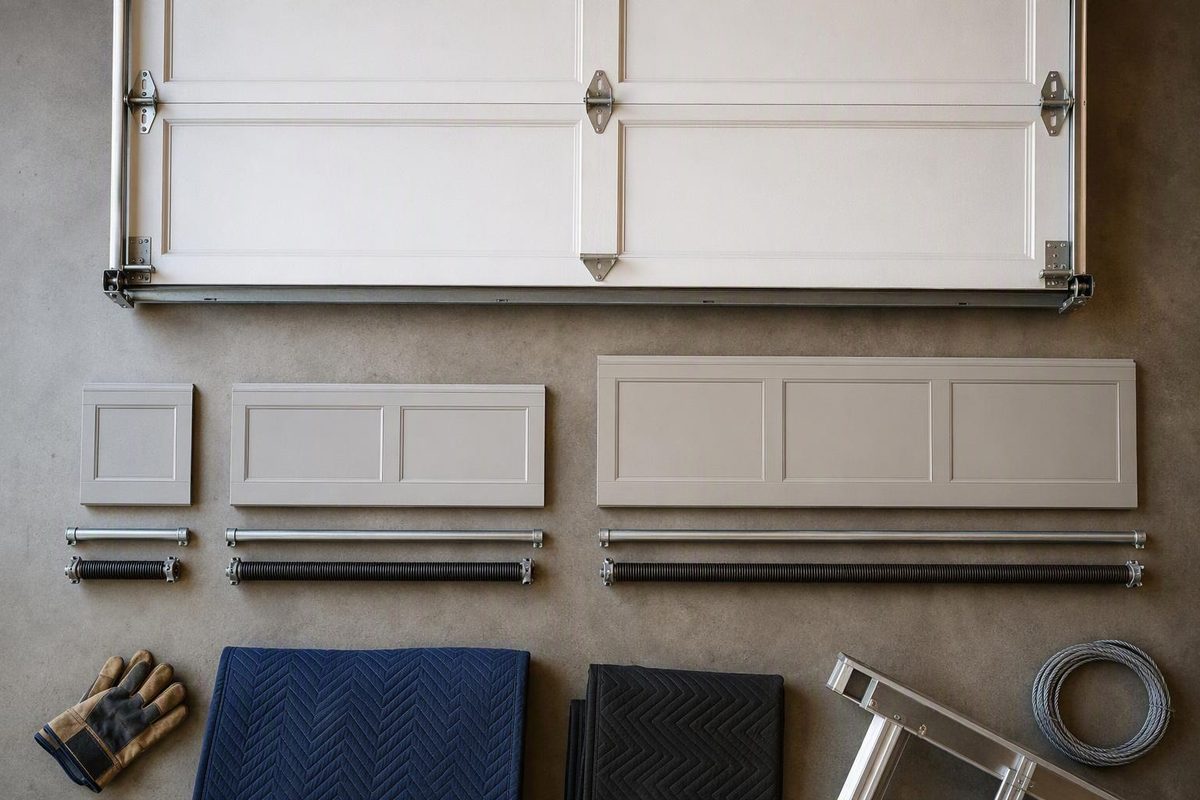
For a rough reference, published examples of 8- or 9-foot-wide, 7-foot-high sectional steel garage doors weigh about 80–130 pounds, while 16 × 7-foot steel examples span roughly 125–260 pounds. These are examples, not limits: insulation, steel thickness, windows and reinforcement change the answer. Veteran Garage Door’s weight chart and DDM Garage Doors’ recorded examples illustrate that variation.
The important distinction is total door weight versus the effort needed to lift it. Working springs counterbalance the door; a door that feels light by hand can still weigh hundreds of pounds. A door that suddenly feels heavy needs diagnosis—not a guess at its weight. Clopay’s spring guidance explains the counterbalance function and warning signs.
Steel garage-door weight examples by size
The table below summarizes entries in Veteran Garage Door’s installer chart. Insulated examples include different constructions, including steel-backed doors. Figures are rounded to the nearest pound and are not spring-selection specifications.
| Door size, width × height | Non-insulated steel examples | Insulated steel examples |
|---|---|---|
| 8 × 7 ft | 79–84 lb | 87–114 lb |
| 9 × 7 ft | 85–91 lb | 95–127 lb |
| 16 × 7 ft | 151–164 lb | 168–219 lb |
| 16 × 8 ft | 184–210 lb | 204–253 lb |
Source: Veteran Garage Door’s published chart. Your door can fall outside these examples.
For help identifying dimensions, see our garage-door sizes and measurement guide. Dimensions narrow the possibilities; they do not identify the weight on their own.
Why doors of the same size weigh differently
Construction matters as much as size. In a 2007 technical article, DDM reported two 16 × 7-foot insulated steel sandwich doors, each with one reinforcing strut, weighing 126 pounds and 260 pounds, respectively. That is why a generic “insulated double door” estimate is too broad for ordering springs.
Wood doors vary substantially too. In the same article, DDM reported 16 × 7-foot wood-panel doors with three reinforcing struts weighing 240–250 pounds for some newer, lighter constructions and 350–360 pounds for some older constructions with thicker panels, wider rails and heavier struts. These are historical installation examples, not specifications for a current model. DDM’s comparison explains why weight calculators are only approximations.
When comparing doors, record the full configuration: material, panel construction and thickness, insulation, glazing and attached reinforcement. “Steel” or “wood” alone is not enough.
How to find your door’s actual weight
Start with identification, not lifting:
- Look for a manufacturer label on the inside of the closed door. Photograph the model, serial number and any product-identification number you can safely reach. Check the original invoice or installation paperwork too. Do not move a damaged door just to expose a label.
- Ask the manufacturer or original installer for the weight of that exact size and configuration. DDM notes that model, serial and PID numbers can help determine weight for Clopay, Ideal and Holmes doors. Its identification guide shows common label locations.
- Report any modifications. Added insulation, glazing or reinforcement must be accounted for rather than assuming the original specification still describes the door.
- If identification is inconclusive, have a qualified door technician verify the weight. Weighing must account for spring assistance and opener interference. Simply pulling the emergency release does not remove the springs’ contribution. DDM’s weighing guidance illustrates why this is not a straightforward bathroom-scale check. Do not loosen springs, cables or bottom brackets to obtain a reading; these stored-energy components require specialist handling.
For replacement torsion springs, weight is only part of the specification: door height, cable drums and track geometry also matter. DDM’s sizing guidance identifies these inputs. Do not order springs from the table above.
If you are asking because the door feels heavy
A properly balanced door should be relatively easy to lift manually. New heaviness, jerky travel or difficulty lifting can indicate spring trouble, according to Clopay’s spring guidance.
Stop operating a heavy, crooked, slamming or visibly damaged door. Do not pull the emergency release while it is open or partly open: an unbalanced door can fall. Genie requires the door to be closed before a balance check and directs spring and cable repairs to a trained service person. Genie’s balance and safety guidance explains these boundaries; Clopay’s installation safety instructions also warn against operating damaged doors or loosening tensioned hardware.
If a spring appears broken, follow our broken-spring guidance by door position. The useful next step is restoring safe balance—not fitting a stronger opener to overcome the problem.