
What Determines Whether a Garage Epoxy Floor Lasts Months or Years
Published estimates span roughly 5–20 years, but they aren't verified averages for residential garages—so treat the range as guidance.
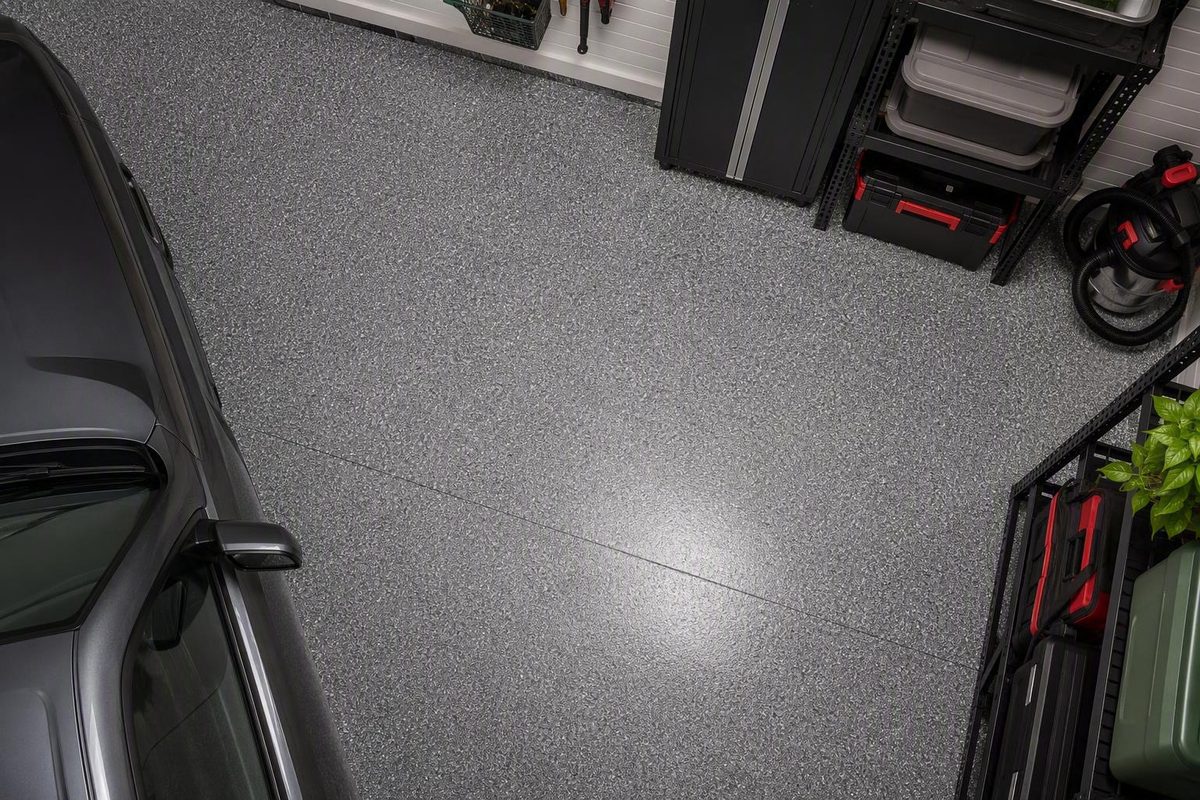
A garage epoxy floor can remain serviceable for years, but there is no dependable expiration date for every installation. Slab moisture, concrete condition, preparation, coating specifications, curing, traffic, sunlight, abrasion, and maintenance are more useful for judging a particular floor than one universal number.
The short answer: 5–20 years is an estimate, not a promise
Published estimates from commercial flooring businesses collectively span roughly 5–20 years, but they are not independently verified averages for residential garages. Surface Solutions USA gives a 10–20-year estimate for commercial and industrial epoxy floors, qualified by system thickness, use, traffic, chemical exposure, and maintenance. Its estimate is a contractor’s general guidance, not a garage-specific performance study.
CPC Floor Coatings gives a shorter estimate of 5–10 years for most industrial applications. It also says some residential coatings have reached 30 years, but it provides no supporting dataset. That 30-year figure is better treated as an exceptional reported outcome—not a normal expectation or guarantee. CPC explains its estimates and the factors it associates with coating life.
Garage-owner reports show why the range is so wide. In one discussion, owners describe coatings peeling in roughly six months to a year, a five-year floor still performing well, and a 10-year installation whose base coat reportedly remained intact even though its clear finish had dulled. Those anecdotes involve different products, slabs, preparation methods, climates, traffic, and topcoats, so they cannot establish a typical lifespan. The Garage Journal discussion records the varied owner experiences.
The practical answer is to use 5–20 years only as a broad discussion range. A coating over dry, sound, properly prepared concrete has a different risk profile from one installed over retained sealer, contamination, moisture, weak concrete, or a failing previous coating. Daily parking and workshop use also create different wear patterns from occasional vehicle storage.
An epoxy floor has two lifespan clocks
An epoxy floor can look old before it loses its bond. Separate its service life into two clocks:
- Cosmetic life: How long the exposed finish stays glossy, uniform, and relatively free of scratches, dull patches, fading, or chalking.
- Adhesion life: How long the epoxy base remains securely bonded to the concrete.
Tires follow the same paths, grit accumulates near the door, tools fall around workbenches, and carts repeatedly cross narrow routes. That gradual surface wear is different from an installation that develops early peeling or delamination.
One garage owner reported that a floor’s base coat had not failed after 10 years, although the clear coat had dulled and was due for refreshing. This is an anecdote, not a predicted service life, but it illustrates the distinction between finish wear and bond failure. The owner’s account appears in the Garage Journal discussion.
Sun exposure creates another cosmetic concern. Regular ultraviolet exposure can fade epoxy or cause its binder to chalk and become powdery. In a garage, the threshold and the area reached by sunlight through an open door may age differently from the shaded interior.
When the underlying system remains sound, a worn finish does not automatically require complete removal. Surface Solutions USA reports that an existing epoxy topcoat can sometimes be sanded and recoated with a compatible urethane or polyaspartic finish. That option depends on evaluating and preparing the existing system correctly.
What shortens—or protects—an epoxy floor’s service life
Premature deterioration rarely comes down to “cheap epoxy” or “too much traffic” alone. Six variables interact.
-
Slab condition. Loose, weak, cracked, or spalled concrete does not provide a dependable foundation. Deteriorated concrete must be evaluated and repaired rather than hidden beneath another coating.
-
Moisture. Moisture moving through concrete can weaken the coating-to-slab bond. A slab that looks dry may still require evaluation, especially if it is on grade or has a history of dampness.
-
Surface preparation. Oil, grease, dust, curing compounds, sealers, and poorly bonded old coatings can prevent a new system from attaching to sound concrete. Preparation must also create the surface profile specified for the selected product.
-
Coating-system design. A single consumer coat and a primer-plus-industrial-finish system are materially different assemblies. Primer requirements, layer compatibility, dry-film thickness, decorative broadcasts, and protective topcoats can all affect performance. Thickness alone does not determine lifespan.
-
Application and curing. Incorrect component ratios, incomplete mixing, unsuitable temperature or humidity, and premature traffic can compromise the result. One industrial epoxy data sheet specifically warns that improperly activated material can produce soft spots.
-
Garage exposure. Tires, carts, machinery, dropped tools, tracked-in grit, spills, and sunlight concentrate wear in particular zones. Maintenance can reduce avoidable abrasion, but it cannot repair a failed bond beneath the coating.
New concrete needs both time and acceptable substrate conditions. The two cited manufacturers specify minimum curing periods of 28 and 30 days, respectively, but neither treats slab age alone as proof that the concrete is ready. Their requirements also address moisture, soundness, cleanliness, previous coatings, and sealers.
Before coating a garage floor:
- Assess slab moisture using a method appropriate to the selected system.
- Repair loose, spalled, or otherwise unsound concrete.
- Determine whether a sealer or curing compound is present and remove it as required.
- Test previous coatings and remove material that is weak or incompatible.
- Remove oil, grease, dust, and other contaminants.
- Create the surface profile required by the coating manufacturer.
- Mix each component in the specified ratio and for the stated time.
- Apply the required primer, coats, and dry-film thickness.
- Protect the floor from traffic, vehicles, water, and contamination throughout curing.
A coating contractor identifies ASTM F2170 as the reference for in-situ relative-humidity testing, which uses probes placed in the concrete. Testing can inform product selection and moisture-mitigation decisions, but it does not guarantee successful adhesion. Nor can bubbles, peeling, damp areas, or white residue prove moisture failure by appearance alone. Good Boy Coatings discusses the test method and possible moisture-related symptoms.
Preparation should follow the slab’s condition and the selected system rather than a universal slogan. The International Concrete Repair Institute defines adhesion as arising from molecular forces, mechanical interlocking, or both. It lists abrasive preparation methods such as shotblasting and characterizes acid etching as typically used when no alternative preparation method is available, but it does not prescribe one method for every garage. ICRI also warns that unremoved amine blush on an epoxy film can interfere with adhesion of a subsequent coat.
Not every product labeled epoxy is the same floor
“Epoxy floor” can describe materially different formulations and complete systems. These two products demonstrate the range of specifications; they do not provide a controlled longevity comparison.
| Cited system and intended setting | Specified dry-film thickness | Substrate and system requirements | Vehicle traffic |
|---|---|---|---|
| EpoxyShield water-based garage coating; sound residential garage concrete | 3.0–3.5 mils per coat | Concrete cured at least 28 days; no moisture problem, curing agents, or sealers; weak previous coatings must be addressed | 3 days |
| 6500 System 100%-solids industrial epoxy; heavy foot and rubber-tired vehicle traffic | 16 mils for the high-gloss finish | Concrete cured at least 30 days; required primer on bare concrete; persistent moisture prevents coating | 48–72 hours |
The stated return-to-vehicle times apply under each manufacturer’s application and curing conditions. They do not indicate how many years either coating will remain serviceable, and neither data sheet supplies a service-life figure.
The comparison also does not prove that the 16-mil industrial finish will last a particular number of years longer than the thinner garage coating. Nor does it show that professional installation always outlasts careful DIY work. Product selection matters, but substrate assessment, preparation, mixing, application, and curing still determine whether the system reaches its potential.
Estimate your risk by how the garage is used
Instead of assigning unsupported year ranges, match the garage’s use to its likely wear mechanisms.
| Garage use | Dominant concerns | Areas to inspect |
|---|---|---|
| Occasional parking in a shaded, dry garage | Limited tire-path wear and tracked-in grit | Tire contact points, entrance, isolated spill areas |
| Daily vehicle parking | Repeated tire-path loading, grit, and fluid drips | Tire lanes, parking stops, threshold |
| Workshop with carts, tools, and spills | Scratches, impacts, chemical exposure, abrasive debris | Workbench zones, cart routes, tool-drop areas |
| Heavy equipment or frequent wheeled loads | Concentrated loading and heavier abrasion | Turning points, equipment paths, loading zones |
Treat direct sunlight as a separate exposure factor regardless of use category. The threshold and other regularly sunlit sections may fade or chalk while the rest of the floor remains glossy.
A lightly used floor over dry, sound, well-prepared concrete may remain serviceable longer than a heavily used workshop floor exposed to grit, impacts, wheeled loads, spills, and sunlight. That is a direction of risk, not a calculation of years gained or lost.
Wear is rarely uniform. Inspect tire paths, the garage-door threshold, sunlit strips, workbench areas, equipment routes, and places where fluids are stored or transferred. These concentrated zones may reveal deterioration before the open center of the floor does.
Use the failure pattern to choose the next step
A symptom can point you toward the next inspection, but it rarely proves the cause by itself.
| Symptom | Possible interpretation | Sensible next step |
|---|---|---|
| Dirt, haze, or general loss of gloss | Surface contamination or ordinary finish wear | Clean with a suitable nonabrasive method, then inspect again |
| Scratches or localized dulling with a firmly bonded base | Cosmetic wear in the exposed finish | Identify the system and evaluate preparation for a compatible refresher coat |
| Fading or powdery chalking near sunlight | Possible UV-related degradation | Determine how far the damage extends and whether a compatible protective recoat is practical |
| Bubbles, peeling, delamination, hollow-sounding areas, or bond loss | Possible moisture, contamination, weak concrete, sealer, poor preparation, or incompatibility | Diagnose the slab and surrounding bond before applying more coating |
| Soft or tacky spots | Possible mixing, activation, curing, or contamination problem | Identify the product and installation conditions; do not simply cover the area |
| Persistent dampness or white residue | Possible moisture movement through the slab | Investigate moisture conditions rather than assuming a surface-only defect |
| Isolated chip or impact crater | Local mechanical damage | Check whether the surrounding coating and concrete remain sound before choosing a patch |
| Widespread peeling or bond loss | Systemic adhesion or substrate problem | Determine the failure depth and likely cause before deciding on removal and replacement |
Bubbles, peeling, hollow areas, dampness, or white residue can be consistent with moisture trouble. The same symptoms may also arise from retained sealer, contamination, weak concrete, inadequate preparation, mixing errors, or incompatible layers. Testing and examination are needed before selecting a repair.
Treat an isolated impact chip differently from widespread delamination.
To preserve a sound installation:
- Remove sand and grit before tires or carts grind it into the finish.
- Avoid rough brushes and abrasive pads unless the coating manufacturer calls for them.
- Clean spills promptly with products compatible with the coating.
- Inspect concentrated wear zones instead of judging only the center of the floor.
- Record the original product, slab preparation, moisture results, layer specifications, installation date, cure conditions, repairs, and later recoating.
Do not judge an epoxy garage floor by installation date alone. A dull finish may need cleaning or a compatible recoat. Peeling, bubbles, soft spots, persistent dampness, or widespread bond loss call for diagnosis of the slab and coating system before more material is applied.