
Clear Epoxy for a Garage Floor: Check the Slab Before You Buy
Clear epoxy can protect bare garage concrete, but it won't hide repairs. Check slab condition, sunlight, traction, coverage and vehicle-ready cure times.
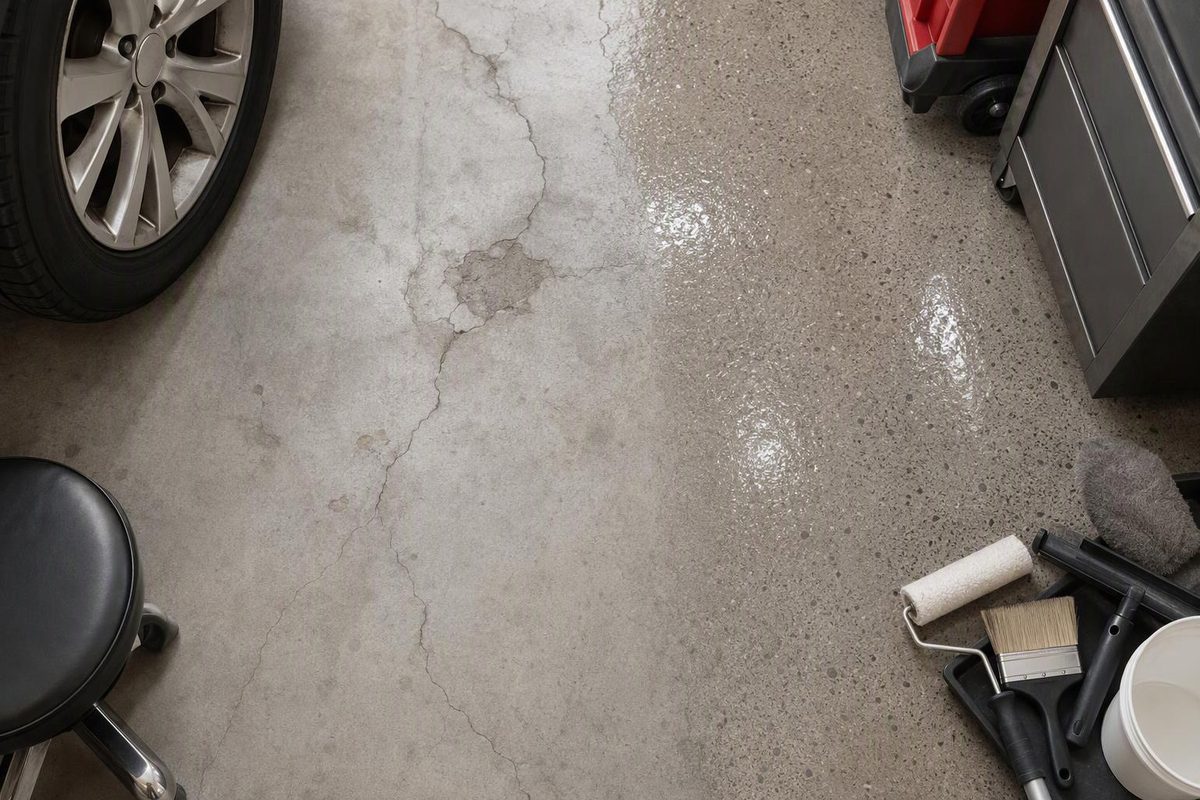
Clear epoxy can work directly over a bare concrete garage floor—if the product permits that use and the slab is properly prepared. It is a sensible choice when you want a protective, glossy surface while keeping the concrete visible. It is not a way to hide oil marks, mismatched patches or cracks.
For example, Rust-Oleum’s EpoxyShield Premium Clear kit, SKU 292514, is approved for coated or bare concrete and vehicle traffic. Its technical sheet limits use to enclosed garages without direct sunlight. That is a product-specific approval, not permission to use any clear resin on a parking floor. Product details · Technical data
Start with what you want to keep visible
| Your floor and goal | Better starting point |
|---|---|
| Bare concrete whose appearance you like | A clear floor epoxy specifically approved for bare concrete and vehicle traffic |
| Bare concrete with stains or contrasting repairs you want concealed | A pigmented coating system rather than clear alone |
| An existing colored or flake epoxy floor | A compatible topcoat; follow the clear-coat and recoat guide |
| Concrete you want to color while retaining variation | A tested stain-and-sealer system; start with the acid-stain slab checks |
Make a small test application using the intended preparation and coating before committing to the whole garage. Include a repaired or discolored area if you have one, and inspect the cured result under your garage lighting. Confirm how to incorporate that test area into the final installation with the manufacturer.
Check the slab before choosing a kit
Walk the empty floor and mark oil contamination, peeling coatings, powdery concrete, chipped areas and damp spots. Then use the selected product’s instructions to decide whether each condition can be corrected.
- Possible sealer: Drip water onto several areas. Beading is a warning that a sealer may interfere with adhesion; it is not a reason to coat over it unchanged.
- Possible moisture: SKU 292514’s instructions describe taping all four edges of a 2-by-2-foot, 4-mil plastic sheet to bare concrete for 24 hours. Droplets underneath or darkened concrete mean you need the manufacturer’s moisture-treatment guidance before coating. Treat this as a screening check, not a guarantee against future moisture problems.
- Weak concrete: Loose or chipped material must be addressed before coating.
- New concrete: This product requires at least 28 days of curing before application. Reaching that age does not override its requirement for a completely dry surface.
These checks and limits come from the product’s technical sheet.
Stop if the slab remains damp, sheds material, or has an unidentified coating. Resolve the substrate problem before buying enough epoxy for the floor. For the wider preparation sequence, use the garage epoxy installation plan.
Decide about sunlight and wet traction
Check where sunlight reaches when the door is open—not just whether the garage has a roof. SKU 292514’s technical sheet excludes direct-sun areas. If retaining a colorless appearance matters, obtain approval for the actual exposure rather than assuming “clear” means UV-stable.
Gloss also needs a traction decision. The same sheet warns that coated concrete can become slippery when wet and provides an anti-skid additive. Choose the manufacturer-approved texture before installation, especially where wet tires or shoes cross the floor. Do not omit it solely to maximize clarity. Sunlight limitations and anti-skid instructions
Calculate coverage for bare concrete—not a topcoat
Bare concrete and an already coated floor may need very different quantities. For SKU 292514, published practical coverage is approximately:
- 250 square feet per kit on bare concrete
- 500 square feet per kit on painted surfaces
A measured 400-square-foot bare slab therefore needs two kits by that rating, not one. Use the exact kit’s recommended film thickness and coverage; do not stretch it by rolling thinner or compensate by leaving puddles. Coverage and thickness specifications
Plan preparation, safe handling and parking separately
Clear epoxy still needs surface preparation. The cited kit calls for degreasing, etching bare concrete with the specified product, thorough rinsing and complete drying. It explicitly prohibits muriatic acid. Existing sound coatings have different preparation requirements. Follow the instructions for the product in hand rather than borrowing a method from another kit. Surface preparation
If preparation requires grinding, do not dry-grind without appropriate dust controls. OSHA’s construction-worker standard gives task-specific controls: for walk-behind floor grinders, Table 1 specifies integrated water delivery or manufacturer-recommended dust collection, with HEPA vacuuming between passes indoors when using dust collection. Handheld grinders have different requirements. If you cannot control the dust safely, make preparation a professional job. OSHA grinder controls, Table 1
Read both coating components’ safety data sheets before mixing. “Low odor” does not mean harmless: SKU 292514’s activator SDS identifies severe skin-burn and eye-damage hazards and calls for protective equipment and adequate ventilation. Component safety data
Finally, arrange parking elsewhere for the vehicle-ready cure period, not just until the coating feels dry. SKU 292514’s technical sheet lists a 60-minute pot life at 70–80°F and 50% relative humidity. Its drying instructions, based on 70°F and 50% relative humidity, allow light foot traffic after 12–16 hours and vehicle traffic after three days; colder conditions can extend drying. Have the floor, tools and exit route ready before activating a pouch, and mix only one pouch at a time. These timings belong to that kit—use the current instructions supplied with yours. Mixing and cure schedule