
Pick the Right Genie Opener for Your Garage
Compare Genie belt, chain, screw and wall-mount residential garage door openers by door fit, noise, battery backup, controls and exact model.
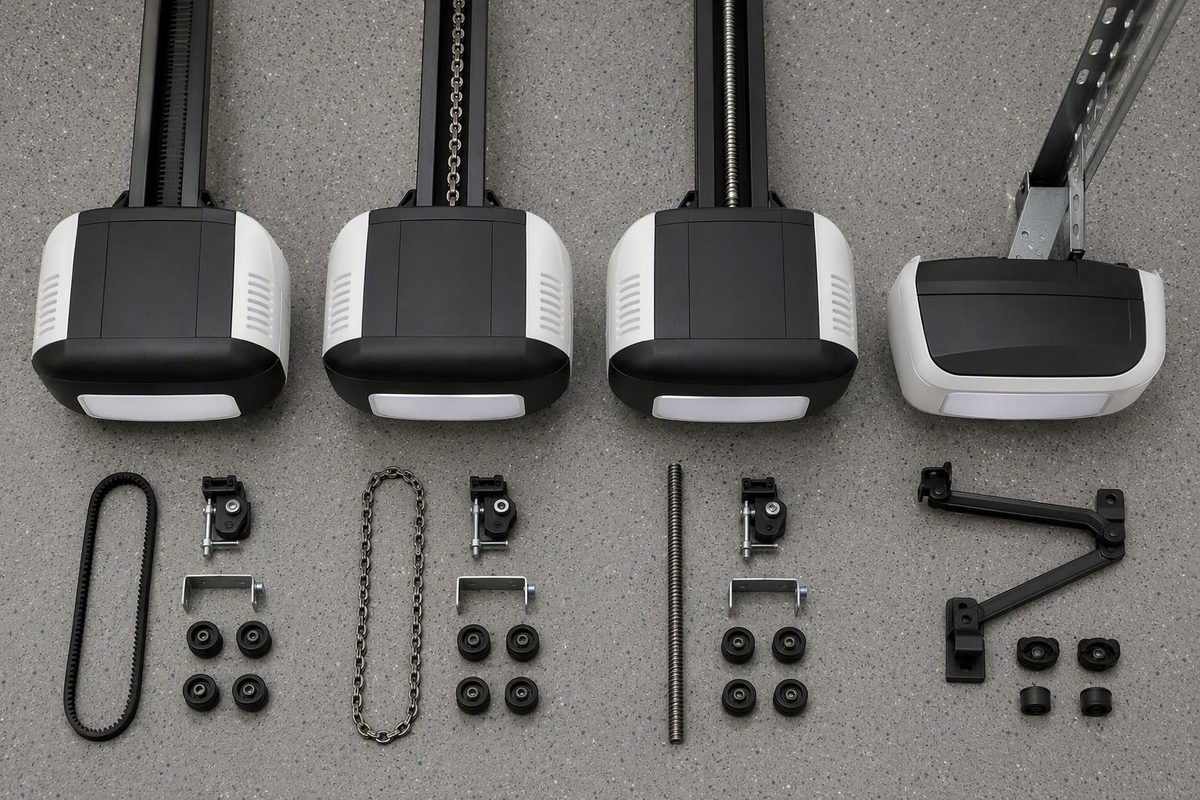
Genie residential garage door openers fall into four practical groups: quiet belt drives, lower-cost chain drives, direct-drive screw models and space-saving wall-mount openers. Start with a belt drive near living space, a chain drive where cost matters more than noise, a screw drive for its speed and drive design, or a wall mount when the ceiling centerline must remain clear—provided the exact opener fits the door hardware.
Choose your garage layout, noise situation and priority; the tool will identify the drive type to investigate first.
Best Starting Point
Start With a Belt Drive
A belt drive is the straightforward first choice beside or below living space. The 7155 is one Wi-Fi belt-drive example with battery backup; verify its door limits, rail and carton contents.
| Drive | Genie Examples | Primary Check |
|---|---|---|
| Belt | 7155 | Rail length, door rating and included battery |
| Chain | 2033 | Acceptable noise and included controls |
| Screw | 4062, 4063 | Approved door and maintenance instructions |
| Wall mount | 6072, 6172 | Shaft, drums, side clearance and door geometry |
Model-specific wall-mount caveat
The cited 6172H-B information specifies a 1-inch torsion shaft, at least 2¼ inches of shaft beyond the bearing plate and at least 7 inches from the torsion shaft to the sidewall. Those measurements do not establish the requirements for every wall-mount model.
Sources: Genie residential lineup, drive comparison, model 7155 specifications and 6172H-B fit information; catalog reviewed September 2026.
Genie’s residential catalog, reviewed in September 2026, contains numerous model numbers and closely related suffixes. Use the full number on the carton and opener label when checking the manual, included accessories and warranty.
The Door Determines Which Openers Fit
Before comparing models, record the door type, finished height and width, documented construction and weight, spring type, lift arrangement and available clearance. Locate the receptacle and note whether living space is beside or above the garage.
An opener should operate a correctly sprung, balanced door. It is not a substitute for stronger springs. Genie warns against installing an opener on an improperly balanced door and says homeowners should not adjust springs, cables or related high-tension hardware (Genie safety guidance). Stop if the door is crooked, binding, off track, unexpectedly heavy or has a broken spring or cable.
Door height is easy to miss. Genie specifies model 7155 for residential sectional doors up to 7 feet high; an 8-foot door requires an extension kit (Genie model 7155). Check that requirement for the exact opener rather than assuming rails and extension kits are interchangeable.
If the door itself is still being planned, settle its width, height and hardware clearances before buying the operator.
Each Drive Type Solves a Different Problem
| Genie Opener Type | Usually Suits | Check Before Buying |
|---|---|---|
| Belt drive | Attached garages and rooms near the garage | Door rating, rail length, battery and Wi-Fi inclusion |
| Chain drive | Detached garages or value-focused installations | Noise, vibration and included controls |
| Screw drive | Buyers prioritizing speed and a direct-drive rail | Approved door type, dimensions and maintenance instructions |
| Wall mount | High ceilings, center-rail conflicts or overhead storage | Shaft arrangement, drums, side clearance, outlet and door geometry |
Genie describes belt drives as quiet because their rails avoid metal-on-metal drive contact, chain drives as durable and relatively affordable, and screw drives as solid-steel direct-drive systems (Genie drive comparison).
A belt drive is the straightforward starting point beside a bedroom. In a detached building where sound transmission matters less, a chain drive may leave more of the budget for controls or battery backup. See the broader belt-versus-chain comparison before deciding.
Genie’s September 2026 catalog illustrates the range. The 7155 is a Wi-Fi belt drive with battery backup, while the 2033 is a Wi-Fi chain drive. The 4062 and 4063 are screw drives, and the 6072 and 6172 are wall-mount models. The catalog lists Wi-Fi on the 6172, plus LED lighting and battery backup on both wall-mount models (Genie residential lineup).
These are examples, not interchangeable packages. Models and retailer bundles can change, so confirm what is actually in the carton.
Wall Mount Is a Hardware-Fit Decision
A wall-mount opener removes the operator and rail from the ceiling centerline. That can help when planning lighting, a vehicle lift or an overhead storage layout, but this opener style does not fit every door.
For the cited 6172H-B listing, Genie’s fit answers require a 1-inch torsion shaft for a standard shaft installation, at least 2¼ inches of shaft beyond the bearing plate and at least 7 inches between the torsion shaft and sidewall. The listing excludes one-piece, roll-up and reverse-wound arrangements, although it identifies an adapter for a specific Torquemaster setup (Genie 6172H-B fit information).
Those dimensions and exclusions apply to the cited model, not every wall-mount opener. Verify the manual for the complete model number under consideration.
Do not move, unwind or alter torsion hardware to make an opener fit. If the shaft, drums or springs are incompatible, choose another opener or have a qualified door technician assess the system.
Exact-Model Features Matter More Than the Product Family
Battery Backup May Be Included, Optional or Required
“Battery capable” and “battery included” are different specifications. Genie says the 7155’s included backup provides up to 50 cycles from the initial power failure. That is a model-specific manufacturer claim, not a rating for every Genie opener (7155 specifications).
California law has required residential openers sold or installed in the state since July 1, 2019, to have battery backup. It also prohibits connecting a replacement residential door to a noncompliant existing opener (California SB 969). That rule is specific to California; buyers elsewhere should check their applicable requirements and desired outage operation.
Smart Controls Do Not Replace Physical Controls
Wi-Fi models use Genie’s Aladdin Connect system. Decide whether remote status, alerts and app operation justify relying on a cloud-connected feature. The quantity and type of remotes, keypads and wall controls still matter.
Confirm the exact opener and vehicle combination for HomeLink or Car2U rather than assuming compatibility from the Genie name alone.
Lighting and Accessories Vary by Package
Determine whether the package has bulb sockets, integrated LEDs or a separate wireless light. Brightness and motion-sensing features vary.
Count the remotes, keypads and wall-console functions included in the carton. Buying omitted accessories separately can erase the price advantage of a cheaper package.
Warranty Terms Can Differ Within One Opener
Motor, belt, parts, accessories and labor may have different warranty terms. Read the warranty tied to the complete model number and retailer package rather than relying on a general product-family statement.
HPc Is Not Measured Motor Horsepower
Do not treat an HPc label as measured motor horsepower. Genie says Horsepower Comparable means a DC opener meets or exceeds its lifting-force specification for the stated horsepower rating; it does not denote direct equivalency. Genie also says required power depends on the door’s size, construction and weight (Genie power guidance).
An approved door application and documented limits are more useful than simply selecting the largest HPc number. A properly balanced door should not need an oversized opener to overcome defective springs or binding hardware.
Confirm These Points Before Ordering
Do not order until the door moves smoothly by hand and passes the balance procedure in its manual. The exact opener must support the door type, height, width and weight.
Check that the rail or wall-mount mechanism clears the door throughout its full travel. If an extension kit is required, identify it by a compatible part number instead of relying on door height alone.
Confirm that a suitable grounded receptacle can be provided where the opener manual requires it. Plan unobstructed safety-sensor locations and a protected wiring route.
Finally, verify that battery backup, Wi-Fi, lighting, remotes, keypads and wall controls are included rather than merely supported as options.
After installation, retain the manual and follow its test procedure. Genie calls for monthly balance, contact-reverse and non-contact sensor tests. If the opener fails a reversal test, do not continue operating it normally; follow the manual and have the fault corrected (Genie safety and maintenance guidance).
If an existing unit already has a fault, use this safe opener troubleshooting sequence before assuming replacement is the only answer.