
The Common Torsion-Spring Turn Counts—and Why They Are Only Starting Estimates
Neither 30 nor 31 quarter-turns is universal for a 7-foot door. Check lift type, drums and spring specifications before using either starting reference.
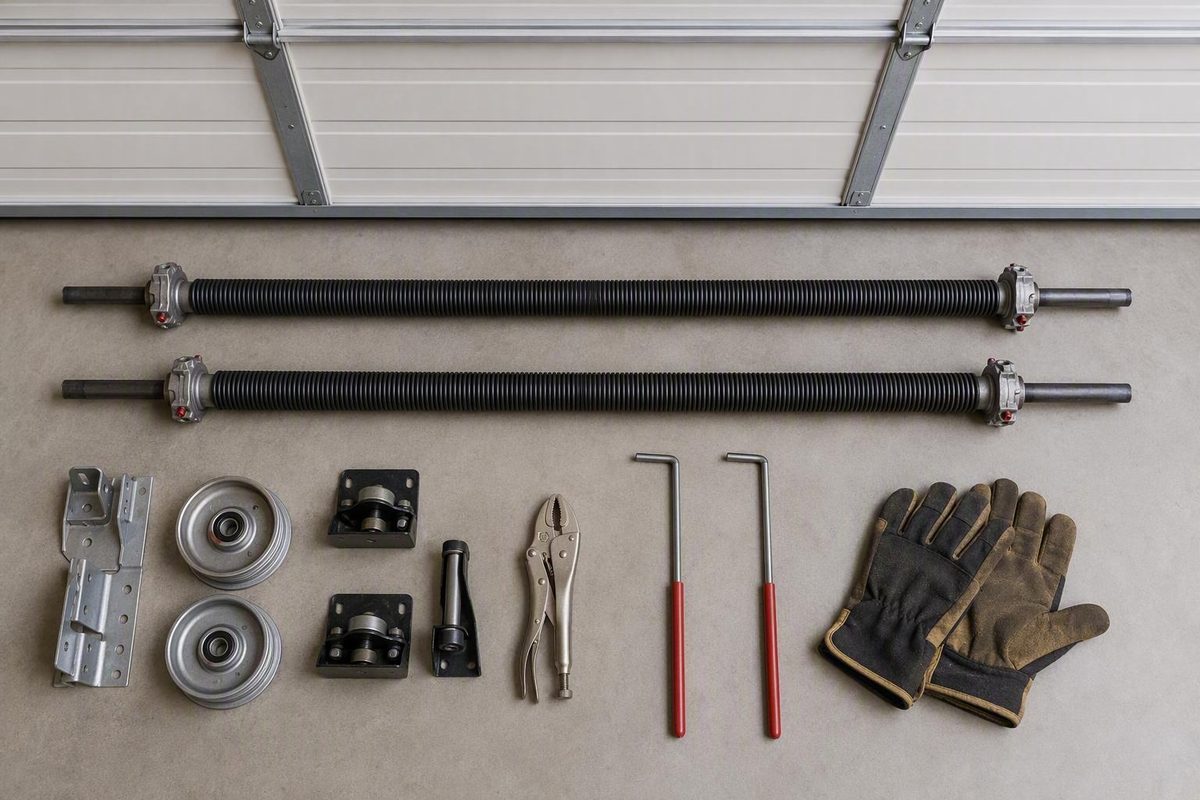
Quick answer: common turn counts for standard residential torsion doors
For a typical 7-foot-high, standard-lift residential garage door with standard 4-inch drums and correctly matched torsion springs, a common starting estimate is 7.5 full turns, or 30 quarter-turns, per spring. For a comparable 8-foot door, published guidance falls around 33–34 quarter-turns, or approximately 8.25–8.5 full turns, per spring. These figures are commercially published trade estimates, not an independent engineering standard (Affordable Door Co.).
There is some disagreement at the margins. One commercial seller’s guidance refers to approximately 31 quarter-turns for a 7-foot door, although its formula and table point to 30. That conflict is one reason not to treat either figure as universal (My Garage Door Parts).
| Door height | Full turns per spring | Quarter-turns per spring | System assumptions | Status |
|---|---|---|---|---|
| 7 feet | 7.5 | 30 | Conventional residential torsion system; standard lift; standard 4-inch drums; correctly matched springs | Common starting estimate from a commercial turn calculator |
| 7 feet | 7.75 | 31 | Conventional residential torsion system; correctly sized springs | Alternative starting recommendation in a torsion-spring seller’s FAQ |
| 8 feet | 8.25–8.5 | 33–34 | Conventional residential torsion system; standard lift; standard 4-inch drums; correctly matched springs | Approximate starting range published by a garage-door service company |
Safety warning: Torsion springs are under high tension and can cause severe injury or death if handled incorrectly. These numbers are reference estimates, not a winding procedure. Follow the exact manufacturer instructions and use a trained technician if winding or unwinding would be required (Garage Door Pros).
The word starting is essential. The table can help you interpret an existing specification or recognize the general range associated with a conventional residential door. It cannot identify an unknown spring, prove that a replacement spring is correct, or establish that a door is safe to operate.
The figures apply per spring. On a conventional two-spring door, a specification of 30 quarter-turns ordinarily means approximately 30 quarter-turns on each correctly matched spring—not 15 on each—subject to the documentation for that assembly.
Do not use the table for extension springs, enclosed proprietary systems, high-lift or vertical-lift doors, commercial or industrial installations, nonstandard drums, or specialized spring assemblies. Those systems require their own specifications.
Full turns, quarter-turns, and per-spring counts
One full revolution is one full turn. Garage-door trade guidance commonly counts rotation in quarter-turn increments corresponding to the cited winding-bar counting convention. Four quarter-turns make one full turn.
The conversions are:
- 30 quarter-turns ÷ 4 = 7.5 full turns
- 31 quarter-turns ÷ 4 = 7.75 full turns
- 33 quarter-turns ÷ 4 = 8.25 full turns
- 34 quarter-turns ÷ 4 = 8.5 full turns
The commercial seller behind the alternative recommendation defines one counted winding-bar increment as a quarter-turn and publishes starting counts of 31 and 34 quarter-turns for correctly sized springs on 7- and 8-foot doors, respectively (Express Garage Door Parts).
This terminology matters. Interpreting a specification of 7.5 full turns as 7.5 quarter-turns would apply only one-fourth of the stated rotation. Mistaking 30 quarter-turns for 30 full turns would produce a roughly fourfold counting error. That is not a minor rounding difference.
In a conventional two-spring torsion system, the published count generally applies to each spring. A 30-quarter-turn reference is not normally divided into 15 quarter-turns on one spring and 15 on the other.
Equal operating turn counts do not prove that paired springs have identical specifications. Supplier guidance specifically warns that two-spring systems may contain different wire sizes and that each spring should be identified separately. The relevant characteristics include unwound length, wire size, inside diameter, wind direction, and end type.
In other words, equal counts describe shaft rotation. They do not prove that the springs are interchangeable or that their combined torque is correct for the door.
Why there is no universal number of spring turns
Door height is an important starting variable because the cables must move far enough to carry the door through its full travel. Height alone, however, is not a complete spring specification.
The required setup can depend on:
- Spring-system type
- Door height
- Measured door weight
- Lift configuration
- Cable-drum geometry and circumference
- Number of springs
- Spring wire size
- Spring inside diameter
- Unwound spring length
- Spring wind direction
- End type
- Whether the spring or spring pair is correctly matched to the door
These variables answer different questions. Door height and drum geometry help describe how much rotational travel is needed to take up the cable. Spring dimensions and door weight help determine whether the spring system supplies appropriate torque during that travel. Knowing one group of variables does not establish the other.
Drum circumference illustrates why height is insufficient. Each shaft revolution takes up an amount of cable determined by the drum. If the effective drum circumference changes, the relationship between shaft rotation and linear door travel changes as well. A turn count associated with a standard residential drum therefore cannot automatically be transferred to another drum.
Lift configuration matters for the same reason:
- A standard-lift door rises in vertical tracks before transitioning into horizontal tracks.
- A high-lift door continues farther upward before making that transition.
- A vertical-lift door travels primarily upward and is more commonly associated with tall commercial settings.
High-lift and vertical-lift systems require setup-specific calculations or documentation. The quick 7- and 8-foot figures above exclude them.
Door weight is equally important. Doors with the same height and width can differ in construction, insulation, glazing, reinforcement, and hardware. A shaft may need a familiar amount of rotation to move either door through the opening, but the springs must still be correctly selected for the actual weight.
When requesting an exact specification from a manufacturer, spring supplier, or technician, be prepared to provide:
- Door height: Use the measurement method required by the applicable documentation.
- Measured door weight: Do not rely only on panel dimensions or an estimate.
- Lift type: Standard lift, high lift, vertical lift, or another arrangement.
- Drum identification: Supply the stamped part number if legible or the dimensions requested by the supplier.
- Spring count: Identify whether the system uses one, two, or a specialized assembly.
- Wire size: Record it separately for each spring.
- Inside diameter: Use existing markings, documentation, or safe professional identification.
- Unwound length: Obtain this from labels, records, a previously removed and fully relaxed spring, or a technician.
- Wind direction: Identify left-wound and right-wound springs correctly.
- End type: Confirm the spring’s end-hardware configuration.
Do not loosen, unwind, or manipulate an installed tensioned spring to obtain these measurements. If the necessary information is not visible in existing labels or documentation, have a trained technician identify it.
Verification should be based on the complete door system and documentation or an engineering tool appropriate to that system—not on appearance alone.
Why 7-foot recommendations differ between 30 and 31 quarter-turns
The available evidence does not establish either 30 or 31 quarter-turns as universally correct for every 7-foot door.
A common commercial rule of thumb is:
Door height in feet + 0.5 full turn
For a 7-foot door, that arithmetic produces:
- 7 + 0.5 = 7.5 full turns
- 7.5 × 4 = 30 quarter-turns
Another seller recommends beginning at 31 quarter-turns on each correctly sized spring for a 7-foot door. The difference is best understood as a disagreement among commercial starting references, not proof that one number applies to every door.
One retailer’s article demonstrates why false precision is unhelpful. Its height-plus-half-a-turn formula produces 30 quarter-turns for a 7-foot door, its prose refers to approximately 31, and its table returns to 30. Other entries also conflict with the stated formula (My Garage Door Parts).
The responsible response is not to average the figures into an invented specification such as 30.5 quarter-turns. Instead:
- Treat 30 and 31 as different trade starting references.
- Check whether their assumptions fit the actual system.
- Use documentation for the exact door, drum, and spring combination.
- Investigate spring selection and other components if the system appears to require a substantial departure from its documented starting point.
Generic tension changes are not a substitute for identifying the cause.
Confirm the spring system before using any numeric estimate
The estimates in this article apply only to a conventional residential torsion-spring system under the assumptions stated in the table. They do not apply to every component casually described as a garage-door spring.
Extension springs stretch as the door moves. Their setup is not described by the torsion figures above.
TorqueMaster and other enclosed or proprietary systems use different hardware and adjustment methods. Their instructions must match the exact system.
The quick-reference figures also exclude:
- High-lift doors
- Vertical-lift doors
- Commercial and industrial doors
- Oversized or nonstandard drums
- Unusual track arrangements
- Duplex, triplex, and other specialized spring assemblies
- Systems whose spring identity or door weight is unknown
Use this decision path before interpreting a numeric estimate:
- Identify the spring system. Determine whether it is a conventional exposed torsion assembly, an extension-spring system, an enclosed system, or another proprietary design.
- Identify the lift configuration. Confirm whether the door is standard lift, high lift, vertical lift, or unusual.
- Identify the drums. Establish whether they are the standard residential drums assumed by the reference.
- Verify the springs. Confirm their specifications against the measured door weight and the rest of the system.
- Consult exact documentation. Use the applicable manufacturer chart, installation manual, supplier specification, or a trained technician’s calculation.
If any identification step is uncertain, stop at identification. Do not select a turn count solely because the door is 7 or 8 feet tall.
Do not confuse winding turns with added coils or spring growth
Some references mention about 7.5 turns for a conventional 7-foot door, while others refer to approximately eight added coils. These descriptions can concern related measurements without giving the same instruction.
A torsion spring grows in length as it is wound, at approximately one coil of growth for each applied turn. In one technical example involving a 7-foot residential door with standard 4-inch drums, the spring gains about 7.5 coils from winding plus a small amount of additional stretch, resulting in a total wound-length increase of approximately eight coils. The discussion is primarily a method for estimating the spring’s unwound length, not a universal instruction to apply eight full turns (DDM Garage Doors).
Accordingly:
- 7.5 winding turns describes rotational travel.
- Approximately eight added coils can describe growth in the spring’s length.
- The added-coil measurement may include both winding growth and additional stretch.
- Eight added coils do not automatically mean that a spring requires eight full winding turns.
A paint, chalk, or crayon stripe spiraling around an already wound spring may provide observational information. In the cited supplier guidance, each return of the stripe to the front represents one existing turn.
That visual clue does not make the assembly safe to handle. It is not permission to touch the spring, winding cone, setscrews, anchor hardware, or coils. A tensioned spring may unwind suddenly. Any observation should be made without moving into the path of the assembly or attempting an adjustment.
What too few or too many turns may look like
Operating symptoms can suggest that a torsion system is not supplying appropriate counterbalance, but they do not establish the cause.
| Observation | Possible association | Why it is not conclusive |
|---|---|---|
| Door remains unusually heavy | Too little spring tension | A spring may instead be broken, incorrectly sized, or mismatched to the door |
| Door lacks lifting support or will not lift properly | Under-wound or inadequate spring system | Cables, drums, tracks, hardware, or door-weight problems can cause similar behavior |
| Door rises forcefully or too quickly | Too much spring tension | An incorrect spring may provide excessive torque even at a familiar turn count |
| Door resists closing or tends to rise | Excessive tension or mismatched springs | Track resistance, cable problems, drums, or other setup faults may also affect movement |
| A large correction appears necessary | Starting estimate may not fit the system | The lift type, drum, spring identity, or original system data may be wrong |
These symptoms are diagnostic prompts, not instructions to add or remove turns. A spring that is fundamentally wrong for the door cannot be made correct merely by changing its tension until one symptom becomes less noticeable.
Trade guidance sometimes discusses assessing door balance with the opener disconnected. That should not be treated as a universal homeowner test. If the spring or system specifications are unknown, have a technician assess it.
The more useful diagnostic question is not simply, “Does this need another quarter-turn?” It is: “Have the door weight, spring specification, drums, cables, tracks, and lift configuration been verified?” If not, further adjustment may mask the real fault.
When to stop and call a garage-door technician
Torsion springs are under high tension, and mishandling can cause severe injury or death. A turn-count estimate is not a complete winding procedure and does not make torsion-spring work safe. Industry-supplier guidance likewise warns that garage-door procedures can cause property damage, injury, or death and recommends contacting a door professional when in doubt (Service Spring).
Use a qualified garage-door technician when:
- The spring dimensions or wind direction are unknown.
- The measured door weight is unavailable.
- The lift configuration cannot be identified confidently.
- The cable drums are unmarked, nonstandard, damaged, or uncertain.
- No manufacturer chart matches the door-and-spring combination.
- A replacement spring was selected only by appearance or door height.
- The door is unstable, crooked, off track, or unusually heavy.
- Cables, drums, tracks, bearings, brackets, or anchor hardware appear damaged.
- The system is high lift, vertical lift, commercial, industrial, enclosed, or proprietary.
- The setup appears to require a substantial departure from its documented starting specification.
- A spring is broken or the original installation may contain mismatched components.
Proper winding bars, training, system knowledge, and controlled procedures are necessary. Screwdrivers, rebar, and other improvised objects are not substitutes for the correct tools. This article intentionally does not explain how to loosen setscrews, remove anchor hardware, wind or unwind a spring, or position yourself near a tensioned assembly.
Garage Reference’s editorial approach is to identify genuinely dangerous garage work rather than suggest that a written tutorial makes it safe.
The useful reference points remain narrow: consult the table for the common starting range associated with a standard 7- or 8-foot residential torsion system, then verify the spring system, drums, lift configuration, door weight, and complete spring specifications against setup-specific documentation. If any specification is unknown, the door is unstable, or the system is nonstandard, stop adjusting it and use a qualified technician.
Frequently asked questions about garage-door spring turns
How many turns does a torsion spring need for a 7-foot garage door?
For a conventional 7-foot residential torsion door that meets all the assumptions stated above, use the 7-foot rows in the quick-answer table as commercial starting references. The exact manufacturer specification for the installed spring-and-door combination overrides either estimate.
How many turns does a torsion spring need for an 8-foot garage door?
Use the 8-foot row in the quick-answer table only for a conventional standard-lift residential torsion system with standard drums and correctly matched springs. It does not cover high-lift, vertical-lift, commercial, proprietary, or nonstandard-drum systems.
Does each spring get the full turn count on a two-spring garage door?
Generally, yes. In a conventional two-spring torsion system, the published starting count normally applies to each spring, not to both springs combined. Equal turn counts do not prove that the springs have identical specifications, so each spring still needs to be identified and verified.
Is one winding-bar movement a full turn or a quarter-turn?
In the trade counting convention discussed above, the relevant counted rotation is a quarter-turn increment, not a full revolution. Always confirm the terminology in the exact manufacturer instructions; confusing full turns with quarter-turns creates a fourfold error.
Where can I find the exact turn count for my garage-door spring?
Start with the manufacturer’s winding chart, installation manual, spring label, or documentation supplied for the exact door-and-spring combination. Identification may require the door height and measured weight, lift type, drum identification, spring count, wire size, inside diameter, unwound length, wind direction, and end type.
Obtain those details from existing labels, records, a previously removed and fully relaxed spring, or a trained technician. Do not loosen, unwind, or handle an installed tensioned spring to take measurements. If the correct documentation or system data is unavailable, have a qualified garage-door technician identify and verify the assembly.