
Choose the Right Garage Control for a Buttonless Car
Compare myQ subscriptions, an aftermarket HomeLink mirror, and clip-on remotes by compatibility, connectivity, door status, and ownership cost.
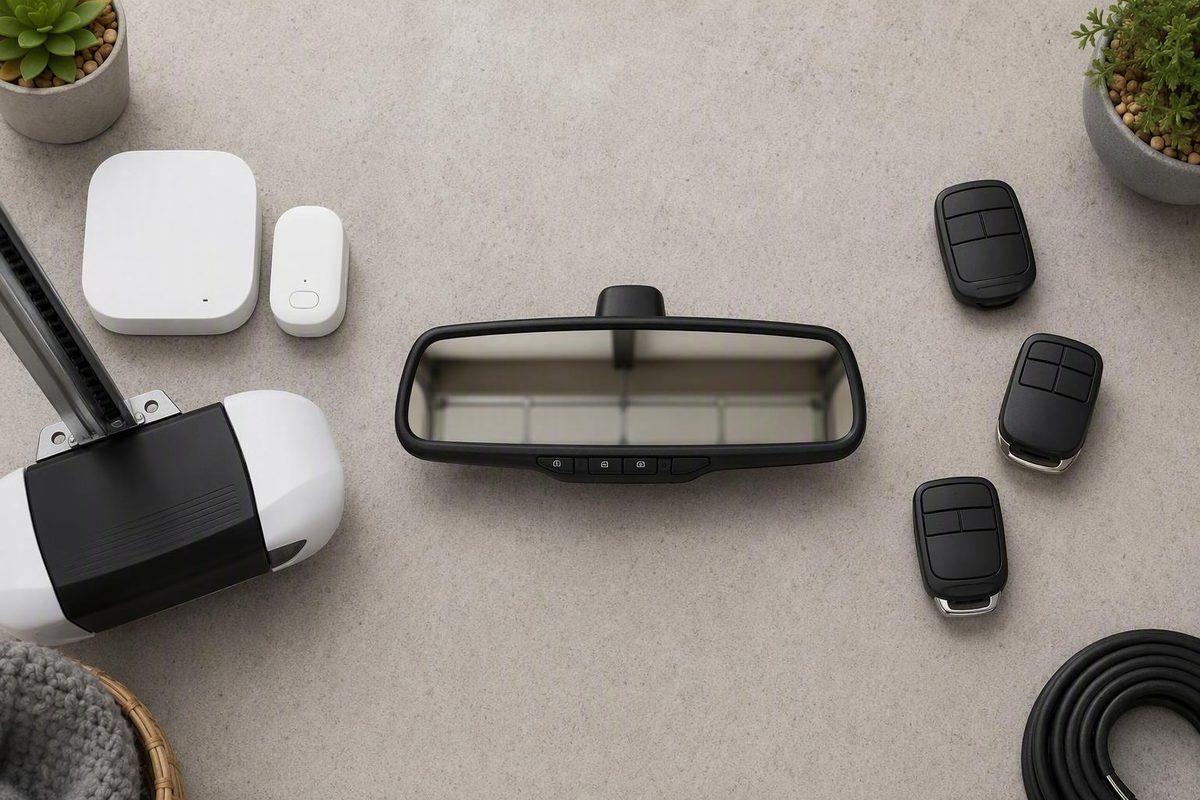
For a new car without a HomeLink button, choose myQ Connected Garage if the car supports its native integration and the opener is myQ-compatible; it costs $45 per year or as little as $179 for five years on the documented plans. Choose an aftermarket HomeLink mirror if you want direct local control without an internet dependency and can justify about $400 installed. Choose a clip-on remote if you only need to open the door from the driveway. No reliable remote price was supplied, so its five-year cost must be quoted for your opener rather than estimated here.
Select your vehicle, opener, and ownership period; the picker shows compatibility and comparable costs.
Choose the closest documented vehicle group and describe the opener. Age is recorded as a warning, not used as a compatibility shortcut.
Reported status, remote control, connectivity required.
Direct local RF control; no ordinary door-state feedback.
Basic local control without native vehicle integration.
| Option | 1 Year | 3 Years | 5 Years | What Must Work |
|---|---|---|---|---|
| myQ, cheapest listed plan | $45 where offered | $129 where offered | $179 | Supported car, opener/hub, Wi-Fi, accounts |
| Aftermarket HomeLink mirror | ~$400 | ~$400 | ~$400 | Vehicle installation and compatible RF receiver |
| Clip-on remote | — | — | — | Exact transmitter and opener protocol match |
Age rule Opener age and brand alone do not prove compatibility. Verify the exact model with the manufacturer before buying hardware or a plan.
Sources: documented Tesla, Hyundai, and Honda myQ plan terms cited in the article; HomeLink mirror cost is the supplied ~$400 installed estimate. Clip-on remote cost is unknown until entered. Prices exclude hubs, bridges, network upgrades, and future changes.
The three routes solve different problems. myQ provides reported door status, off-site control, and supported location automation. HomeLink and a clip-on remote send local radio-frequency commands but ordinarily cannot tell you whether the door is open or closed.
For five years, an eligible $179 myQ plan costs about $221 less than a ~$400 installed HomeLink mirror. Paying $45 annually would total $225. The mirror begins to make financial sense only over a longer ownership period, when local operation is worth the higher initial cost, or when avoiding connected-service dependencies matters more than the five-year difference.
The Three Options at a Glance
| Option | Five-Year Cost | Best Use | Main Limitation |
|---|---|---|---|
| myQ native integration | $179–$225 | Status and remote control | Needs compatible equipment and connectivity |
| HomeLink mirror | ~$400 installed | Built-in local RF control | No door-state feedback |
| Clip-on remote | — | Basic driveway control | Price and compatibility vary |
The $179 figure is the listed five-year price for the documented Tesla, Hyundai, and Honda integrations. The $225 figure assumes five annual payments of $45 where that annual option is offered. Plan availability and transfer rules vary by automaker.
The ~$400 mirror figure comes from the topic brief and is an estimate, not a universal installed quote. No sourced clip-on remote price was provided. That blank should not be filled with a generic online price because the correct transmitter depends on the opener’s receiver and security protocol.
myQ Is the Better Fit for Status and Off-Site Control
myQ Connected Garage is a connected service rather than a transmitter built into the car. A supported opener or retrofit hub connects through garage Wi-Fi, while the vehicle integration communicates through myQ and the automaker’s systems.
A compatible implementation can show whether the door is reported open or closed, operate it beyond ordinary remote range, and use vehicle location for arrival or departure automation. That status feedback is the strongest reason to pay for it.
The tradeoff is a longer dependency chain. Operation normally requires compatible garage hardware, adequate Wi-Fi at the opener or hub, home internet, a myQ account, vehicle connectivity, current vehicle software, and an active plan after the trial.
Tesla documents these requirements and describes myQ and HomeLink as separate options in its Smart Garage manual. A loss of garage Wi-Fi, internet access, vehicle data service, account access, or a connected platform can interrupt commands or status reporting.
The standard myQ phone app and a paid native vehicle integration are not the same product. Native touchscreen placement, vehicle-triggered automation, account linking, trials, and subscription terms are separate purchasing questions even when both reach the same opener.
HomeLink Provides a Direct Local Command
HomeLink is an in-vehicle RF transceiver. Once programmed, it sends a command directly to a compatible opener, gate, light, or other supported receiver. Its core command does not need garage Wi-Fi, cellular service, home internet, or a myQ account.
An aftermarket mirror adds that transceiver to a car that did not receive factory controls. Before ordering one, confirm that the mirror is suitable for the vehicle, the installation quote includes the required wiring and trim work, and the opener supports the relevant HomeLink version. Some combinations require a HomeLink Compatibility Bridge; Chamberlain’s programming guide identifies that possibility.
HomeLink’s local path does not mean universal compatibility. It can fail when the car lacks the correct hardware, programming is incomplete, the receiver uses an incompatible protocol, the vehicle is outside useful RF range, or the opener has lost power.
It also does not normally provide door-state feedback. Tesla warns that HomeLink transmits without determining the device’s current state. With a toggle-style opener, a command intended to open the door can close it if the door is already open.
Tesla documents storage and operation of up to three RF devices, including garage doors, gates, lights, and security systems. That limit and device range are specific to Tesla’s implementation, not every HomeLink-equipped vehicle.
A Clip-On Remote Is Enough for Basic Driveway Use
A compatible clip-on remote follows the same basic local-control idea without modifying the car. It is the straightforward choice when the only requirement is pressing a button near the house.
It lacks the factory appearance of a mirror control and the connected features of myQ. It also needs a usable mounting location, a working battery, successful pairing, and receiver compatibility. A remote bought only by brand name may not support the opener’s specific generation or security protocol.
Because the supplied evidence contains no representative remote price, obtain the exact opener model and price the manufacturer-approved transmitter. Enter that quote in the picker to compare it with $179–$225 for myQ and the ~$400 mirror estimate.
Five-Year Costs Depend on the Available myQ Plan
The documented native integrations do not all offer the same menu of plans.
| Integration | Trial | Listed Plans |
|---|---|---|
| Tesla | 30 days | $45/1 year; $179/5; $299/10 |
| Hyundai | 3 months | $45/1 year; $129/3; $179/5 |
| Honda | 30 days | $129/3 years; $179/5 |
The myQ–Tesla FAQ lists Tesla’s prices. Hyundai’s terms appear in its Connected Garage FAQ, and Honda lists its offering through HondaLink myQ.
At the documented prices, buying a five-year plan for $179 saves $46 compared with five $45 annual payments. A three-year Hyundai or Honda plan at $129 saves $6 compared with three annual payments of $45, although Honda does not list the annual option in the supplied material.
Additional equipment is not included in those subscription figures. A setup may require a myQ Smart Garage Control hub, a HomeLink Compatibility Bridge, an additional door sensor, better garage Wi-Fi, or replacement of an incompatible opener. The draft provides no authoritative prices for those items.
A fair ownership calculation is: total annualized cost equals vehicle hardware, installation, garage hardware, accessories, and subscription payments divided by the years of ownership.
Transfer and sharing terms also affect value. Tesla’s documented plan is associated with the myQ account and can cover an additional compatible Tesla or transfer to a replacement Tesla during the term. Hyundai says one subscription can be shared among multiple compatible Hyundai vehicles on the same primary Hyundai with Bluelink account. These terms do not establish cross-brand transferability.
Check the Car and Opener Separately
A missing HomeLink button establishes only that the visible factory control is absent. It does not establish myQ support, aftermarket-mirror compatibility, or opener compatibility.
Honda reportedly removed the HomeLink button from the 2026 Accord, according to a May 2026 CarBuzz report. The supplied page exposed only a reCAPTCHA notice during research, so verify the equipment through the current Honda specifications or by inspecting the car.
Ford also removed the universal garage-door opener from the 2026 Bronco Sport, according to Ford Authority. That does not itself establish that the Bronco Sport supports a native myQ integration. A compatible clip-on remote remains the least integrated route, while an aftermarket HomeLink installation requires a vehicle-specific assessment.
Hyundai introduced myQ Connected Garage on selected vehicles, but published model-year descriptions differ. Cars.com describes certain 2024–26 vehicles, while Chamberlain’s support material identifies selected 2025 and 2026 models and variants. Do not assume every Hyundai in those years qualifies.
For the vehicle side, verify the exact model, year, trim, country, software version, infotainment equipment, required app, connected-services account, and current plan eligibility.
For the garage side, record the opener’s manufacturer and exact model. Determine whether myQ is built in, whether an external myQ hub officially supports it, whether the safety sensors work, and whether Wi-Fi is reliable at the ceiling-mounted opener. See the guide to garage-door safety sensor faults if the sensors are not operating normally.
Opener age alone cannot answer compatibility. Chamberlain or LiftMaster branding does not guarantee that every generation works with every myQ or HomeLink product, and an older opener from another brand is not automatically excluded. Use the official compatibility result for the exact model.
Automaker Implementations Are Not Interchangeable
Tesla supports connected garage monitoring and control from the touchscreen or paired phone, plus proximity-based operation. Its documented myQ offering is available in the United States and Canada. Compatible owners can enable myQ while retaining installed HomeLink.
Hyundai displays compatible garage-door controls and open-or-closed status on the vehicle touchscreen. Its documented integration can control up to eight compatible garage-door openers and supports geofenced arrival and departure commands. Hyundai cautions that GPS signal and location can affect geofence performance.
Honda’s implementation works through HondaLink with Apple CarPlay or Android Auto on a compatible phone and infotainment system. It requires the HondaLink and myQ Garage & Access Control apps. Honda documents certain garage-door openers, LiftMaster gate operators, Yale LiftMaster smart locks, and myQ-enabled lights, but not cameras or commercial door operators.
Those differences prevent a single brand-wide compatibility claim. A feature available in one Tesla, Hyundai, or Honda cannot be assumed for another automaker or even another trim within the same model year.
Connectivity and Safety Change the Decision
Choose myQ when checking the reported door state after leaving home is worth paying for, or when off-site opening and closing is part of the routine. Choose HomeLink when the control should work locally without depending on home internet or cellular service. Choose the clip-on remote when neither status nor built-in presentation justifies the added expense.
There is no controlled evidence in the supplied research establishing that myQ or HomeLink is universally faster or more reliable. Dated owner reports describe delays and failed commands, but they are not a controlled comparison.
Neither connected status nor a transmitted RF command proves that the door completed safe travel. The opener still needs power, functioning safety stop-and-reverse equipment, clear tracks, working sensors, and an unobstructed opening.
If both myQ and HomeLink are installed, use myQ for remote status and HomeLink as the local control if that division suits the household. Assign automatic arrival or departure operation to only one system for each door. Overlapping automations can issue competing toggle commands without confirming the physical result.
Common Buying Questions
Will HomeLink Work During an Internet Outage?
Its core RF command can work without home internet, garage Wi-Fi, or cellular service. The vehicle transceiver and opener must still be powered, compatible, paired, and within range.
Can myQ Work Without Built-In Opener Wi-Fi?
Sometimes. A supported myQ Smart Garage Control hub may connect an otherwise compatible opener. It is not a universal adapter, so check the exact model and required safety sensors before buying a plan or hub.
Can HomeLink Show Whether the Door Is Open?
Tesla’s documented implementation cannot. It transmits a command without determining the current position. myQ’s reported open-or-closed state is the material advantage for drivers who need that confirmation.
Can Both Systems Be Installed in One Vehicle?
Tesla confirms that compatible owners can use myQ even when HomeLink is installed. That coexistence is not documented here for every automaker. Where both work, avoid enabling location automation in both systems for the same door.
Which Route Costs Least Over Five Years?
The answer cannot be established without a clip-on remote quote. Among the two priced routes, the documented $179 five-year myQ plan costs less than a ~$400 installed HomeLink mirror. Annual myQ renewal at $45 totals $225 over five years. Hardware, hubs, bridges, network upgrades, and future price changes are additional.