
The Best Garage Door Opener Depends on Door Fit, Noise and Controls
Compare four garage door opener picks for everyday use, lower cost, better lighting and clear ceiling space—plus the fit checks before buying.
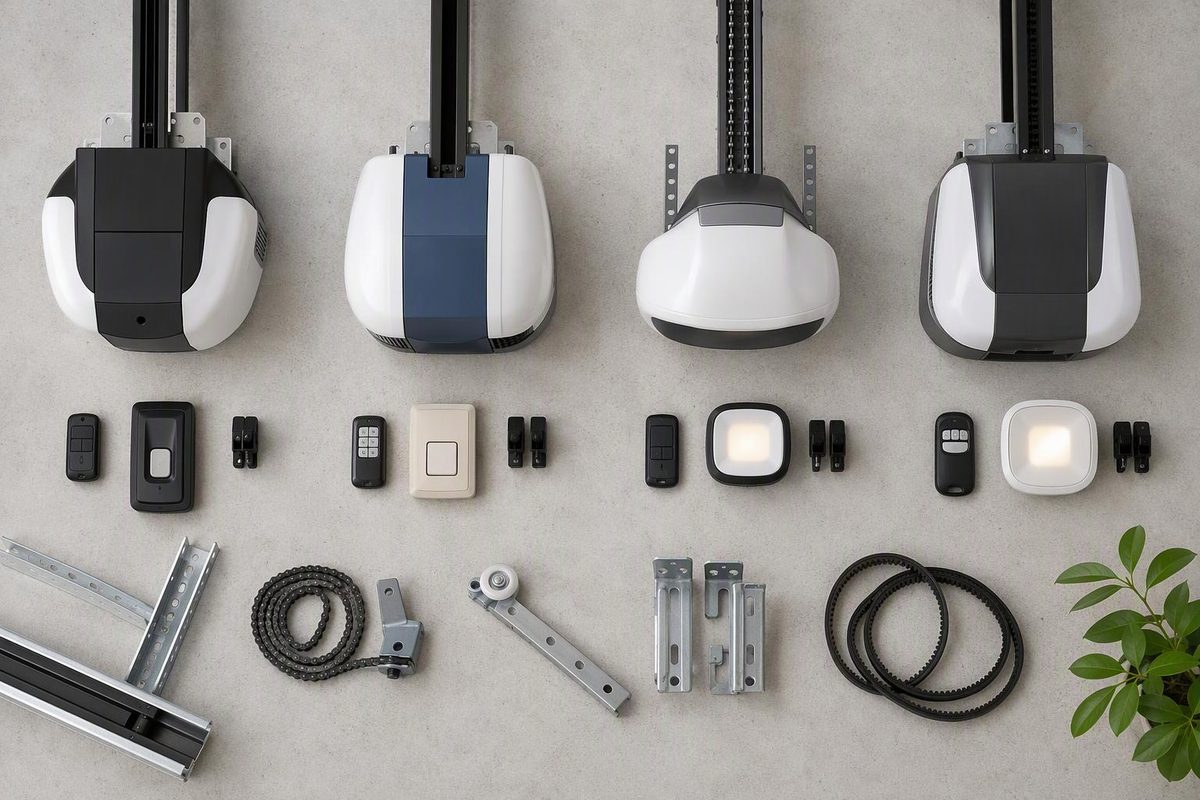
For a typical residential sectional door, the Genie StealthDrive Connect 7155-TKV is our starting-point recommendation: it combines a belt drive, battery backup, smartphone control, two remotes and a wireless keypad. The alternatives below suit different priorities: a lower-cost belt-drive option, integrated lighting or clear ceiling space.
These are specification-based buying recommendations, not hands-on test rankings. Features and prices reflect U.S. manufacturer listings checked October 24, 2026; match the exact model, door hardware and installation instructions before ordering.
Best starting point: Genie StealthDrive Connect 7155-TKV
The 7155-TKV packages the features many homeowners would otherwise buy separately. Genie lists a steel-reinforced belt, DC motor, built-in Aladdin Connect, battery backup, two preprogrammed three-button remotes, a wireless keypad and a multifunction wall console. That makes it a useful shortlist choice for an attached garage where opener noise and convenient access both matter. Genie’s product details support that feature combination—not a claim that it is quieter or more durable than every competitor.
Fit limits: this model is for residential sectional doors. The standard setup serves doors up to 7 feet high; an extension kit is required for an 8-foot door. It is not suitable for a 10-foot-high door. Do not confuse a 16-foot-wide double door with a 16-foot-tall door. Genie specifications and fit answers
Main trade-off: the 7155-TKV does not have motion-sensing lighting or the integrated LED lighting of 7155L variants. Check the complete suffix rather than treating every “7155” box as identical. Genie’s model and lighting answers
Lower-cost belt-drive option: Chamberlain B3000
The B3000 keeps the core features: belt drive, DC motor, soft start/stop, battery backup and myQ control. Its lighting uses one bulb rather than an integrated multi-panel LED system. Chamberlain lists five-year motor and belt warranties, with one-year parts and accessory coverage. B3000 specifications
Chamberlain’s U.S. catalog listed it at $245.99 on October 24, 2026, versus $433.99 for the lighting-focused B6713T below. It is a lower-cost alternative to that model, not the cheapest opener in the catalog. These are listed product prices, not installed quotes or guaranteed retailer prices. Chamberlain catalog
Main trade-off: do not assume your old controls will carry over. Chamberlain warns that most older accessories are incompatible and specifies HomeLink 4 or newer. Its linked user guide also requires a myQ account and Wi-Fi connection before installation. If you want an entirely app-free setup process, this is not the obvious choice. B3000 compatibility · Security+ 3.0 user guide
Best for integrated lighting: Chamberlain B6713T
Choose the B6713T when walking into a well-lit garage matters enough to justify the extra cost. Its defining feature is 2,000-lumen, motion-activated integrated LED lighting. It also includes a belt drive, DC motor, soft start/stop, battery backup and myQ smartphone control. Chamberlain lists lifetime motor and belt warranties, five-year parts coverage and a one-year battery warranty. B6713T specifications
Main trade-off: you are paying for lighting you may not need if the garage already has good fixtures. Do not treat the advertised lumens as a lighting plan for every workbench or storage corner. Certain vehicles also require a separate HomeLink compatibility bridge. B6713T vehicle compatibility
Best for clearing the ceiling: LiftMaster 98022
The 98022 mounts beside the door’s torsion shaft instead of using a central overhead opener rail. LiftMaster lists battery backup, remote LED lighting and an included automatic door lock. It is the shortlist choice when the central rail conflicts with planned ceiling storage or other equipment. 98022 product details
Main trade-off: hardware fit comes first. Its manual specifies installation by trained garage-door technicians on sectional doors with compatible torsion assemblies. It excludes extension-spring doors and low-headroom tracks with outside-pickup drums. One required clearance is 8½ inches between the end of the torsion shaft and the side wall or obstruction—not 8½ inches beside the door opening. Shaft diameter, projection, drum type and other clearances also need checking. 98022 installation manual
Removing the opener rail does not remove the door tracks or the space occupied by the open door. Use our jack shaft fit and clearance guide before planning overhead storage around one.
Four checks before buying
- Separate a failed opener from a faulty door. A stronger motor is not a repair for binding tracks, damaged cables or failed springs. If the door is crooked, unexpectedly heavy or has visible spring/cable damage, stop operating it and have the door system assessed. Spring-and-cable work involves stored energy and belongs with a trained technician. Manufacturer safety instructions If there are no damage signs, start with our safe opener troubleshooting guide.
- Record door height, construction and hardware. Opening width alone does not establish opener compatibility. Verify the permitted door weight, travel height, rail or extension kit, and mounting clearances. Do not rank lifting capacity solely by “HP” or “HPc”: Chamberlain identifies its DC horsepower figures as comparison ratings, while Genie uses its own horsepower-comparable designation. Chamberlain rating explanation · Genie HPc explanation
- Compare complete installation costs. Ask what the quote includes: rail, height extension, keypad, controls, any required door reinforcement or mounting supports, electrical work and installation—not just the motor head. For an attached garage, a belt drive is a sensible starting point; compare the trade-offs in our belt versus chain guide.
- Check controls separately from backup power. Confirm your vehicle buttons and desired smart-home integrations against the exact model. Battery backup powers the opener during an outage; it does not supply backup power to your router or internet equipment.
Make safety testing part of the handover
Before regular use, have the installer demonstrate the photo-eye obstruction test, contact-reversal test, emergency release and battery-backup operation according to the exact manual. Photo-eyes and contact reversal are separate checks. Chamberlain requires monthly contact-reversal testing and testing after adjustments; the door must reverse on a 2×4 laid flat beneath it. If a safety test fails, stop automatic operation until the fault is corrected—never bypass the sensors to make a new opener work. Safety-reversal testing instructions