
Garage Storage Systems for Tools, Totes and Seasonal Gear
Compare garage rails, shelving, cabinets and overhead racks by load limits, usable depth and door clearance—not just advertised capacity.
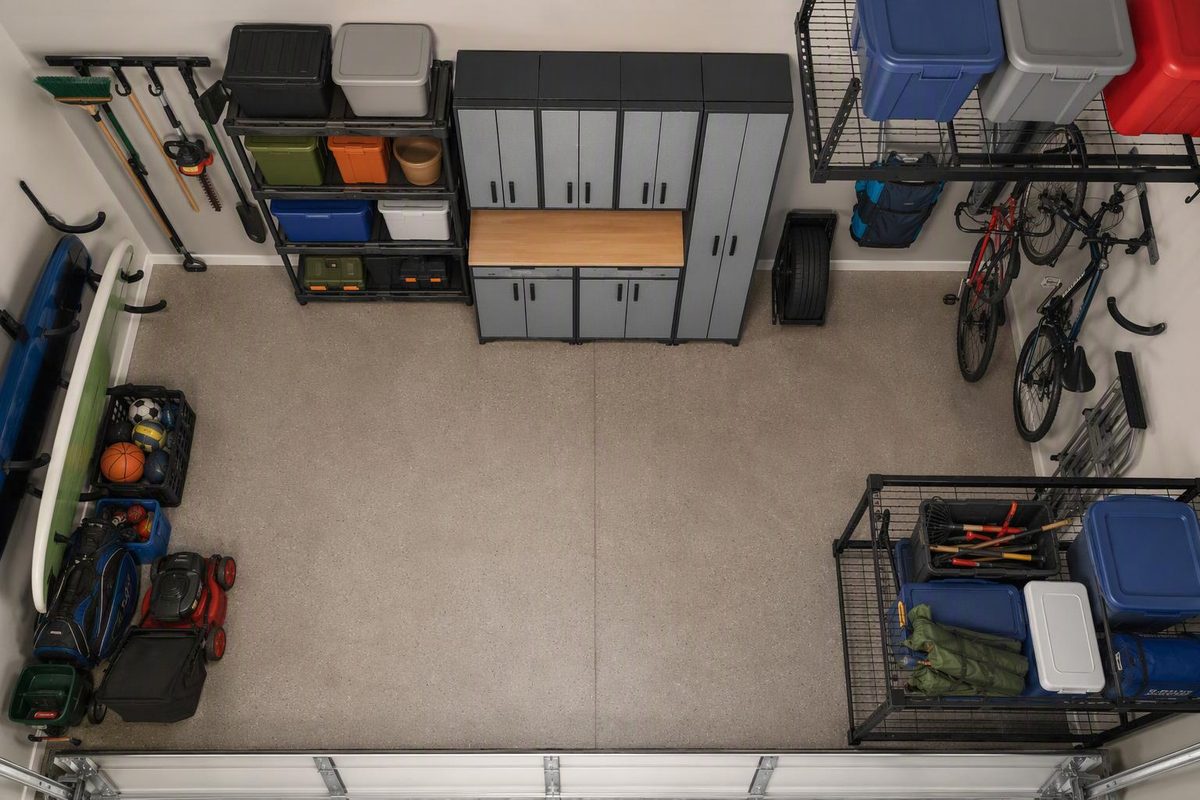
For a garage that still needs to park a car, start with open shelving for totes and a wall rail for frequently used tools. Add cabinets when you need enclosed storage; consider overhead racks for occasional-access items only after checking ceiling structure and door clearance.
The best garage storage systems solve different problems. This shortlist offers specification-based picks by use—not hands-on test winners or a ranking of every available system. The selection priorities are access, dimensions, accessory compatibility and documented mounting and load limits. Manufacturer specifications below were checked on October 5, 2026.
Storage-system picks by use
Gladiator GearTrack: a starting point for a tool wall
Choose GearTrack when the clutter is mostly shovels, rakes, hoses and other items that work better hanging than piled on shelves. Short runs let you organize selected wall areas without covering the whole garage.
Gladiator’s two-pack contains channels 48 inches long and 6 inches high, rated up to 75 pounds per linear foot. Screws are sold separately. The product supports mounting to bare wood studs or drywall over wood studs. Gladiator GearTrack specifications
The catch: channel capacity is not hook capacity. Gladiator’s manual rates its Utility Hook at 50 pounds and its Tool Hook at 25 pounds. For wood-stud mounting, it requires screws in every slot at every stud location. A strong rail does not turn a lighter hook into a heavy-equipment hanger. GearTrack installation and accessory limits
Before buying, list each tool and match it to a compatible hook. Measure how far the loaded tool projects from the wall—not just the channel. See our garage hanging storage guide for planning hooks around vehicles and door travel.
Rubbermaid FastTrack: an alternative rail-and-accessory setup
FastTrack is worth comparing when its hooks, baskets and shelving attachments fit your inventory better than GearTrack’s. Compare the complete accessory list and installed cost rather than selecting by the rail’s headline rating.
The 48-inch FastTrack rail is steel, works with standard 16- or 24-inch stud spacing, and is advertised to hold up to 1,750 pounds. Hardware and accessories are separate purchases. Rubbermaid FastTrack specifications
The catch: Rubbermaid’s instructions say the 48-inch rail must hit four studs for maximum capacity, with anchors every 8 inches between studs. They explicitly say maximum capacity is not possible with 24-inch stud spacing. Do not treat 1,750 pounds as the capacity of every installation—or of an individual hook. FastTrack mounting instructions
Choose between these two rail systems by checking the exact accessories you need, their individual limits and your wall construction. Do not assume accessories from different systems interchange.
Gladiator 77-inch Heavy Duty Rack: for bulky, heavy shelf storage
Choose this rack for large totes and equipment you want accessible without lifting overhead—provided its footprint fits. Model GARS774XEG measures 77 inches wide × 72 inches high × 24 inches deep, with four shelves rated up to 2,000 pounds each and an 8,000-pound total unit limit. Gladiator rack specifications
The catch: its 24-inch depth can consume valuable parking space. The outside dimensions are also not the clear space between uprights; check usable shelf dimensions before planning rows of totes.
The manual requires a level surface, evenly distributed shelf loads and the heaviest loads on the bottom shelf. Assembly and moving require two people. The capacity is a limit, not a target, and does not justify concentrating the entire shelf load in one small spot. Heavy Duty Rack instructions
Measure your loaded totes, including lids and handles, before selecting shelf spacing. Our garage bin storage guide explains the fit checks; the shelf storage guide covers layout and loading.
NewAge Bold Series: for enclosed, coordinated storage
Choose cabinets when you want tools and supplies behind doors, or a combination of base cabinets, drawers and a worktop. Start with the individual cabinet dimensions rather than a photograph of a wall-to-wall set.
The standard, fully welded Bold Series uses 24-gauge steel frames. Its two-door base cabinets are 16 inches deep, with a 600-pound total capacity and a 200-pound shelf capacity. Standard rectangular wall cabinets are 12 inches deep, with a 100-pound total capacity; the corner wall cabinet measures 21 × 21 inches. NewAge Bold Series specifications
The catch: Bold, Bold XL and Bold Ready-to-Assemble are different versions. XL cabinets reach 24 inches deep; Ready-to-Assemble cabinets require full assembly. Confirm the series and each component before comparing sets. Bold version comparison
Allow room to open doors and drawers while the vehicle is parked. Check mounting instructions, wall suitability, worktop inclusion and delivery arrangements in the complete quote.
SafeRacks 4 × 8 overhead rack: for occasional-access seasonal storage
Consider this rack for bulky seasonal gear when floor and wall space are already committed. Its listed platform dimensions are 48 × 96 inches, with a 600-pound total rating and a choice of 12–24-inch or 24–45-inch ceiling-drop ranges. Use the installation drawings—not just the platform dimensions—to plan mounting space. SafeRacks specifications
The catch: ceiling compatibility comes before capacity. The current product page requires wood joists and prohibits installation into I-beams, steel joists, concrete ceilings or other nontraditional materials. Do not treat alternative-installation wording in the linked manual as permission to bypass that restriction. SafeRacks mounting requirements
The manual says to stop if ceiling quality is in question. The rack rating does not establish your ceiling’s available load capacity. It also requires distributed loads, with heavier objects near the vertical posts; weight hanging from accessory hooks counts toward the rack’s total limit. SafeRacks installation and loading warnings
Select the drop range only after measuring obstructions, loaded-bin height and retrieval space. Avoid overhead storage for items you cannot safely lift and retrieve. Use our overhead storage measurement guide before ordering.
Four checks before buying anything
- Mark the occupied space. Park the vehicle in its normal position, open its doors and tape the proposed rack or cabinet footprint on the floor. Include handles, hanging items and drawer extension.
- Check the whole garage-door path. With everyone clear, observe a normally functioning door through its full travel. Keep storage away from panels, tracks, opener rail, moving hardware, safety sensors and the emergency release. Never use door tracks or opener supports as storage mounts. Do not adjust springs or cables to make storage fit; springs store dangerous energy and require qualified professional adjustment. Garage-door spring safety
- Verify the support and every load limit. Identify the wall or ceiling construction, follow the exact mounting instructions, and check accessory, shelf and total-system limits separately. Check for concealed wiring before drilling. Stop if you cannot establish a suitable attachment or structural capacity.
- Price the complete usable setup. Include hooks, brackets, mounting hardware, liners, bins, worktops, freight and installation—not just the advertised rail or cabinet set.
For a mixed-use garage, buy one properly sized shelf unit and one tool-rail section first. Load them, confirm that parking and access still work, then expand. That is a more useful starting point than buying a matching system that leaves no room to use the garage.