
Polyaspartic Garage Floor: Compare the System, Not Just the Topcoat
Decide whether a polyaspartic garage floor fits your slab, then compare preparation, moisture testing, traction, cure times and warranty coverage.
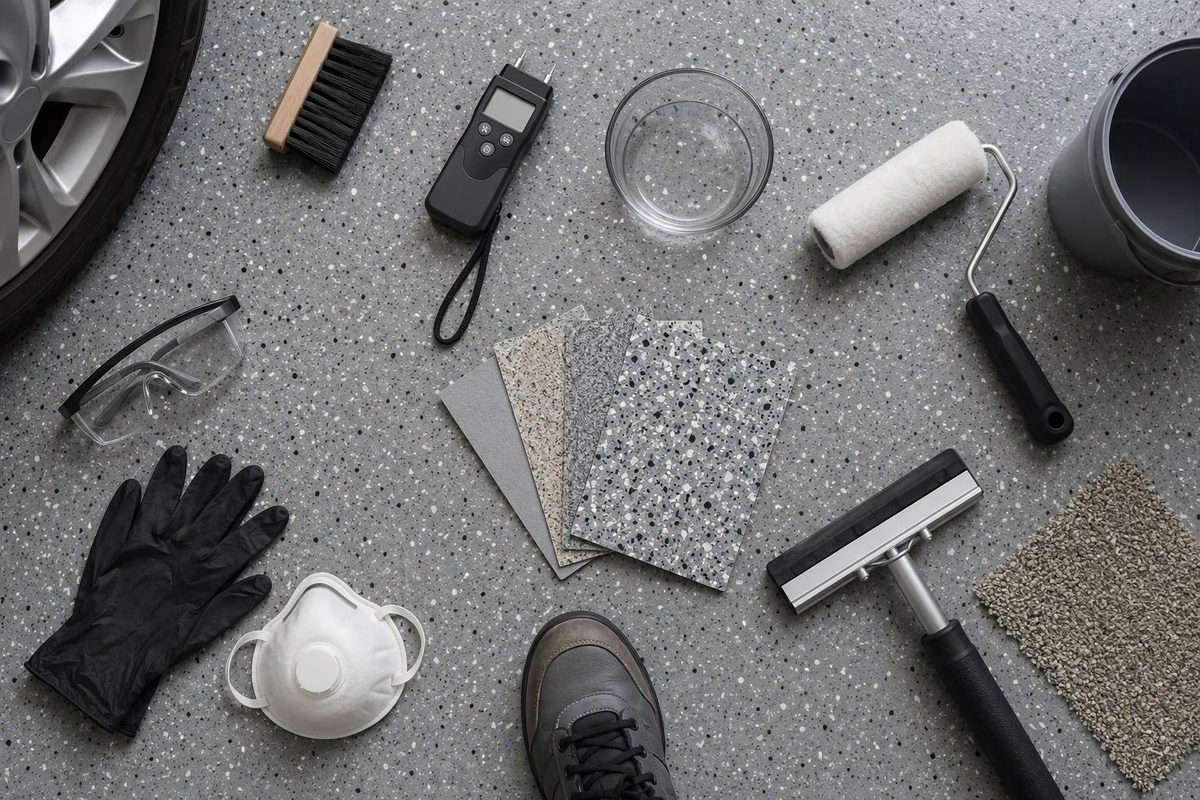
A polyaspartic garage floor is worth considering when you want a UV-stable coating and a short return-to-parking schedule. But the name alone does not tell you what will bond to the concrete, how moisture will be handled, or when your car can return.
Buy a specified coating system, not a promise of a “one-day floor.” The slab condition, preparation, individual products and application conditions matter more than the label on the clear topcoat.
What are you actually buying?
Polyaspartic floor coatings are two-component products mixed before application. Depending on the formulation, they may serve as a base coat, intermediate coat or clear finish. LATICRETE’s SPARTACOTE FLEX XPL, for example, is specified for those roles and can also be used over compatible epoxy systems. Its manufacturer lists UV stability, chemical resistance and abrasion resistance among its properties. See the FLEX XPL data sheet.
A decorative garage floor may therefore combine an epoxy base, broadcast color flakes and a polyaspartic topcoat. It is not necessarily polyaspartic from concrete to finish—and that is not automatically a drawback.
Ask for the product name and purpose of every layer:
- Moisture-control primer, if required.
- Base coat that bonds to the prepared slab.
- Decorative flake or quartz broadcast.
- Clear topcoat and any traction additive.
Compatibility is product-specific. Simiron’s Polyaspartic HS, for instance, is designed for full-broadcast systems, not as a topcoat over a smooth coating system. Substituting one clear resin for another can change whether the assembly follows its manufacturer’s instructions. Simiron’s data sheet lists that restriction.
Polyaspartic versus epoxy: compare complete proposals
Polyaspartic is a useful candidate where sunlight reaches the floor and quick return to service matters. It is not a reason to dismiss an epoxy-based system with a compatible polyaspartic finish.
For either proposal, compare the bond layer, moisture limits, film thickness, traction and cure schedule. A faster topcoat cannot compensate for an unsuitable substrate.
Do not interpret “abrasion resistant” as scratch-proof or “chemical resistant” as permission to leave spills. Simiron warns that tracked dirt can scratch and dull its finish, tire marking may occur, and heavy-traffic areas may need reapplication. It recommends regular cleaning and prompt spill removal—more useful guidance than a blanket claim that a floor will last a lifetime. See its maintenance and limitations sections.
Three checks before approving installation
1. Is the slab sound enough to coat?
Look for flaking concrete, oily patches, loose existing paint, water entry and cracks with vertical offset or visible growth. Treat those observations as questions to resolve before choosing the finish.
Stop for unexplained slab movement or weak concrete. A coating is not a structural repair. Moving joints and shrinkage cracks can also reflect through a finished system; Simiron warns about movement joints that are not honored. For the initial screening, use our garage floor cracking guide.
2. What moisture test will be used?
A dry-looking surface is not a substitute for the specified slab test. The FLEX XPL instructions require concrete relative-humidity testing under ASTM F2170 and direct the installer to a moisture-mitigation product at readings of 75% or greater. That is a limit for this product—not a universal limit for every polyaspartic system. See the preparation requirements.
Ask for the test method, recorded results and the proposed response if readings exceed the selected system’s limits. If water is actively entering the garage, resolve its source rather than assuming a coating primer will fix it.
3. How will the surface be prepared?
The proposal should identify contaminant removal, treatment of existing coatings and the required concrete surface profile. “We clean the floor” is not enough detail.
FLEX XPL specifies mechanical preparation to ICRI CSP-2, with a named primer alternative under separate instructions. Follow the selected system’s requirements rather than assuming every floor needs the same preparation. Our slab-first coating plan explains the broader sequence.
Concrete grinding also creates a silica-dust hazard. NIOSH identifies grinder shrouds connected to suitable dust extraction as a control measure; uncontrolled dry grinding is not a sensible homeowner shortcut. NIOSH’s concrete-grinding guidance explains the risk and controls.
Installation time is not parking time
Keep four clocks separate: working time after mixing, recoat window, foot traffic and vehicle traffic.
FLEX XPL’s February 2026 data sheet lists 20–25 minutes of working time, 3–4 hours to foot traffic and 24 hours to vehicular traffic, based on 70°F and 50% relative humidity. Higher temperature or humidity shortens working time and recoat windows. See FLEX XPL timing.
Simiron’s April 2026 HS data sheet shows why the formulation matters: its XTRA Slow version lists three days to heavy traffic, assuming at least 72°F and 50% relative humidity. Lower temperature or humidity extends traffic times. These are product-specific schedules, not a guarantee that any polyaspartic floor is ready tomorrow. See Simiron HS timing.
Get the earliest parking time after the final coat in writing, along with restrictions on washing, spills and loading.
For DIY planning, short working windows are only part of the difficulty. FLEX XPL is labeled for professional use only; Simiron’s HS activator safety sheet carries the same restriction. Do not treat those products as homeowner kits. Low odor does not mean harmless: the activator SDS identifies inhalation toxicity and respiratory and skin sensitization hazards. For any product you consider handling, read both component safety sheets and establish the required ventilation and protection first. If you cannot meet those requirements, stop. FLEX XPL cautions and Simiron activator SDS.
Make the price—and finish—comparable
Before accepting a square-foot price, require a written scope covering:
- Measured floor area, stem walls, steps and threshold edges.
- Coating removal, grinding, repairs and moisture mitigation.
- Product names, coat count and target film thickness.
- Flake coverage, finished texture and traction additive.
- Return-to-use schedule and cleanup.
- Warranty exclusions and whether repairs include labor.
Request a finished sample with the proposed traction treatment, not just loose color flakes. FLEX XPL permits named traction additives and requires mock-ups or field test areas. Specify the final surface rather than treating decorative flakes as a complete answer to wet-floor grip.
Use our garage flooring contractor checklist to compare bids. Favor the proposal that explains how it will handle your slab over the one that offers only a faster installation or a longer warranty slogan.