
Concrete Grinding: What Your Garage Slab Actually Needs
Decide whether your garage floor needs concrete grinding, repairs or leveling, with coating-prep checks, silica controls and clear stop points.
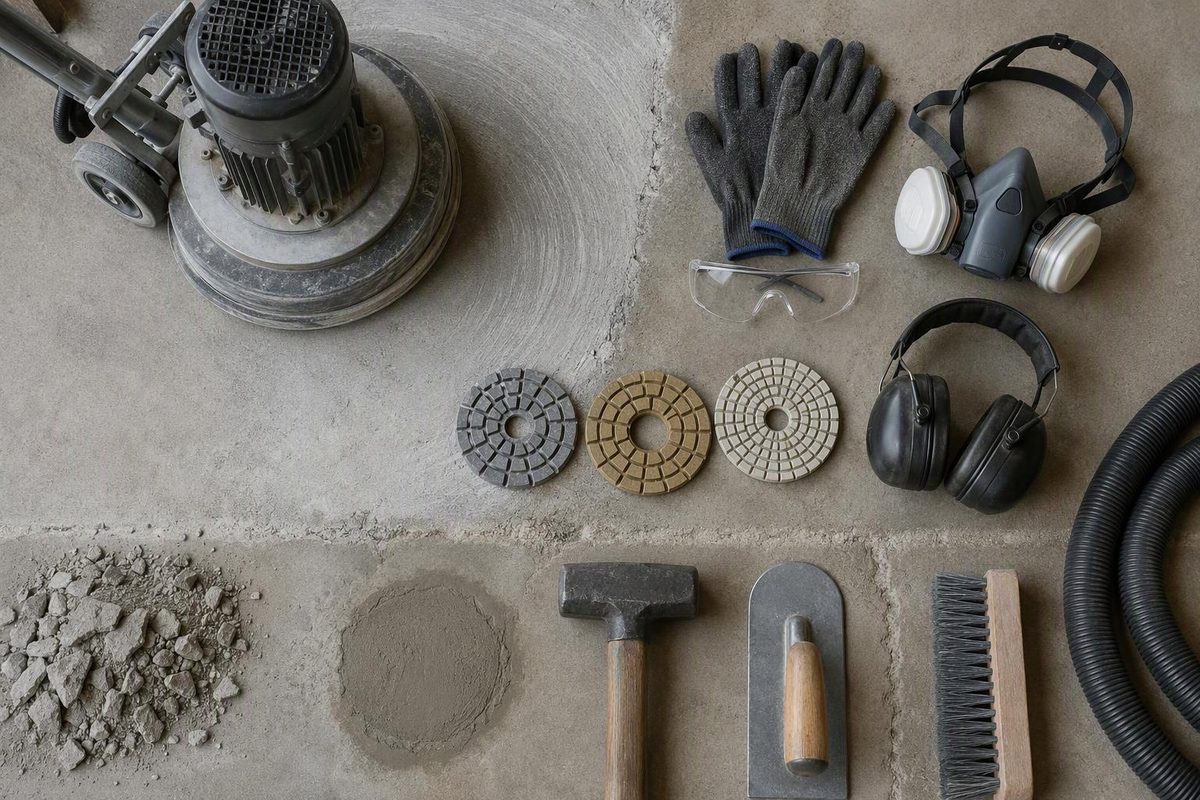
Concrete grinding removes material from the surface of a slab. In a garage, it can remove existing coatings, prepare concrete for a new finish, or reduce localized high spots. It is not a cure for every uneven floor—and a surface ground for epoxy is not the same as polished concrete.
Before renting a grinder, identify the result you need, inspect the slab, and decide how dust will be controlled. Those decisions determine whether grinding is appropriate at all.
1. Choose the job before choosing the machine
| Your goal | What grinding can do | What still needs a separate plan |
|---|---|---|
| Prepare for epoxy or another coating | Remove surface material and create a bonding profile | Contamination, moisture, repairs and the coating’s specified preparation |
| Remove old paint or resin coating | Mechanically strip the finish with suitable tooling | Identifying the old material and confirming complete removal |
| Reduce a localized high spot | Remove raised concrete | Why the height difference exists and how much removal is acceptable |
| Fix low areas or puddles | Reduce an obstructing high spot, if that is the cause | Grinding cannot fill a depression; repair or reprofiling may be needed |
| Produce polished concrete | Start the refinement process | Further steps with progressively finer diamond tools and a defined finish system |
Sika’s preparation guide identifies diamond grinding as a method for creating surface profile, removing coatings and reducing high spots. Husqvarna describes its polished-concrete process as multiple steps using increasingly fine diamond tools—not simply one pass with a grinder.
For coating work, choose the finish first. Our garage epoxy installation plan covers the decisions beyond grinding. If the concrete itself will be the finished surface, use the garage concrete polishing guide instead.
2. Inspect the slab—and mark stop points
Clear the floor enough to inspect corners, wheel paths, the vehicle-door opening and any drain. Photograph cracks and mark high spots, depressions, flaking areas, stains and remaining coatings.
Use a straightedge to map local unevenness. Treat a broad slope separately from a localized hump: flat and level are different targets. Do not grind away a drainage slope merely to make the floor horizontal. Sherwin-Williams’ preparation guide requires a substrate pitched to project specifications and calls for inspection of soundness, contamination and moisture before selecting equipment.
Stop before grinding when you find:
- Cracks with vertical displacement, suspected movement or widespread deterioration. Have the slab assessed before treating the raised edge as a cosmetic high spot.
- Weak or crumbling concrete. A coating needs a sound substrate; deteriorated concrete requires removal and compatible repair, not just smoothing.
- Unknown old flooring, backing or adhesive. Identify suspect materials before disturbing them. EPA says asbestos generally cannot be identified by appearance and advises against sanding or leveling asbestos flooring or its backing. Use a trained and accredited asbestos professional where material is suspect; do not take samples yourself. EPA homeowner guidance
- A proposal for substantial concrete removal, altered drainage or grinding near equipment anchors. Get a project-specific assessment rather than relying on a universal “safe grinding depth.”
Oil contamination also needs attention before profiling. Sika directs installers to decontaminate first; contamination that cannot be eliminated may require removal and replacement of affected concrete. Grinding is not a substitute for that evaluation.
3. For coatings, specify texture—not just grit
A clean-looking slab is not automatically ready for epoxy. The preparation must create the surface texture required by the selected coating system.
Manufacturers often express that texture as an ICRI Concrete Surface Profile (CSP). ICRI’s profiles range from CSP 1, minimal roughness, to CSP 10, very rough. The prepared floor can be compared with replica chips. ICRI’s explanation
There is no single grit or CSP that suits every garage coating. Sherwin-Williams notes that the required profile depends on the system, its thickness and intended service. Ask for the exact product’s preparation instructions, then confirm that the proposed tooling can achieve them. “Diamond ground” describes a method, not an acceptance standard.
Make a small trial area before committing to the whole floor. For exposed concrete, evaluate the appearance too: grinding can reveal pores and uneven aggregate distribution, and existing cracks will not simply disappear. Husqvarna recommends an early test area to establish the achievable result.
4. Dust control is part of the equipment—not an accessory
Grinding concrete generates respirable crystalline silica, which can irreversibly damage the lungs. An open garage door and a mask are not a complete control plan.
For walk-behind floor grinders, OSHA’s construction guidance describes either an integrated water-delivery system or a manufacturer-recommended shroud and vacuum dust-collection system. The dry system needs adequate suction, filtration of at least 99% efficiency and a filter-cleaning mechanism. Indoors, it also requires HEPA vacuuming between passes to remove loose dust; extra ventilation may be needed.
Do not assume an ordinary shop vacuum meets those requirements. Have the rental supplier identify the matched grinder, extractor, hose, filters and collection bags, and explain their maintenance and safe emptying.
Edge work needs its own controls. OSHA’s handheld-grinder guidance specifies at least 25 cubic feet per minute of vacuum airflow per inch of wheel diameter—125 cfm for a 5-inch wheel—plus an appropriate shroud, at least 99%-efficient filtration and a cyclonic pre-separator or filter-cleaning mechanism.
Under OSHA’s Table 1, indoor handheld grinding with dust collection exceeding four hours per shift requires respiratory protection with a minimum assigned protection factor (APF) of 10. Required workplace respirator use also needs a respiratory-protection program—not simply a mask purchase. That four-hour threshold is not a safe-time allowance for uncontrolled grinding.
These are U.S. workplace requirements, not a declaration that a homeowner’s setup is safe. Obtain equipment instruction, follow the tool manual’s protective-equipment requirements, and keep household members and pets out of the work area. Stop if dust escapes, extraction fails or you cannot prevent contamination entering the house. If you cannot arrange suitable equipment and training, use a contractor with a defined dust-control plan. Do not clean concrete dust with compressed air or a leaf blower.
Wet grinding also needs compatible equipment, electrical protection and prompt slurry collection so residue does not dry into dust. OSHA’s wet-control option for handheld grinders applies outdoors only, unlike its walk-behind floor-grinder option. Neither is permission to spray water onto a dry-only grinder. OSHA grinder guidance
5. Define what “finished grinding” means
Before accepting a quote or returning rental equipment, check the agreed result:
- Coatings and bond-inhibiting material have been removed as specified.
- The floor and edges meet the coating’s required profile, or the approved exposed-concrete sample.
- High-spot work has preserved the agreed drainage and transitions.
- Unsound areas, cracks and joints have an appropriate repair plan.
- Dust or slurry has been collected and the surface cleaned.
- Moisture testing required by the coating manufacturer is complete before coating begins.
A ground floor can still contain too much moisture for a coating. Sherwin-Williams warns that excess moisture can cause resinous systems to delaminate; a plastic-sheet check indicates moisture movement but does not quantify it.
For comparable bids, request separate scope for coating removal, profiling, edge work, localized grinding, repairs, moisture testing and cleanup. A useful grinding proposal states what surface will be delivered, not just how many square feet the machine will cover.