
TorqueMaster spring replacement starts with identifying the system—not opening the tube
Identify your Wayne Dalton TorqueMaster system, gather spring-matching details, and compare replacement or conversion without handling stored spring energy.
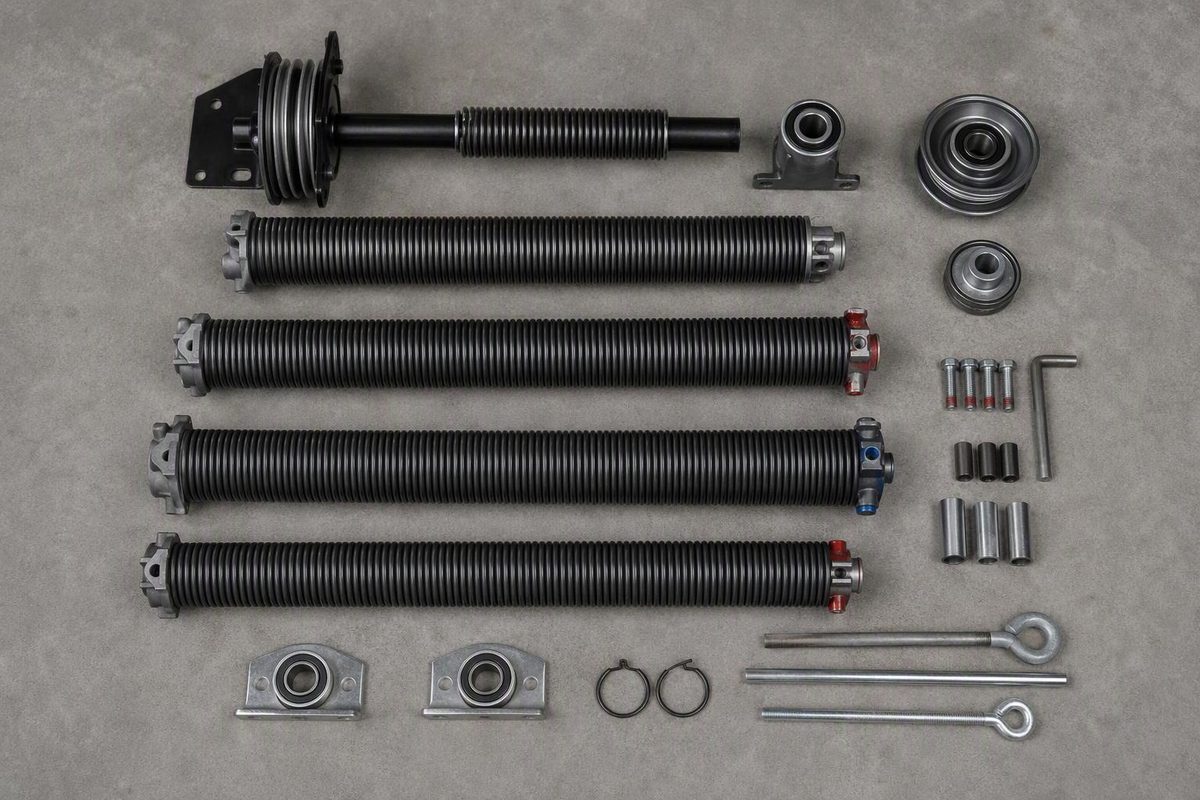
Wayne Dalton TorqueMaster spring replacement is specialist work, even though the springs are enclosed in a tube. The useful homeowner checks are identifying the system, photographing its labels and describing the failure—not removing end brackets or trying a winding tool. Wayne Dalton’s TorqueMaster Plus manual for models 8000 and 8200 directs spring, cable and related hardware repairs to a trained door systems technician because of the stored-energy hazard. Manufacturer safety instructions
The replacement decision has three parts: confirm what failed, match the spring system and door specifications, then compare an in-system repair with any proposed upgrade or conversion.
1. Stop operating the door if spring failure is suspected
TorqueMaster springs sit inside the spring tube, so you cannot look for the exposed coil gap used to identify many conventional broken torsion springs. A door that suddenly becomes hard to operate needs inspection; the symptom alone does not establish which part failed.
TorqueMaster Plus also has a safety mechanism intended to prevent rapid descent after spring failure or forceful manual operation. Wayne Dalton describes a door that will not close on an engaged single-spring system, and distinct clicking during opening on an engaged double-spring system. These are diagnostic clues, not instructions to keep cycling the door. TorqueMaster Plus safety-system explanation
Use these stop points:
- Fully closed: leave it closed rather than trying the opener again or lifting it to test the spring.
- Open or partly open: keep people away from the opening. Do not pull the emergency release or attempt to force it down; arrange professional securing and repair.
- Crooked door, slack cable or cable off a drum: stop all operation and report the door position and visible damage.
Chamberlain’s manual-operation guidance warns that a door with weak or broken springs may fall rapidly and without warning, and says not to proceed when springs, cables or rollers appear damaged. Emergency-release precautions
Do not increase opener force to overcome the problem or move the Plus pawl knobs to bypass an engaged safety mechanism. Wayne Dalton warns that a misadjusted opener can lift a single-spring door despite a broken spring, producing slack cables and potentially dangerous damage. Opener-force warning For position-specific precautions, see what to do with a broken-spring door.
2. Identify Original versus Plus without dismantling it
“Wayne Dalton spring” is not a sufficient part description. TorqueMaster Original and TorqueMaster Plus use different spring-end designs.
Parts supplier Express Garage Doors identifies Original spring ends as round with small splines, versus hexagonal ends on Plus springs. It also notes that tube labels may say “TM” for Original or “TM3” or “TM Plus” for Plus. Those end shapes are useful when a technician has safely exposed the parts; do not remove hardware to inspect them yourself. Start with a readable tube-label photograph and photographs of both end assemblies, taken without standing beneath an elevated door or reaching into the hardware. TorqueMaster identification guide
Treat an installation date as supporting information, not a final match: it does not tell you whether someone later changed the hardware.
3. Gather the information needed to match replacements
Send the technician or parts supplier:
| Information | What to collect safely |
|---|---|
| Door identification | Model and serial labels, plus any installation paperwork |
| Spring-tube label | A clear photograph of the entire label, including part numbers and spring specifications |
| Door dimensions | Existing width and height from paperwork, or measurements accessible without moving the failed door |
| System layout | Photographs of both tube ends and the track arrangement, taken from a safe position |
| Changes to the door | Added insulation, struts, windows or replacement sections |
| Failure description | What happened, current door position, noises already heard and visible cable problems |
Express Garage Doors lists door height, door weight and Original/Plus style as replacement-selection information, with existing part numbers providing another identification route. Do not order by door width alone. Spring-selection requirements
If the label is missing or the door has changed, have the technician establish the correct weight and spring specification. Weighing a failed door can require controlling the door and removing remaining spring assistance; it is not a routine homeowner measurement. See garage-door weight and safe checks.
4. Compare repair, Plus upgrade and conventional torsion conversion
Ask for clearly separated options rather than accepting “spring replacement” as a complete scope:
- Repair the existing system: confirm compatible springs are available and whether the tube, winding hardware, drums and cables remain serviceable. On a two-spring system, ask whether the quote covers one spring or both, and why.
- Upgrade Original to Plus: require an itemized compatible hardware package. Express Garage Doors offers Plus upgrades with springs and additional winding and drum hardware; do not assume a Plus spring alone makes an Original system compatible. Have availability and the required parts confirmed for your assembly before ordering. Supplier’s upgrade package description
- Convert to conventional exposed torsion springs: this changes the counterbalance system, not just the spring. DDM’s Original TorqueMaster conversion guide specifies a shaft, spring anchor bracket, bearing, end bearing plates, drums and cables. The proposal should also address mounting surfaces, track layout, headroom and opener compatibility. Conversion components
For a wind-rated door, obtain confirmation that the proposed substitutions are permitted: Wayne Dalton states that wind performance depends on the entire door system and does not authorize component substitution without express manufacturer permission. Manufacturer requirements
What a complete quote should include
Compare the installed total, not a spring-only online price. Require the system type, spring quantity and specifications, additional hardware, labor, service fees, disposal and warranty terms in writing. Use our torsion-spring replacement cost guide for budget context, not as an exact TorqueMaster quote.
Before the repair is handed back, ask the technician to demonstrate smooth manual operation and correct balance, inspect cable seating and the Plus safety mechanism where retained, and verify opener operation and safety tests under the relevant manuals. Wayne Dalton’s maintenance instructions address door balance, hardware inspection, the Plus safety mechanism and testing under the opener manufacturer’s instructions. Operation and maintenance requirements The opener should operate a repaired, balanced door—not compensate for an unresolved spring problem.