
Which Alternative to Epoxy Fits Your Garage Floor?
Compare garage floor tiles, rollout mats, densified concrete, paint and polyaspartic coatings by preparation, moisture, vehicle use and maintenance.
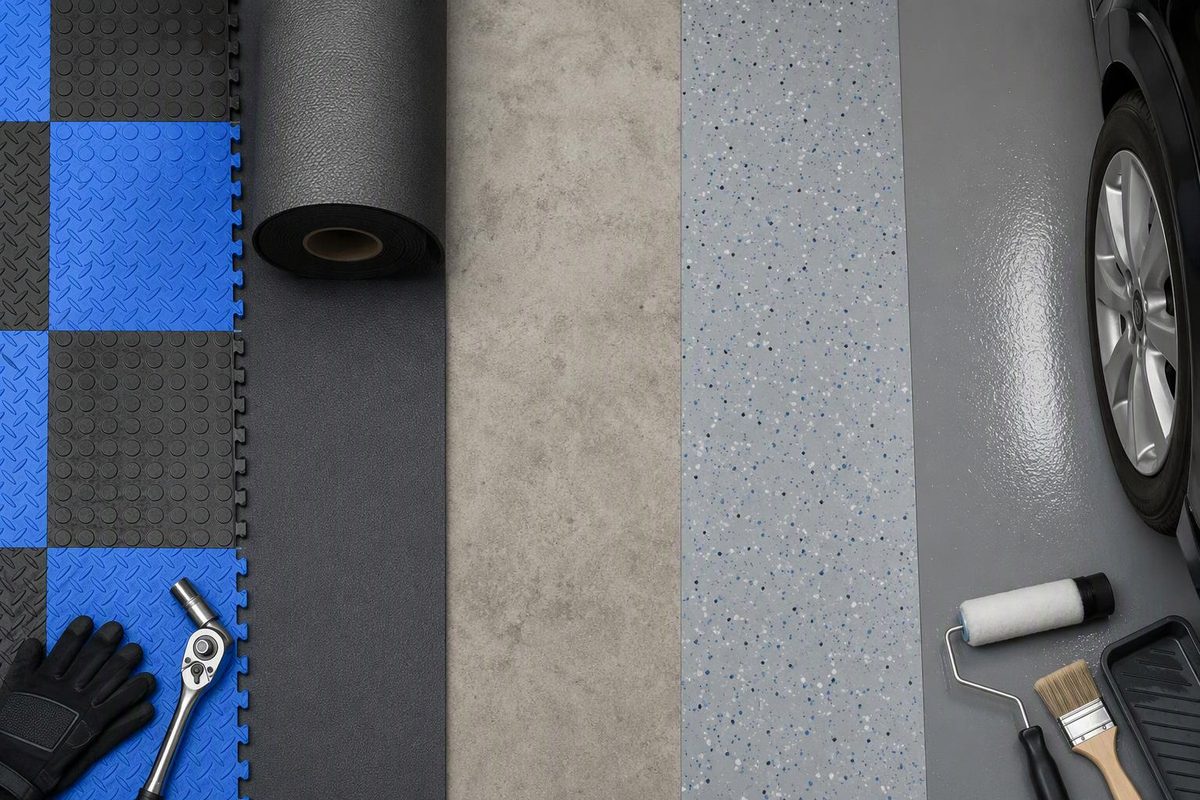
If you want to avoid mixing and curing a coating, start with vehicle-rated interlocking tiles or a rollout parking mat. If you prefer exposed concrete, consider a densifier, with polishing optional. Polyaspartic is worth comparing when you still want a seamless coating—but it is not a shortcut around slab preparation.
The useful question is why you are avoiding epoxy:
- Removable floor, no coating cure: interlocking tiles.
- Cover only the parking area: rollout mat.
- Reduce concrete dust without a colored surface film: densifier.
- Add color with a brush-and-roller project: one-part, non-epoxy garage floor paint.
- Keep a seamless finish with fast-curing options: polyaspartic coating.
1. Interlocking tiles: for a removable, full-floor finish
Automotive-grade tiles are a strong starting point when you want to cover unattractive concrete without bonding a coating to it. RaceDeck’s modular system, for example, installs without adhesive in typical applications and allows individual damaged tiles to be replaced. That is a product-specific example, not a rating for every plastic tile. RaceDeck buying guide
Choose the surface around your cleaning needs. Open-grid tiles let water and small debris reach the slab below; solid tiles provide a closed walking surface, but their seams are not necessarily watertight. Neither design should be treated as waterproofing for the concrete. RaceDeck also requires an expansion gap at walls and fixed objects. Follow your chosen system’s dimensions rather than copying another brand’s gap. RaceDeck tile guidance
Check before buying: Does the manufacturer approve your floor jack, jack stands and equipment? A rolling vehicle-load rating is not a concentrated-load rating; RaceDeck explicitly distinguishes the two. Load guidance
2. Rollout mats: for a parking pad rather than a renovation
A vehicle-rated rollout mat is useful when only the area beneath the car needs covering. It also lets you leave workshop or storage areas as exposed concrete.
Do not assume “no adhesive required” applies to every layout. G-Floor’s manufacturer distinguishes a floating parking pad from a wall-to-wall installation, for which it recommends adhesive. Heavy stationary objects can restrict movement and contribute to buckling as the material expands and contracts. G-Floor installation instructions
Plan the edges before ordering. The same instructions warn against overlapping mats because that can create a trip hazard, trap moisture and cause warping. Drains, poles, cabinets and doorway transitions also need space in the layout.
Best fit: A defined parking area. For a full-floor installation, read the attachment and expansion requirements first—not after cutting the roll.
For layout help, see easy garage flooring installation options.
3. Densified or polished concrete: for an exposed-slab finish
You do not have to add a colored covering. A penetrating silicate densifier reacts within the concrete and can harden and dustproof the surface. PROSOCO’s LS/CS, for example, is a penetrating treatment rather than a surface film that can peel. It still requires clean, sound, dry, absorbent concrete; the manufacturer notes that its LS product may be a better choice for existing floors. PROSOCO product data
Densifying and polishing are different tasks. Polishing uses progressively finer abrasives to develop the finish; applying densifier alone does not reproduce that process. Nor should you assume dustproof means oil-stain-proof: PROSOCO recommends additional protective treatments for improved resistance to water and oily stains. Preparation and protective-treatment guidance
Best fit: You like the existing concrete and accept visible repairs. If you want a more refined appearance, use the garage concrete polishing guide to assess the work involved.
4. Garage-rated concrete paint: for a simpler color change
A one-part, non-epoxy concrete floor paint is an option if you prefer brush-and-roller application to mixing a two-component resin. Choose a product explicitly intended for garage floors and automobile use—not merely a porch or general masonry paint.
Paint still needs preparation and downtime. DRYLOK’s latex concrete floor paint requires cleaning, suitable surface porosity and moisture checks. Its instructions allow five days before automobile use, despite a two-hour touch-dry time. High humidity and low temperatures can extend drying. That illustrates why “dry” and “ready to park” are different specifications. DRYLOK preparation and application instructions
Check before buying: Vehicle approval, compatibility with existing paint, required preparation and the parking cure time. Do not choose it solely because the application looks easy.
5. Polyaspartic: for another seamless coating system
Polyaspartic is an alternative resin, not an alternative to preparing concrete. Sika’s February 2025 data sheet for Sikafloor-510 LPL describes a fast-curing, UV-resistant polyaspartic coating, but requires a clean, sound, dry, primed substrate and experienced professional application. UV resistance is not a promise of no color change: the same sheet warns of discoloration over time and says a clear UV-resistant topcoat may not prevent underlying coatings from discoloring. It also distinguishes foot traffic, light traffic and full cure. Get an explicit vehicle-return time for the complete proposed system. Sika product data
Ask what is in every layer. A polyaspartic topcoat does not establish that the floor is epoxy-free. Sika’s DecoDur Flake FX system, for example, uses an epoxy binder in its standard build and offers polyaspartic topcoat options. If avoiding epoxy is essential, require the primer, basecoat and topcoat product names in writing. Sika system specification
See what to check in a polyaspartic coating quote before comparing installation promises.
Checks that come before the finish
- Water or dampness: Establish where it comes from before covering it. Ventilated tiles are not drainage repairs; a resin coating is not automatically a moisture barrier.
- Changing cracks, vertical offsets or rocking concrete: Pause the finish decision and assess the slab. Use the garage floor crack checks to organize observations.
- Clearances: Include the new floor thickness, ramps and trims when checking drains, cabinets, the door’s bottom seal and the vehicle entrance.
- Grinding: Do not dry-grind concrete without appropriate dust controls. Grinding can release respirable crystalline silica, which causes serious lung disease. OSHA silica guidance
For cost comparisons, request the same scope: covered area, preparation, repairs, edge pieces, protective treatments and time out of service. Compare the usable floor—not just the package price.